



Building a Multi-Year Valuation Roadmap for Your Advisory Firm
The most successful advisory firm owners spend years quietly wondering if their firm is actually worth what they hope or fear it isn’t. The truth is,...
Comprehensive, data-driven valuations and comparative equity analyses to accurately price your practice, establish market benchmarks, and support informed decision-making.
Comprehensive M&A guidance encompassing deal structuring, negotiation strategies, market listings, and transaction closings.
Comprehensive systems, targeted coaching, and in-depth assessments designed to optimize operational efficiency and enhance advisory team effectiveness.
Strengthen continuity through the implementation of formal continuity agreements, the establishment of legal entities, execution of enforceable legal contracts, and securing appropriate capital resources.
9 min read
Anthony Whitbeck, CFP®, CLU®
March 4, 2026
The most successful advisory firm owners spend years quietly wondering if their firm is actually worth what they hope or fear it isn’t. The truth is, most business owners only get serious about valuation when a major event forces their hand: a health scare, a partner’s departure, or a surprise offer from a competitor. By then, the window to shape the outcome has already narrowed.
According to Medium, 87% of firms don't have a formal succession or valuation plan in place. Treating valuation as a one-time event leaves firms exposed to market shifts, missed growth, and unplanned exits. A multi-year valuation roadmap transforms valuation into a strategic management tool.
This guide covers:
P.S. If you want to increase your firm’s value, protect your legacy, and make informed decisions about growth or succession, start by benchmarking your business with Advisor Legacy’s Financial Advisor Practice Valuation Calculator. The tool provides a directional estimate and highlights the key drivers that impact your firm’s value, giving you a practical foundation for your next steps.
| Section | Actionable Takeaway |
|---|---|
| Baseline Valuation | Conduct a formal business valuation to establish your starting point, tracking EBITDA, AUM, client demographics, and retention rates. Use this as your annual benchmark. |
| Multi-Year Targets | Set 3–5 year value goals tied to key metrics (profitability, recurring revenue, client base quality) and update targets annually based on results and market trends. |
| Annual Review Integration | Schedule annual valuation reviews, assign ownership, prepare updated financials, and use findings to drive strategic planning and accountability. |
| Benchmarking & Coaching | Compare your metrics to top-performing firms, leverage professional guidance, and adjust business strategies to close gaps and capture growth opportunities. |
| Scenario Planning | Model different growth, succession, and exit scenarios using valuation data to set realistic expectations and optimize timing for maximum value. |
| Risk Management | Identify value detractors (client concentration, low retention, operational gaps) and implement mitigation steps each year to reduce risk and increase buyer appeal. |
| Avoiding Pitfalls | Don’t treat valuation as a one-off event—recurring reviews catch hidden risks, support better tax/legal planning, and keep your firm attractive to buyers and successors. |

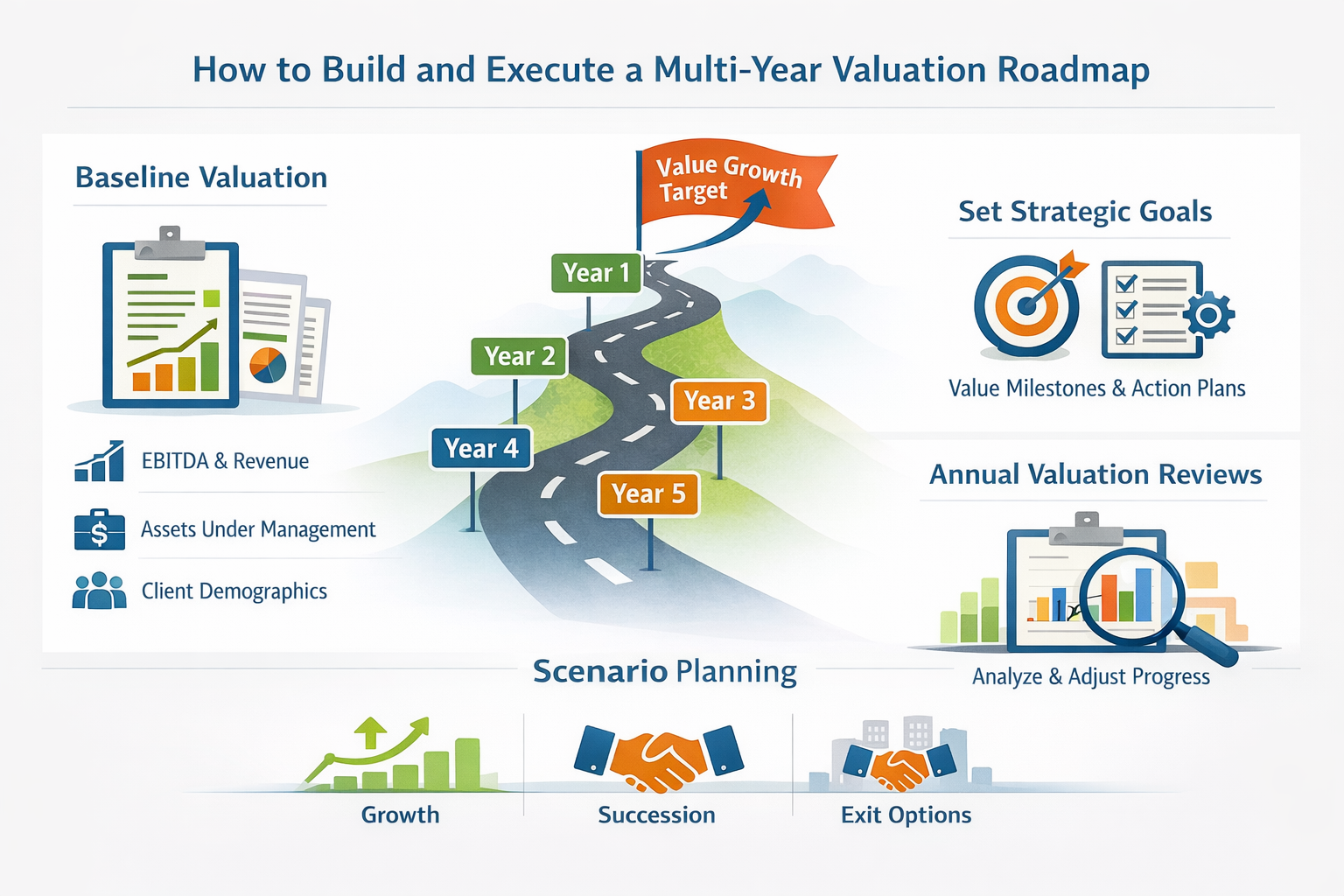
A multi-year valuation roadmap is the foundation for professionalizing your advisory firm’s management, succession, and growth strategy. Instead of relying on a single valuation before a sale or transition, top-performing firms use annual valuations as a management dashboard for tracking progress, benchmarking against peers, and proactively addressing risks. Here’s how to build and execute your roadmap.
Establishing a baseline valuation is the first step in any multi-year roadmap. This process provides a clear picture of your advisory firm’s current value, strengths, and vulnerabilities. The baseline should include a comprehensive review of financials, client demographics, and operational metrics.
Setting multi-year value targets is not just about forecasting a bigger number for your firm’s future. It creates a disciplined, forward-looking framework that forces you to confront what actually drives value and what damages it.
Without clear milestones, most advisory businesses limit their growth potential, reacting to market noise or client demands instead of building toward a defined outcome. Strategic targets anchor your roadmap utilizes annual valuation reviews as checkpoints for real progress.
This approach gives owners the leverage to make intentional decisions, measure what matters, and course-correct before small issues become deal-breakers. These targets should be specific, measurable, and tied to key business drivers.
| Year | Value Target | Key Metrics to Improve | Strategic Actions | How to Verify Progress |
|---|---|---|---|---|
| 1 | Baseline | EBITDA, retention | Document processes, review client base | Annual valuation, CRM audit |
| 2 | +10% value | Recurring revenue, AUM | Launch new fee-based offerings, client segmentation | Revenue analysis, client survey |
| 3 | +20% value | Profit margin, team depth | Hire/coach NextGen advisors, optimize expenses | Margin review, team assessment |
| 4 | +30% value | Client demographics, succession readiness | Target younger clients, formalize succession plan | Demographic report, succession checklist |
| 5 | +40% value | Market positioning, brand reputation | Expand marketing, pursue M&A opportunities | Brand audit, deal pipeline review |
Annual valuation reviews are the core of a multi-year roadmap. Embedding these reviews into your management cycle ensures you stay proactive, not reactive, about value creation and risk management.
Assign a responsible party (often the COO, CFO, or managing partner) to oversee the annual valuation process. Schedule reviews at the same time each year, ideally after year-end financials are finalized, to ensure consistency and accountability.
Gather updated financial statements, CRM exports, client segmentation data, and documentation of any major business changes. Involve key team members to ensure all relevant information is captured and to foster buy-in for improvement initiatives.
Analyze year-over-year changes in key metrics (EBITDA, retention, AUM, client demographics). Compare results to your multi-year targets and industry benchmarks. Identify areas of improvement and emerging risks.
Use your valuation findings to create business strategies, such as refining your client value proposition, investing in team development, or adjusting your service model. Assign action items, set deadlines, and track progress at quarterly leadership meetings.
Most owners underestimate how quickly their circumstances—or the market—can change. Effective scenario planning prepares you for those shifts before they become disruptions.
By stress-testing assumptions and modeling different growth, succession, and exit paths, you can see how each decision affects your firm’s value. This process sets realistic expectations, reduces surprises, and gives you the clarity to act strategically instead of reacting under pressure.
Read next: Financial Advisor Practice Values Reach All-Time High
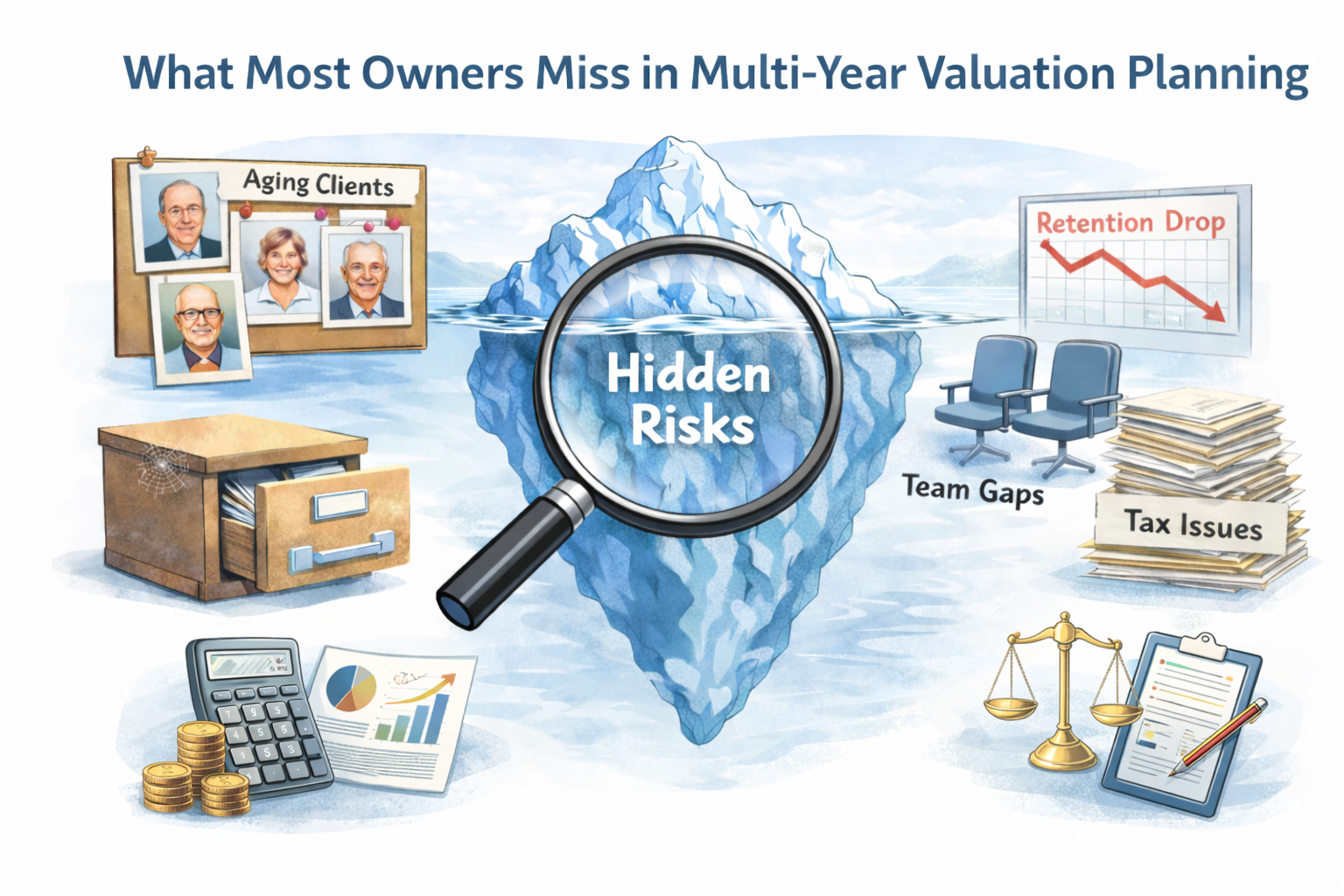
Every advisory firm has hidden risks; some obvious, others hidden from the naked eye. The problem is, most owners only discover them when a buyer, lender, or regulator points them out. Recurring valuations highlight these value detractors before they become costly mistakes.
Effective risk management systematically identifies, quantifies, and addresses the issues that could shrink your firm’s value or derail a transition. This discipline is what separates firms that command premium multiples from those that struggle to close a deal.
| Risk Area | How to Identify | Mitigation Action |
|---|---|---|
| Client Concentration | >20% revenue from top 5 clients | Diversify client base, deepen relationships |
| Low Retention Rates | Attrition >5% per year | Enhance client engagement, improve service model |
| Operational Gaps | Incomplete documentation, workflow gaps | Standardize processes, invest in CRM/training |
| Aging Client Base | >50% clients are over age 65 | Target younger clients, develop generational plans |
| Compliance Issues | Regulatory findings, audit flags | Conduct internal audits, address deficiencies |
| Weak Succession Plan | No documented successor or plan | Formalize succession, coach NextGen leaders |
| Tax/Legal Blind Spots | No pre-exit planning, outdated entity | Consult CPA/attorney, review IRS Sec. 409A, 280G* |
IRS Section 409A governs deferred compensation and can impact buyout structures; Section 280G addresses golden parachute payments in M&A. Consult your tax advisor for applicability.
For more on operational value drivers, see Factors That Impact Practice Value.

Advisors who treat valuation as a box to check miss the deeper, structural issues that quietly shape their firm’s future. The real risks and opportunities rarely show up in a single year’s numbers or a surface-level review. They accumulate over time, hidden in client rosters, team dynamics, outdated processes, or unexamined assumptions about what buyers value.
A multi-year roadmap is only as strong as your willingness to confront these blind spots. If you want to build a business that’s resilient, transferable, and attractive to the next owner, you have to look beyond the obvious.
Ignoring the age profile and concentration of your client base can lead to declining revenue and lower buyer interest. Buyers and lenders scrutinize the average duration of client relationships and the percentage of clients nearing retirement. Firms with a younger, more diverse client base and strong generational planning are more attractive and command higher multiples.
Lack of documented workflows, CRM discipline, and compliance records increases transition risk and reduces the buyer’s willingness to pay. Well-documented firms are easier to diligence, transfer, and scale. Owners should regularly audit documentation and invest in process improvement.
A firm’s value is not just in its book of business, but in its people. Without a clear succession plan and a developed NextGen team, buyers see higher risk and may discount the asking price. Succession planning should include leadership development, equity pathways, and client transition protocols.
Retention rates are a leading indicator of client satisfaction and loyalty. Low client retention signals instability and can trigger earn-outs or holdbacks in deal structures. Owners should track retention by segment, analyze root causes of attrition, and implement strategies to improve client engagement.
Static valuation models miss the impact of changing market trends, fee compression, and shifts from commission-based to fee-based revenue. Owners should monitor industry benchmarks, adjust their service offerings, and diversify revenue streams to stay competitive.
Failing to plan for tax and legal implications can result in unexpected costs and reduced net proceeds at exit. Owners should consult with a CPA and attorney at least 2–3 years before a transition. Key areas include entity structure, capital gains treatment (IRC Sec. 1202 for qualified small business stock), and buy-sell agreement terms.
For more on avoiding data pitfalls, see Valuation Mistakes.
As competition for experienced advisors and support staff intensifies, firms that use valuation data to inform their talent strategy gain a measurable advantage. Recurring valuations reveal which roles, teams, or service lines drive the most value, allowing owners to design incentive compensation and equity participation plans that align employee interests with long-term firm growth.
Transparent communication of firm value and growth targets can also help recruit high-potential advisors who want a clear path to partnership or ownership. By integrating valuation insights into career development and retention programs, firms reduce turnover risk and build a stronger foundation for succession.
A multi-year valuation roadmap gives advisory firm owners a practical way to measure progress, address risks, and set clear priorities for growth and succession. Treating valuation as an annual discipline, rather than a one-time event, supports better decision-making and protects the value you’ve built.
To make valuation a core part of your management process, use Advisor Legacy’s Financial Advisor Practice Valuation Calculator to benchmark your firm’s value and identify areas for improvement. This will help you set clear priorities, reduce risk, and prepare your business for every stage of growth and transition.
A multi-year valuation roadmap is a structured plan that uses annual business valuations, benchmarking, and scenario planning to track and increase an advisory firm’s enterprise value over time. It integrates valuation into ongoing management, not just as a pre-sale event.
Recurring valuations identify succession risks early, track progress on leadership development, and ensure the firm is always ready for a transition. This approach supports higher retention rates and makes the firm more attractive to buyers or internal successors.
Key metrics include EBITDA, revenue mix (recurring vs. transactional), AUM, client demographics, retention rates, profitability, and operational efficiency. Tracking these annually helps firms set realistic targets and benchmark against peers.
Market trends, such as fee compression, regulatory changes, and shifts in client demographics, impact valuation multiples and buyer demand. Firms that monitor and adapt to these trends are better positioned to maintain or increase value.
Tax implications depend on entity structure, deal terms, and timing. Key considerations include capital gains treatment (IRC Sec. 1202 for qualified small business stock), deferred compensation (IRC Sec. 409A), and golden parachute rules (IRC Sec. 280G). Consult a CPA or tax attorney for guidance.
Benchmarking provides context for your firm’s performance, highlights gaps, and sets improvement targets. Regular benchmarking helps firms stay competitive, increase value, and adapt to changing buyer expectations.
Anthony "Tony" Whitbeck, CFP®, CLU®, is CEO and Owner of Advisor Legacy. He began his career as a financial advisor in 1989 and later shifted to coaching, where he’s guided more than two hundred advisory practices through growth, valuation, and succession. Tony leads Advisor Legacy’s certified third-party valuation engagements and coordinates lending and legal partners to streamline transactions. His articles focus on building transferable enterprise value, mapping internal vs. external exits, and avoiding common succession pitfalls. Drawing on decades of in-the-trenches experience, Tony provides practical, compliance-friendly guidance advisors can use right away.
Receive timely articles, tip sheets, events, and more right in your inbox.
The most successful advisory firm owners spend years quietly wondering if their firm is actually worth what they hope or fear it isn’t. The truth is,...
Your reports may look clean. But if a buyer, lender, or regulator pulled your raw data tomorrow, would it reconcile without explanation?
If you are planning to sell your advisory firm, pursue succession, or explore financing within the next one to three years, preparation will...