



Skip to the main content.

19 min read

When You Need A Certified Business Appraisal For Your Advisory Firm

When You Need A Certified Business Appraisal For Your Advisory Firm

A certified business appraisal becomes important when the value of an advisory firm must be reviewed by a third party. Attorneys, CPAs, courts, lenders, buyers, sellers, estate planners, and tax professionals may require more than a general business valuation or informal opinion of value. The difference often comes down to the intended use.

A planning-level valuation may support internal strategic planning, while a certified appraisal is designed to withstand scrutiny in litigation, tax planning, estate planning, acquisition, or selling a business. That distinction matters in an active transaction environment. Fidelity reported that 2025 set a new high-water mark for RIA M&A activity, with 276 completed transactions totaling $796.4 billion in purchased assets, surpassing 2024’s 233 transactions and $669.8 billion in acquired assets. As more advisory firms enter acquisition, succession, and ownership transition discussions, valuation conclusions are more likely to be reviewed by buyers, sellers, lenders, attorneys, CPAs, and other third parties.

Advisory firms and wealth management practices face distinct valuation challenges tied to recurring revenue, client relationships, and intangible asset quality. Understanding when a certified business appraiser is needed, which credentials matter, and what valuation standards apply can prevent costly delays and disputes.

Not every advisory practice valuation requires a certified appraisal, but when the matter involves legal review, tax treatment, third-party financing, acquisition, ownership transfer, or selling a business, the standard changes.

This guide covers:

  • When a certified business appraisal is needed instead of a planning valuation

  • Which legal, tax, acquisition, and ownership scenarios require defensible valuation support

  • What credentials, valuation standards, and report details advisors should understand

  • How to choose a valuation provider for an advisory firm appraisal

P.S. If your advisory firm needs a valuation for a legal, tax, ownership, or other complex situation, Advisor Legacy’s Specialty Valuation service provides a fully customized process built around your needs. Specialty Valuations can support divorce, estate and gift tax, shareholder or owner disputes, FINRA disputes, CPA/accounting matters, OSJ and branch value, multiple entities, IRS, SBA, or other government agency reviews, and other complex situations.

We also offer Business Valuation for AUM-based investment advisor practices with less than 30% of revenue from insurance or annuities, and Business Valuation Plus for practices with a higher concentration of income from insurance and annuities, as well as AUM income.

Request a Specialty Valuation Consult to discuss your situation with a valuation professional who understands advisory practice economics.

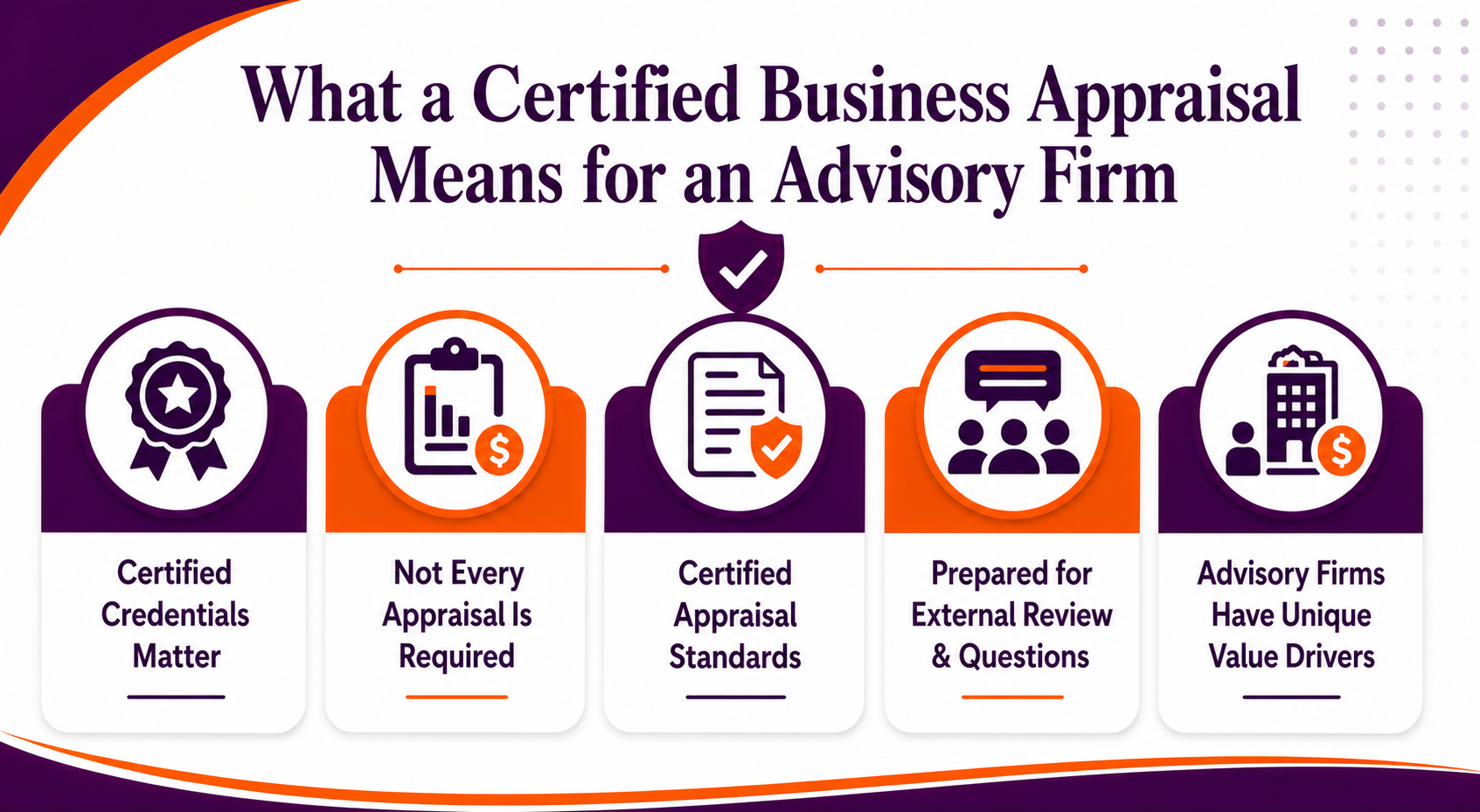
What a Certified Business Appraisal Means for an Advisory Firm

The term “certified” in business valuation can mean more than one thing. It may refer to the credential held by the valuation professional, the standards followed during the valuation process, the report format required for the matter, or the documentation level needed for review by attorneys, CPAs, courts, lenders, buyers, sellers, or tax authorities.

What a Certified Business Appraisal Means for an Advisory Firm

For that reason, advisors should not assume every business appraisal is the same. A certified business appraiser or credentialed valuation professional may hold a recognized business valuation credential such as ABV, CVA, or ASA. The ABV credential, which stands for Accredited in Business Valuation, is granted by the AICPA, also known as the American Institute of Certified Public Accountants. CVA stands for Certified Valuation Analyst and is granted by the National Association of Certified Valuators and Analysts. ASA stands for Accredited Senior Appraiser and is granted by the American Society of Appraisers.

Even with these credentials, a certified appraisal is not always required. Many advisory firms use a calculation of value or opinion of value for internal strategic planning, partner discussions, or early-stage succession planning. These reports may rely on simplified assumptions, limited documentation, and faster turnaround. They can be useful for planning, but they are not designed for every legal, tax, acquisition, or third-party review situation.

The standard changes when the value of a business must be defended, explained, or reviewed by someone outside the firm. A certified business appraisal should include a clear statement of the report's purpose, the standard of value, the valuation date, the financial data reviewed, the valuation methodologies used, and the reasoning behind the conclusion. The appraiser should be able to explain assumptions, support adjustments, and respond to questions from attorneys, CPAs, lenders, or opposing experts.

This is especially important for advisory firms because their value is rarely based on financial statements alone. Revenue quality depends on client age, household concentration, fee structure, advisor dependency, and relationship depth. Intangible asset value is tied to client retention, team continuity, platform portability, and goodwill. A valuation expert with general expertise in business valuation but no experience with advisory firms may miss the factors that impact valuation in this specific type of business.

Read Next: How to Value a Financial Advisory Practice

When You Need A Certified Business Appraisal For Your Advisory Firm

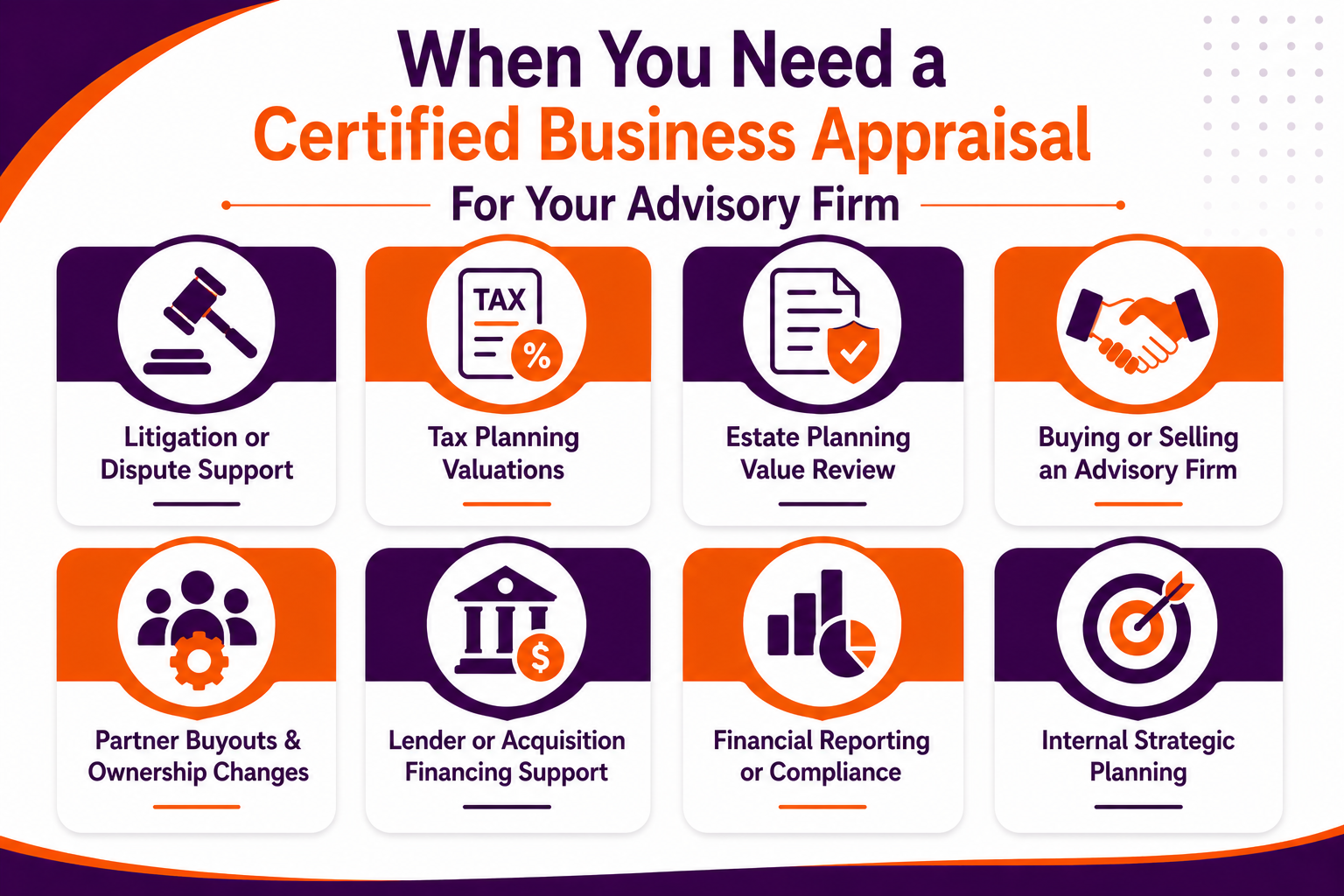
The need for a certified appraisal depends on who will review the valuation, how the value will be used, and what level of documentation the matter requires. Internal planning rarely demands the same rigor as litigation, tax planning, estate planning, acquisition financing, or ownership disputes.

When You Need A Certified Business Appraisal

Litigation Or Dispute Support Requires A Defensible Appraisal

Litigation raises the standard for valuation support because the appraisal may be reviewed by opposing counsel, challenged by another valuation expert, or presented to a judge or arbitrator. A business valuation report prepared for litigation should show the methodology used, the assumptions made, the market data considered, the financial support reviewed, and the reasoning behind the conclusion.

That level of support matters because disputes often turn on whether the valuation can be explained under pressure. Shareholder buyouts, partner exits, ownership transfers, divorce, FINRA disputes, and breach of contract claims may require a certified business appraiser who can provide a defensible opinion of value. In some matters, the appraiser may also need to provide expert testimony. The appraiser’s credentials, valuation experience, report quality, and familiarity with the type of business being valued all matter.

Before the engagement begins, advisory firms should confirm the report purpose, the standard of value required, and the expected level of documentation. The valuation may need to follow specific valuation standards, include certain disclosures, or address assumptions about client retention, revenue quality, goodwill, or intangible asset value. Waiting until the dispute is underway to clarify these issues can weaken the appraisal and delay resolution.

Tax Planning Can Require A Qualified Valuation

Tax-related matters may require more than a planning estimate. The IRS, state tax authorities, and tax courts often expect valuations to follow recognized valuation standards, use supportable methodologies, and include documentation that can be reviewed later. A certified business appraisal prepared for tax planning should identify the standard of value, the valuation date, the financial data reviewed, and the assumptions made about revenue quality, client retention, and intangible asset value.

This is why estate planning, gift tax planning, charitable contribution planning, and certain ownership transfers may require a qualified appraisal prepared by a qualified valuation professional. Depending on the matter, the appraiser may need to meet education requirements, hold a recognized credential, and follow professional standards issued by the AICPA, the National Association of Certified Valuators and Analysts, the American Society of Appraisers, or another recognized valuation body.

Advisors should confirm the exact tax requirement with their CPA or attorney before choosing a business appraiser. Some matters may require analysis of minority interest discounts, lack of marketability discounts, goodwill, or other adjustments that affect the value of the business. A valuation expert with general expertise in valuation but no experience in tax-related appraisals may not structure the report correctly.

Read Next: The Advisor's Guide to Tax Planning Before Selling Your Practice

Estate Planning Needs A Value That Can Be Reviewed Later

Estate planning valuations are often reviewed years after the valuation date. The people reviewing the appraisal later may include attorneys, CPAs, beneficiaries, tax authorities, or courts that were not involved in the original planning. That makes documentation especially important.

A certified appraisal prepared for estate planning should explain the assumptions, financial data, and valuation methodologies used so the conclusion can be understood and defended later. The report should also clarify exactly what was valued and under what conditions.

  • Ownership Interest: Identify the ownership percentage being valued, whether the interest is controlling or minority, and whether discounts apply based on the operating agreement or buy-sell terms.

  • Valuation Date: Confirm the valuation date and ensure the financial data, market conditions, and assumptions reflect the business as of that date, not a later period.

  • Standard of Value: Clarify whether the appraisal uses fair market value, fair value, or another standard, and explain how the standard affects the conclusion.

  • Discounts Where Relevant: Document any minority interest discounts, lack of marketability discounts, or other adjustments, and provide support for the discount percentages used.

  • Entity Structure: Describe the entity structure, ownership agreements, transfer restrictions, and any provisions that affect the value of the ownership interest.

  • Revenue Quality: Analyze recurring revenue, client age, household concentration, fee structure, and other factors that affect the sustainability and transferability of the revenue stream.

  • Supporting Financials: Include financial statements, tax returns, revenue reports, and other documentation that support the financial data used in the valuation process.

Buying Or Selling An Advisory Firm Requires More Than A Pricing Estimate

A transaction may begin with a pricing discussion, but the final value often needs more support than an informal estimate. Buyer financing, seller expectations, partner buy-in, tax treatment, and dispute risk can all require a formal appraisal instead of a simple opinion of value.

Lenders may want an independent business valuation to support the loan amount and confirm the reasonableness of the purchase price. Sellers may want a certified appraisal to justify the asking price or respond to buyer questions. Buyers may need a valuation to support their financing application or negotiate adjustments based on revenue quality, client retention, or intangible asset risk.

Acquisition financing usually raises the documentation standard. A lender may review the valuation methodologies, assumptions about client retention, and adjustments made to normalize owner compensation or discretionary expenses. A calculation of value or an informal estimate may not meet the lender’s documentation requirements.

Tax treatment can also make the appraisal more important. Asset sales, stock sales, and earn-out structures may trigger different tax consequences, and the IRS may review the allocation of purchase price across tangible assets, intangible assets, and goodwill. A business appraiser with expertise in valuation and experience in mergers and acquisitions can help structure the appraisal to support the intended use and reduce the risk of later disputes.

Partner Buyouts And Ownership Changes Need Documented Value Logic

Partner buyouts, equity grants, and ownership changes often trigger valuation requirements defined in the operating agreement or buy-sell agreement. These documents may specify the valuation process, the standard of value, the appraiser credential required, and the timeline for completing the valuation.

Because the agreement may control the process, a certified business appraiser should review the relevant language before starting the valuation. That step helps confirm whether the report will meet the requirements and whether the value applies to the full business or a specific ownership interest.

  • Operating Agreement Language: Review the operating agreement to identify the valuation trigger, the standard of value required, and any restrictions on the valuation process or appraiser selection.

  • Buy-Sell Terms: Confirm whether the buy-sell agreement requires a certified appraisal, a calculation of value, or another report type, and whether the appraiser must hold a specific credential.

  • Ownership Percentages: Document the ownership percentages before and after the transaction, and clarify whether the valuation applies to the entire business or a specific ownership interest.

  • Valuation Date: Identify the valuation date based on the agreement terms, and ensure the financial data and assumptions reflect the business as of that date.

  • Compensation Adjustments: Normalize owner compensation, discretionary expenses, and other adjustments to reflect the economics available to the buyer or remaining partners.

  • Revenue Allocation: Analyze how revenue is allocated across partners, whether client relationships are tied to specific advisors, and how the allocation affects the value of the ownership interest.

  • Client Ownership: Clarify whether clients are owned by the firm, the individual advisor, or shared, and how client ownership affects the transferability and value of the business.

  • Transfer Restrictions: Identify any transfer restrictions, non-compete provisions, or other terms that affect the marketability or value of the ownership interest.

Lender Or Acquisition Financing Review May Need Independent Support

Lenders may want independent support for the value being financed, the repayment capacity of the buyer, and the reasonableness of the transaction structure. A business valuation prepared for acquisition financing should address revenue quality, client retention risk, intangible asset value, and the financial performance of the advisory firm.

That analysis should connect the value of the company to its ability to generate cash flow after the transaction. A certified business appraiser with experience in advisory practice valuations can provide the documentation and analysis a lender may need to review the loan request. The appraiser should understand the factors that impact valuation in advisory firms, including recurring revenue, client age, household concentration, fee structure, owner dependency, and platform portability.

Advisors seeking acquisition financing should confirm the lender’s valuation requirements before engaging a business appraiser. Some lenders may require a full appraisal, while others may accept a calculation of value or opinion of value. The report type, standard of value, and level of documentation all affect the cost, timeline, and usefulness of the valuation.

Read Next: Funding A Financial Advisor Practice Acquisition

Financial Reporting Or Compliance Matters Can Raise The Standard

Financial reporting and compliance situations can require a defined standard of value, a specific valuation date, a particular report format, and recognized valuation methodologies. A certified business appraisal prepared for financial reporting should follow the accounting standards applicable to the situation, whether GAAP, IFRS, or another framework.

The same need for clarity applies when a valuation may be reviewed by regulators, auditors, or other professionals. Compliance matters involving regulatory review, audit support, or third-party oversight may require a business valuation report with transparent assumptions, supportable calculations, and a defensible conclusion.

Advisors preparing for financial reporting or compliance matters should confirm the report purpose, standard of value, and documentation requirements before choosing a business appraiser. The valuation may need to address specific intangible assets, goodwill, or other balance sheet items, and the appraiser should understand how the valuation fits into the broader reporting or compliance process.

Internal Strategic Planning Usually Does Not Require A Certified Appraisal

Internal strategic planning, succession discussions, and early-stage exit planning often do not require a certified business appraisal. A calculation of value or opinion of value may provide enough information to help business owners and advisors make informed decisions without the cost, timeline, and documentation level of a full appraisal.

The risk is choosing the wrong report type for the situation. Overbuying a certified appraisal for internal planning adds cost and complexity without adding much practical value. Underbuying a calculation of value for a transaction, tax matter, or litigation can create risk and may require a second valuation later.

A valuation professional with expertise in business valuation and experience in advisory practices can help advisors choose the right report type. The appraiser should ask about the intended use, timeline, budget, and level of documentation needed before recommending a type of business valuation.

Read Next: Using a Valuation as a Business Planning Tool

Which Credentials And Standards Matter In Business Valuation?

Credentials and certification signal education, experience, and adherence to valuation standards, but they do not guarantee the appraiser understands advisory firm economics or the requirements of the matter. The credential matters, but so does the appraiser’s experience with the type of business, the intended use of the valuation, and the ability to explain assumptions under review.

ABV And Accredited In Business Valuation

The ABV credential, or Accredited in Business Valuation, is granted by the AICPA to CPAs and qualified valuation professionals who demonstrate business valuation education, experience, and adherence to professional standards.

The credential is widely recognized in tax planning, estate planning, litigation, financial reporting, and business appraisal services. CPAs and valuation professionals with the ABV credential often work with attorneys, business owners, and other professionals on matters that require a certified valuation or defensible business valuation report.

Still, the credential should not be the only selection factor. The ABV credential indicates a foundation in valuation methodologies, valuation standards, and professional ethics, but advisors should still confirm whether the appraiser has experience with advisory practice valuations.

CVA And Certified Valuation Analyst

The CVA credential, or Certified Valuation Analyst, is awarded by the National Association of Certified Valuators and Analysts. CVA holders are commonly trained in valuation methodologies, valuation reporting, business appraisal services, and valuation analysis for transactions, disputes, tax matters, and strategic planning.

This credential is recognized in mergers and acquisitions, litigation, business appraisal services, tax matters, and strategic planning. Certified valuators and analysts with the CVA credential often work with business owners, attorneys, lenders, and CPAs on transactions, disputes, and valuation planning.

As with any credential, advisors should look beyond the letters after the appraiser’s name. The CVA credential indicates training in valuation methodologies and business valuation process requirements, but advisors should still confirm the appraiser has valuation experience with advisory firms.

ASA And Accredited Senior Appraiser

The ASA credential, or Accredited Senior Appraiser, is awarded by the American Society of Appraisers. In business valuation, the accredited senior appraiser designation signals valuation education, valuation experience, and adherence to professional standards.

The ASA credential is recognized in litigation, estate planning, financial reporting, and business appraisal services. ASA professionals often provide opinions of value, expert testimony, and valuation support in complex matters.

Even so, the advisory practice context still matters. The credential indicates advanced training and valuation experience, but it does not automatically mean the appraiser understands the intangible asset value, revenue quality, client retention dynamics, or transferability issues that affect advisory practice valuations.

Credentials Do Not Replace Report Fit

Credentials matter, but they do not replace the need to verify the appraiser’s experience, report type, and fit between the valuation and the intended use. An appraiser may be highly credentialed and still be the wrong fit if the report does not match the matter.

  • Advisory Industry Experience: Confirm the appraiser has experience valuing advisory firms, understands recurring revenue models, and can analyze client retention, household concentration, and intangible asset quality.

  • Intended Use: Clarify the intended use of the valuation, whether litigation, tax planning, estate planning, acquisition, or ownership transfer, and confirm the appraiser has experience preparing valuations for that purpose.

  • Report Type: Identify the report type required, whether a full appraisal, a calculation of value, or an opinion of value, and confirm the appraiser can deliver the report in the format and timeline needed.

  • Standard of Value: Confirm the standard of value required, whether fair market value, fair value, or another standard, and ensure the appraiser understands how the standard affects the valuation process and conclusion.

  • Supportable Methodology: Ask the appraiser to explain the valuation methodologies that will be used, the market data that will be considered, and the assumptions that will be made about revenue quality, client retention, and intangible asset value.

  • Documentation Request List: Review the documentation request list to confirm the appraiser will review financial statements, tax returns, revenue reports, client data, and other information needed to support the valuation.

  • Ability To Explain Assumptions: Confirm the appraiser can explain the assumptions, respond to questions from attorneys or CPAs, and defend the conclusion if the valuation is reviewed or challenged.

What A Certified Business Appraisal Should Include

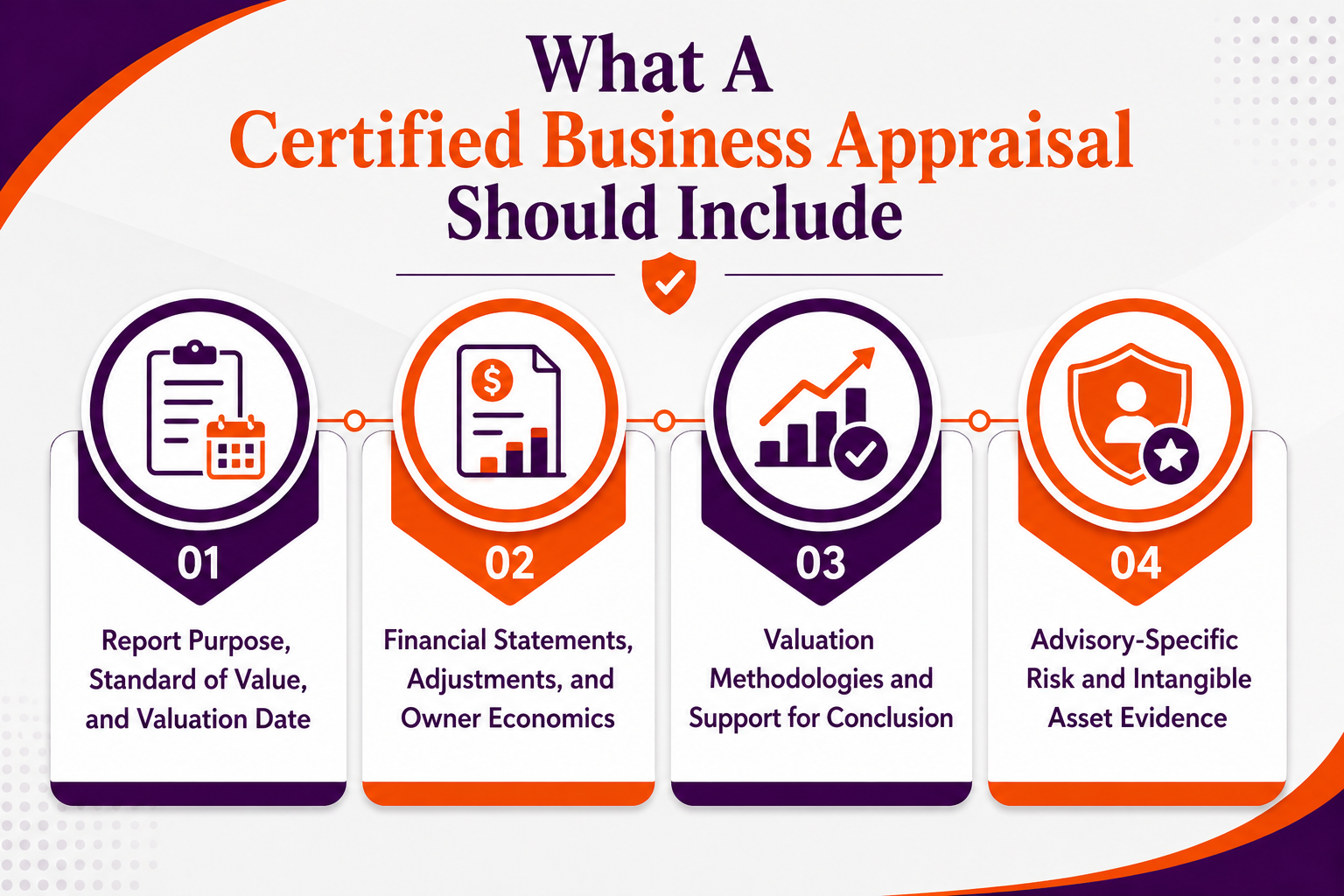
A certified business appraisal should provide enough detail to support the conclusion, explain the assumptions, and withstand review by attorneys, CPAs, lenders, courts, or other professionals. The report should be clear, organized, and tailored to the intended use.

That does not mean every report should look identical. The right structure depends on the purpose of the valuation, the type of business, and who will rely on the report. Still, most certified business appraisals should address the core areas below.

What A Certified Business Appraisal Should Include

Report Purpose, Standard Of Value, And Valuation Date

The report should begin with a clear statement of the purpose, standard of value, and valuation date. These elements control the scope of the valuation, the methodologies used, and the assumptions made.

If these items are unclear, the report may not meet the needs of the matter. A valuation prepared for estate planning may not use the same assumptions as one prepared for acquisition financing, litigation, or internal ownership transfer.

  • Report Purpose: Identify the intended use of the valuation, whether litigation, tax planning, estate planning, acquisition, or ownership transfer, and explain how the purpose affects the report scope and documentation level.

  • Standard of Value: Define the standard of value used, whether fair market value, fair value, investment value, or another standard, and explain how the standard affects the valuation process and conclusion.

  • Valuation Date: State the valuation date and confirm the financial data, market conditions, and assumptions reflect the business as of that date, not a later period.

  • Scope of Work: Describe the scope of work performed, the information reviewed, the valuation methodologies applied, and any limitations or assumptions that affect the conclusion.

  • Ownership Interest: Identify the ownership interest being valued, whether the entire business or a specific percentage, and clarify whether the interest is controlling or minority.

Financial Statements, Adjustments, And Owner Economics

After the report defines the purpose and scope, it should explain the financial foundation of the appraisal. This usually includes a review of financial statements, an analysis of normalization adjustments, and an explanation of the owner's economics available to a buyer or successor.

These details matter because small changes in normalized earnings can affect the value of a business. The appraiser should show how the financial data was reviewed and why any adjustments were made.

  • Financial Statements Reviewed: List the financial statements reviewed, including income statements, balance sheets, tax returns, and revenue reports, and identify the periods covered.

  • Normalization Adjustments: Explain the adjustments made to normalize owner compensation, discretionary expenses, non-recurring items, and other financial data to reflect the economics available to a buyer.

  • Owner Compensation: Analyze owner compensation and adjust it to reflect market-rate compensation for the role, responsibilities, and time commitment required to operate the business.

  • Discretionary Expenses: Identify discretionary expenses that may not continue under new ownership, such as personal expenses, excess travel, or family member compensation, and adjust the financial data accordingly.

  • Revenue Quality: Analyze recurring revenue, client age, household concentration, fee structure, and other factors that affect the sustainability and transferability of the revenue stream.

  • Profitability Analysis: Calculate profitability metrics such as EBITDA, net income, and profit margin, and compare the results to industry benchmarks to assess the financial performance of the business.

Read Next: Financial Due Diligence Checklist: How to Prepare Your Business for Sale

Valuation Methodologies And Support For The Conclusion

Once the financial foundation is clear, the report should explain how the appraiser determined the value. A certified business appraisal may use one or more valuation methodologies depending on the type of business, available data, and intended use.

The report should not simply name a method. It should explain why the method fits the advisory firm, what data was used, what assumptions were made, and how the appraiser reconciled the result.

Valuation Methodology What It Measures And When It Applies
Income Approach Measures the present value of future cash flows or earnings. Commonly used for advisory firms with recurring revenue, stable client relationships, and predictable cash flow. Requires assumptions about growth, risk, and discount rates.
Market Approach Compares the business to similar businesses that have sold or been valued. Relies on market data, transaction multiples, and comparable sales. Useful when market data is available, and the business is similar to the comparables.
Asset-Based Approach Measures the net asset value of the business by valuing tangible and intangible business assets and subtracting liabilities. Less common as the primary approach for advisory firms because much of the value is tied to client relationships and goodwill.
Reconciliation Of Methods Explains how the appraiser reconciled results from multiple methodologies, weighted the approaches, and arrived at the conclusion. Should address the strengths and limitations of each method.


Advisory-Specific Risk And Intangible Asset Evidence

For advisory firms, the report also needs to go beyond standard financial metrics. Much of the value of the company may come from intangible assets such as client relationships, recurring revenue, team continuity, goodwill, and platform portability.

These factors help explain whether the value is durable or fragile. A certified business appraisal should analyze them directly instead of relying only on revenue multiples or general market data.

  • Client Retention Risk: Analyze client retention rates, client age, household concentration, and the strength of client relationships to assess the risk of client attrition during or after a transition.

  • Recurring Revenue Quality: Evaluate the percentage of revenue from recurring fees, the fee structure, the client service model, and the sustainability of the revenue stream under new ownership.

  • Team Continuity: Assess the strength of the team, the roles and responsibilities of key employees, and the risk of staff turnover during or after a transition.

  • Platform Portability: Analyze the portability of client relationships, the ease of transferring accounts, and any restrictions or friction that could affect the transition process.

  • Intangible Asset Documentation: Document the intangible assets that contribute to the value of the business, including client relationships, brand reputation, proprietary processes, and intellectual property.

  • Goodwill Analysis: Explain the goodwill component of the value, whether it is personal goodwill tied to the owner or enterprise goodwill tied to the business, and how the distinction affects the valuation.

Read Next: Factors That Impact Practice Value

What Can Weaken A Certified Business Appraisal

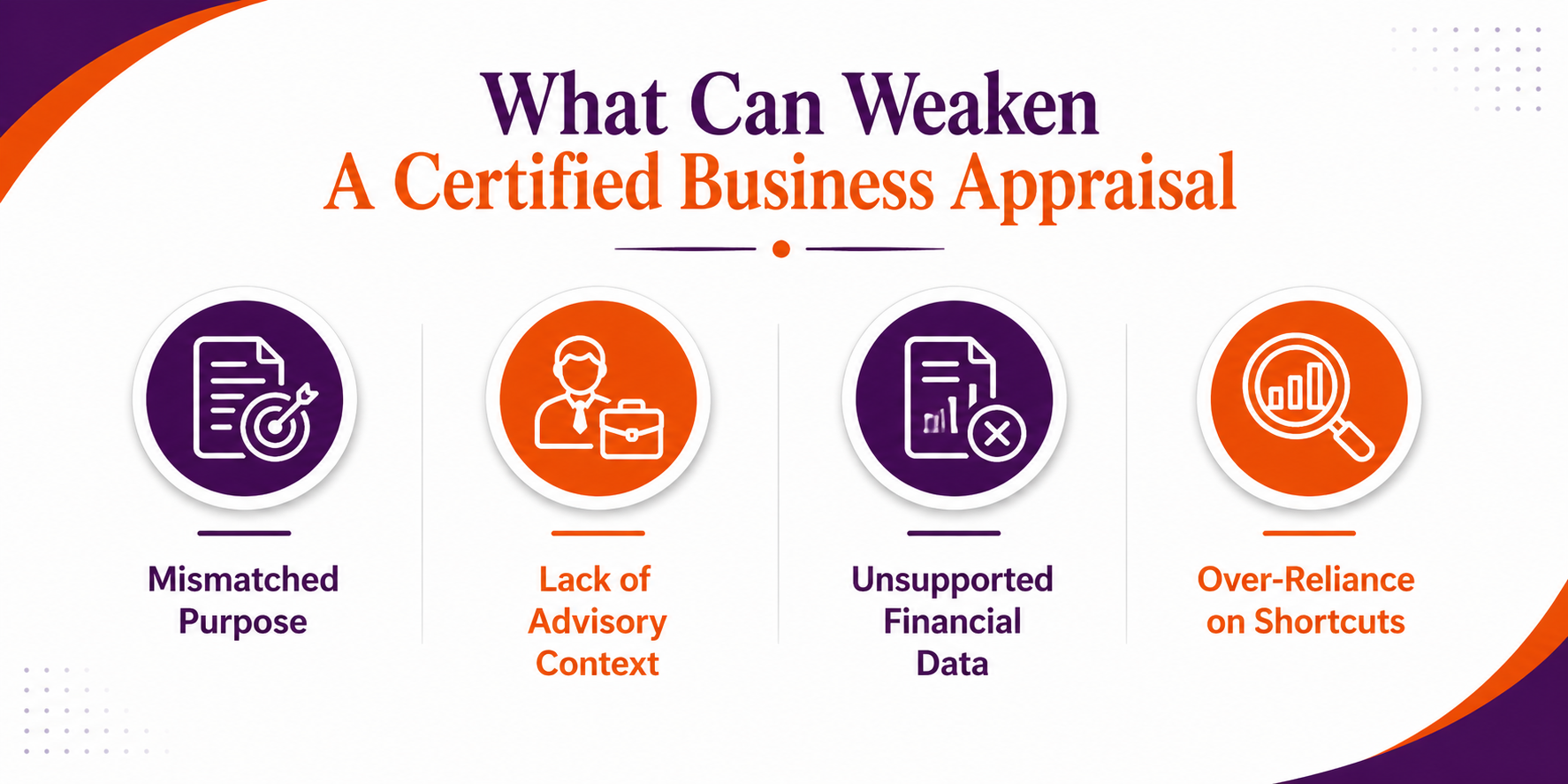
A certified business appraisal can be weakened by a mismatched report purpose, lack of advisory practice context, unsupported financial data, or over-reliance on market shortcuts. These problems are preventable, but they require attention during the appraiser selection and engagement process.

What Can Weaken A Certified Business Appraisal

The Report Does Not Match The Legal Or Tax Purpose

A business valuation report prepared for internal planning may not meet the documentation requirements for litigation, tax planning, estate planning, or acquisition financing. The report's purpose controls the standard of value, valuation methodologies, documentation level, and required disclosures.

Because of that, advisors should confirm the report purpose with their attorney or CPA before engaging a business appraiser. The appraiser should ask about the intended use, timeline, parties who will review the valuation, and documentation standards required. An experienced business appraiser should be able to structure the report correctly from the start.

The Appraiser Lacks Advisory Practice Context

A valuation expert with expertise in business valuation services but no experience in advisory practices may not understand the factors that impact valuation in this field. Recurring revenue, client retention, household concentration, fee structure, platform portability, and intangible asset value all affect the value of a business.

This is why advisory industry experience matters. Advisors should confirm the appraiser has experience valuing advisory firms and understands the revenue quality and retention risk that affect this type of business. A business appraiser with no advisory practice experience may rely on generic valuation methodologies that do not fit the business model.

Financial Reporting Does Not Support The Conclusion

A certified business appraisal should be supported by financial statements, tax returns, revenue reports, client data, and other documentation that can be reviewed and verified. A valuation that relies on incomplete financial data, unsupported assumptions, or unexplained adjustments may not withstand review by attorneys, CPAs, lenders, or opposing experts.

To reduce that risk, advisors should provide complete and accurate financial data to the appraiser. This may include income statements, balance sheets, tax returns, revenue reports, client data, and other information needed to support the valuation. The appraiser should review the data, identify gaps, and request additional documentation before completing the valuation.

Read Next: What Valuation Mistakes Do Sellers Make Before Selling a Practice?

The Appraisal Relies Too Heavily On Market Shortcuts

Market data can provide useful benchmarks, but over-reliance on market shortcuts can weaken the appraisal if the appraiser does not analyze the specific characteristics of the business. A certified business appraiser should use market data to inform the valuation, but the conclusion should also reflect financial performance, revenue quality, client retention, profitability, and intangible asset value.

A simple market multiple may not tell the full story. Advisors should ask the appraiser to explain how market data was used, what adjustments were made to account for differences between the business and comparables, and how the appraiser reconciled the market approach with other valuation methodologies. A business valuation based only on simple market multiples may not reflect the true value of the business.

A Certified Appraisal Should Stand Up To The Matter It Supports

A certified business appraisal becomes important when the value of an advisory firm must be reviewed by attorneys, CPAs, courts, lenders, buyers, sellers, or other stakeholders. The appraisal should follow recognized valuation standards, use supportable methodologies, and include documentation that explains how value is determined.

Advisors preparing for litigation, tax planning, estate planning, acquisition, financial reporting, or ownership transfer should confirm the report purpose, standard of value, report type, and appraiser experience before starting the engagement. That step helps ensure the valuation matches the matter instead of forcing a planning-level report into a legal, tax, lender, or transaction context.

Key Takeaways:

  • A certified business appraiser with advisory practice experience can analyze the revenue quality, client retention, and intangible asset value that affect the business.

  • The valuation should include a clear statement of the report's purpose, the standard of value, the valuation date, and the methodologies used to conclude.

  • Advisors should confirm the appraiser holds a recognized credential, follows valuation standards, and can explain assumptions and defend the conclusion under review.

P.S. A certified business appraisal is only useful if it matches the matter it supports. Advisor Legacy’s Specialty Valuation service is built for situations where advisory firm value needs to be explained, documented, and reviewed in a legal, tax, ownership, dispute, or other complex setting. For AUM-based advisory practices with less than 30% of revenue from insurance or annuities, Business Valuation may be a better fit for strategic planning, succession, or transaction preparation.

Request a Specialty Valuation Consult to clarify the level of documentation your matter may require.

FAQ

What Is A Certified Business Appraisal?

A certified business appraisal is a formal business valuation prepared by a credentialed business appraiser or qualified valuation professional who follows recognized valuation standards. It is designed to provide an accurate valuation that can support a third-party review. The appraisal usually includes the report purpose, standard of value, valuation date, financial data reviewed, valuation methodologies used, and reasoning behind the conclusion.

When Does An Advisory Firm Need A Certified Business Appraisal?

An advisory firm may need a certified business appraisal when the value will be reviewed by attorneys, CPAs, courts, lenders, buyers, sellers, tax authorities, or other stakeholders. A valuation may be required for litigation, tax planning, estate planning, acquisition, ownership transfer, partner buyouts, financial reporting, lender financing review, or the sale of a business.

What Credentials Should A Business Appraiser Hold?

A business appraiser may hold a recognized credential such as ABV, CVA, or ASA. ABV stands for Accredited in Business Valuation, and professionals may need to meet education, experience, and ABV exam requirements to complete the ABV credential. These credentials signal training in the field of business valuation, but advisors should also confirm the appraiser has experience valuing advisory firms and understands intangible asset value, revenue quality, client retention, and platform portability.

What Is The Difference Between A Certified Appraisal And A Calculation Of Value?

A certified appraisal is typically more detailed, follows recognized valuation standards, and is designed to support third-party review. A calculation of value is usually more limited, relies on agreed-upon procedures or simplified assumptions, and is often used for internal planning. Both can help business owners learn about the business valuation process, but they serve different needs depending on whether the value will be used internally or reviewed in a legal, tax, lender, or transaction matter.

How Much Does A Certified Business Appraisal Cost?

The cost of a certified business appraisal depends on the complexity of the business, intended use, report type, documentation required, and the appraiser’s valuation experience. Advisors should request a proposal that outlines the scope of work, timeline, report format, appraisal services offered, and fee structure before engaging a business appraiser.

Can A Certified Business Appraisal Be Used For Multiple Purposes?

Sometimes, but not always. A certified business appraisal is usually prepared for a specific purpose, such as litigation, tax planning, estate planning, acquisition, ownership transfer, or buying or selling a business. The report's purpose controls the standard of value, valuation methodologies, assumptions, and documentation level. Using a valuation prepared for one purpose in a different matter may not meet the requirements of the new matter, and an updated or separate valuation may be required.

How Do Business Valuation Professionals Determine The Value Of A Company?

Business valuation professionals determine the value of a company by reviewing financial performance, revenue quality, assets, liabilities, risk, market data, and future cash flow. In advisory firms, the process of determining the value also considers client retention, recurring revenue, advisor dependency, intangible assets, and transferability. Business valuations are conducted using methods such as the income approach, market approach, or asset-based approach, depending on the type of business and the purpose of the appraisal.

About the Author: Alan Salomon, CPA/ABV, CVA

Alan Salomon, CPA/ABV, CVA, is a valuation and tax specialist with more than a decade of firm ownership and hands-on experience serving closely held businesses. He provides accredited valuations for buy/sell agreements, estate and gift matters, divorces, shareholder/member disputes, and fair value reporting, as well as personal, business, and fiduciary income tax preparation and planning. Alan’s articles explain how valuation approaches apply to advisory practices, how to document defensible conclusions, and where tax planning can materially impact deal structure and after-tax proceeds. His work emphasizes compliance with professional standards and practical documentation that stands up to scrutiny.

Subscribe

Receive timely articles, tip sheets, events, and more right in your inbox.

When You Need A Certified Business Appraisal For Your Advisory Firm

When You Need A Certified Business Appraisal For Your Advisory Firm

A certified business appraisal becomes important when the value of an advisory firm must be reviewed by a third party. Attorneys, CPAs, courts,...

Read More
Designing A Practice Valuation Program For Broker-Dealer Networks

Designing A Practice Valuation Program For Broker-Dealer Networks

Broker-dealer networks face a growing succession challenge. Advisors need practice valuations for succession planning, M&A conversations, liquidity...

Read More
How To Build A Lender-Ready Valuation Report For Your Advisory Practice

How To Build A Lender-Ready Valuation Report For Your Advisory Practice

Most financing requests stall because the valuation report doesn't answer the questions lenders actually ask. A practice might be worth $2 million,...

Read More