





Valuation Insights for NextGen Financial Advisors Building Equity
NextGen financial advisors are entering a period of unprecedented transition in the wealth management industry. According to InvestmentNews, a...
Comprehensive, data-driven valuations and comparative equity analyses to accurately price your practice, establish market benchmarks, and support informed decision-making.
Comprehensive M&A guidance encompassing deal structuring, negotiation strategies, market listings, and transaction closings.
Comprehensive systems, targeted coaching, and in-depth assessments designed to optimize operational efficiency and enhance advisory team effectiveness.
Strengthen continuity through the implementation of formal continuity agreements, the establishment of legal entities, execution of enforceable legal contracts, and securing appropriate capital resources.
10 min read
Anthony Whitbeck, CFP®, CLU®
March 18, 2026
NextGen financial advisors are entering a period of unprecedented transition in the wealth management industry. According to InvestmentNews, a significant number of advisory firms expect to retire, transferring ownership internally, including to the existing staff. The opportunity for junior and associate advisors to build equity and shape their own succession path has never been greater.
Yet, the path to partnership is rarely straightforward. Negotiating equity, buy-in, and compensation requires a clear understanding of what drives practice value, how internal deals are structured, and why objective valuation insights are essential for protecting your interests.
This guide covers:
P.S. If you are a NextGen advisor preparing for a partnership or a principal designing an equity path, understanding valuation is essential for making informed decisions and protecting your long-term interests. Advisor Legacy offers objective, data-driven valuations and internal deal modeling to help both parties align on fair, defensible terms. Book a joint valuation and equity strategy session to clarify your next steps and build a partnership that lasts.

The decision to pursue equity in an advisory firm is one of the most significant career moves a NextGen advisor can make. It is not just about buying shares or negotiating compensation. Valuation insights help you understand the true value of what you are building, the risks you are accepting, and the legacy you are helping to shape.
For firm principals, designing an equity path that attracts and retains top talent requires more than intuition or tradition. It demands a transparent, data-driven approach that aligns the interests of all stakeholders and stands up to external scrutiny.
Valuation insights are the foundation of every successful internal succession, partnership, and buy-in. They provide the objective data needed to set fair pricing, structure compensation, and ensure that both NextGen and senior advisors are protected as the business evolves.
Without clear valuation insights, equity negotiations often devolve into guesswork, leading to disputes, growth limitation, and even failed transitions. By prioritizing valuation as a strategic tool, NextGen advisors and firm leaders can create equity paths that are competitive, defensible, and designed for long-term sustainability.
For NextGen advisors, equity is a signal of trust, a path to leadership, and a stake in the future of the firm. But without a clear understanding of what drives practice value, it is easy to overestimate your contribution or underestimate the risks involved.
For principals, the challenge is to design equity offers that are attractive enough to keep top talent engaged, but realistic enough to protect the firm’s long-term interests.
Objective valuation insights bridge the gap between ambition and reality. They help both parties:
When valuation is not treated as a strategic priority, the consequences can ripple through every aspect of an internal equity deal. Many advisory firms assume that informal estimates or “rules of thumb” are sufficient for setting buy-in prices or structuring partnership offers. However, this approach exposes both NextGen advisors and principals to significant risks, including financial, operational, legal, and relational.
Firms that overlook valuation may find themselves facing:
Valuation insights consist of a comprehensive view of what makes a financial advisory practice valuable, sustainable, and transferable. For NextGen advisors on the partnership track, understanding these components is critical for negotiating fair terms, identifying areas for improvement, and building a defensible case for equity.
Assets under management (AUM) and the percentage of revenue that is recurring are the backbone of practice value. High AUM and stable recurring revenue streams signal a durable business model and attract higher multiples from buyers and lenders. NextGen advisors should track these metrics over time and understand how shifts in product mix or client preferences impact long-term value.
Client retention rates and demographic profiles reveal the firm’s ability to sustain revenue and transfer relationships during succession. High retention, especially among high-net-worth and multi-generational households, reduces transition risk and supports premium pricing. Analyze retention by segment, age, and geography to identify strengths and vulnerabilities.
Normalized profitability after adjusting for owner-specific expenses and one-time costs shows how much cash flow is truly available to support buy-ins, distributions, and reinvestment. Operational efficiency, measured by cost ratios and process discipline, increases buyer confidence and supports higher equity valuations.
Segmenting clients by revenue, service tier, and engagement level allows for targeted growth strategies and more accurate valuation modeling. A well-segmented book of business, combined with strong market presence and brand recognition, increases the value of your business and makes internal deals more attractive.
Comparing your firm’s growth rate, client acquisition, and retention metrics to industry benchmarks helps identify areas for improvement and supports defensible valuation claims. Use benchmarking to set realistic expectations for buy-in pricing and future equity appreciation.
The geographic location of your practice and local market dynamics can influence what buyers are willing to pay and how internal deals are structured. Practices in high-growth or underserved markets may command higher multiples, while those in saturated or declining regions may face valuation compression.

Internal equity deals are among the most scrutinized and consequential decisions in an advisory firm’s lifecycle. NextGen advisors are investing their careers and capital, while the retiring advisors are entrusting the future of their business to new leadership. Without a structured, data-driven approach, even well-intentioned deals can unravel, leading to disputes, client attrition, or lost value.
By leveraging valuation insights at every stage, both parties can negotiate terms that are fair, defensible, and aligned with industry best practices.
Choosing the right buy-in structure is critical for balancing the needs of NextGen advisors, principals, and the firm as a whole. Each model has unique advantages, risks, and verification requirements.
| Buy-In Model | Structure Description | Pros/Cons | Verification Steps | Stakeholder Impact |
|---|---|---|---|---|
| Fixed Price | Set price based on recent valuation | Simple, transparent; may not reflect growth | Use a third-party valuation report | Clear for all parties |
| Formula-Based | Price tied to revenue/profit metrics | Adjusts with firm performance; can be complex | Document calculation method | Aligns incentives, needs clarity |
| Phased Vesting | Equity earned over time | Reduces upfront cost; requires a long-term plan | Track vesting schedule | Retains talent, gradual transfer |
| Seller Financing | Seller provides a loan for buy-in | Eases cash flow; risk for seller | Formalize loan terms, payment plan | Supports NextGen, seller risk |
Choose a model that matches your firm’s goals, cash flow, and stakeholder needs. Use objective valuation data to set terms and avoid disputes.
Read next: Selling to Junior Partner vs External Buyer: Which Path Fits Your Succession Plan?
Too often, firms treat compensation, bonuses, and equity as separate conversations, missing the opportunity to align incentives and reinforce the behaviors that increase practice value.
By connecting valuation data directly to compensation and growth pathways, both NextGen advisors and principals can ensure that rewards are tied to measurable outcomes, such as recurring revenue, client retention, and profitability, rather than subjective assessments or legacy formulas. This approach not only builds trust but also provides a clear roadmap for career advancement and ownership.
Benchmarking is a critical step in validating internal deal terms and ensuring your equity path is competitive and defensible. It allows both buyers and sellers to move beyond anecdotal evidence and gut feelings, grounding negotiations in real-world data and industry standards.
Use this data to support your valuation, identify areas for improvement, and negotiate from a position of strength:
Read next: Understanding Valuation Multiples for a Financial Advisor Practice
Tax and estate planning are potentially disruptive elements of internal equity transfers. Failing to address these issues early can result in unexpected tax bills, compliance headaches, and even legal disputes that derail the entire succession process. Both buyers and sellers must understand the tax implications of equity transfers, including capital gains, ordinary income, and potential gift tax exposure.

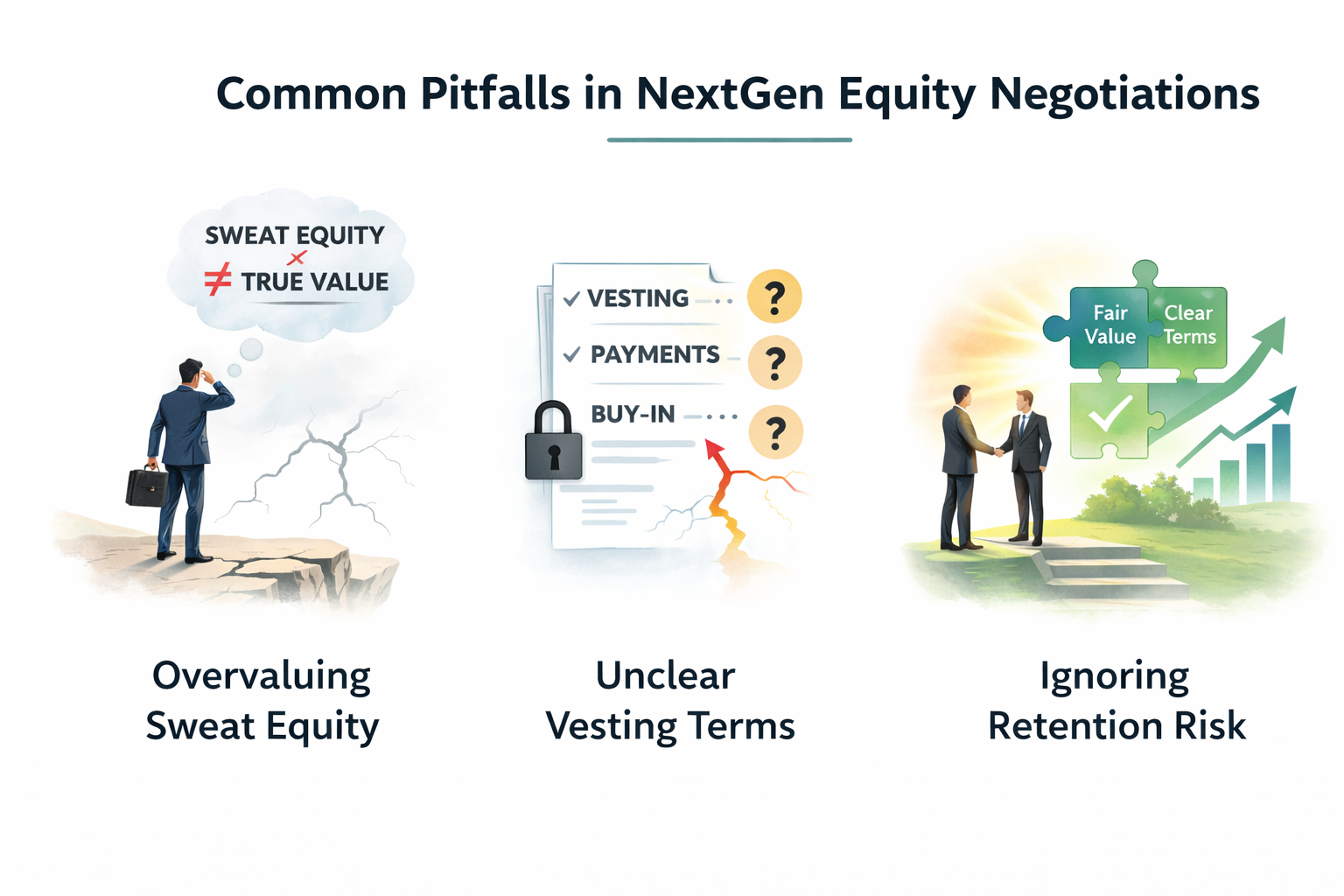
Internal equity negotiations are complex, high-stakes, and often emotionally charged. Even experienced advisors and principals can fall into traps that undermine trust, erode value, or jeopardize the long-term success of the firm. Recognizing these pitfalls and knowing how to avoid them is essential for building a partnership that stands the test of time.
It is common for NextGen advisors to believe that years of hard work or business development should translate directly into a larger equity stake. While contributions matter, equity value must be grounded in objective metrics, such as recurring revenue, client retention, and profitability, not just effort or tenure.
Principals, on the other hand, may underestimate the risk of client attrition or operational disruption during a transition. If these risks are not quantified and addressed, both parties may end up with unrealistic expectations or a deal that fails to deliver value. Using third-party valuations, documenting contributions, and analyzing retention risk are essential steps to ensure fairness and avoid disputes.
Ambiguity in vesting schedules, payment terms, or buy-in formulas is a recipe for conflict. Without clear documentation, misunderstandings can arise about when equity is earned, how payments are made, or what happens if an advisor leaves early. This uncertainty can erode trust and make it difficult to enforce agreements if disputes arise.
All terms should be spelled out in formal, attorney-reviewed documents, with provisions for early departure, disability, or changes in business performance.
Client relationships are the lifeblood of any advisory practice. Failing to address retention risk or succession readiness can undermine the value of the deal and threaten the firm’s future. If clients are not prepared for the transition, or if the successor is not fully integrated into the relationship, attrition can spike, reducing revenue, profitability, and ultimately, practice value.
A detailed client transition plan, successor readiness assessment, and ongoing monitoring of retention metrics are critical to a successful equity transfer.
Read Next: RIA Succession Plan Checklist: A Guide to Continuity, Valuation & Transition
A defensible value proposition is the cornerstone of successful internal equity negotiations. It is not enough to simply state what the business is worth or what terms are “fair”. You must be able to prove it, communicate it, and withstand scrutiny from all stakeholders, including buyers, sellers, lenders, and even clients.
Building this level of confidence requires a disciplined, transparent approach to documentation, communication, and third-party validation. When all parties understand how value is created, measured, and transferred, trust increases and the risk of disputes decreases. This is especially important in multi-owner firms or when external financing is involved, as lenders and regulators will expect a clear, defensible rationale for all deal terms.
Building equity as a NextGen advisor is a career-defining opportunity, but it requires more than ambition. By prioritizing valuation insights, you can negotiate fair buy-in terms, align incentives, and protect your interests as both a partner and a future leader. For firm principals, a transparent, data-driven approach to equity and succession planning is the key to retaining top talent and securing your legacy.
Valuation insights are the foundation for every successful internal equity negotiation—use them to set fair pricing, benchmark against industry standards, and ensure transparency for all stakeholders.
Understanding the drivers of practice value, from recurring revenue to client retention and operational efficiency, empowers both NextGen advisors and principals to structure deals that are defensible and sustainable.
Integrating valuation, compensation, and succession planning creates a clear, actionable path to partnership, supporting long-term growth and a smooth leadership transition.
If you are ready to make informed decisions about equity, succession, or partnership, schedule a joint valuation and equity strategy session with Advisor Legacy. Our objective, data-driven approach helps you build trust, align incentives, and secure your legacy for the next generation.
NextGen advisors should start by understanding the firm’s valuation, key metrics, and industry benchmarks. Use objective data to propose buy-in terms, clarify payment schedules, and ensure all agreements are documented and reviewed by legal and tax professionals.
Income and market approaches are most common for advisory firms. Use third-party valuations that factor in recurring revenue, client retention, and profitability. Document all assumptions and calculations to withstand scrutiny from stakeholders and lenders.
High client retention reduces transition risk and supports higher equity valuations. Track retention rates by segment and address any concentration risk before finalizing a deal. Strong retention signals stability to buyers and lenders.
Tax planning affects both buyers and sellers. Early consultation with tax professionals helps structure deals to minimize tax liability, comply with IRS rules, and avoid surprises during ownership transfer or succession.
Revalue the practice at least annually or whenever there is a significant change in revenue, client base, or market conditions. Regular valuations keep equity offers and succession plans current and defensible.
Avoid overvaluing sweat equity, unclear vesting terms, and ignoring client retention risk. Use objective valuation data, document all agreements, and communicate openly to prevent disputes and protect long-term value.
Anthony "Tony" Whitbeck, CFP®, CLU®, is CEO and Owner of Advisor Legacy. He began his career as a financial advisor in 1989 and later shifted to coaching, where he’s guided more than two hundred advisory practices through growth, valuation, and succession. Tony leads Advisor Legacy’s certified third-party valuation engagements and coordinates lending and legal partners to streamline transactions. His articles focus on building transferable enterprise value, mapping internal vs. external exits, and avoiding common succession pitfalls. Drawing on decades of in-the-trenches experience, Tony provides practical, compliance-friendly guidance advisors can use right away.
Receive timely articles, tip sheets, events, and more right in your inbox.
NextGen financial advisors are entering a period of unprecedented transition in the wealth management industry. According to InvestmentNews, a...
Internal partner buy-ins are increasingly central to succession strategies in financial advisory firms as founders plan exits and next-generation...
The most successful advisory firm owners spend years quietly wondering if their firm is actually worth what they hope or fear it isn’t. The truth is,...