



Skip to the main content.

13 min read

How Reducing Owner Dependency Increases RIA Sale Value

How Reducing Owner Dependency Increases RIA Sale Value

Reducing owner dependency increases RIA sale value because buyers pay for transferable entities and scalable cash flows that don't collapse when the founder walks away. Owner-dependent advisory firms sell for lower multiples and face more restrictive earn-out structures than practices with documented processes, strong leadership teams, and distributed client relationships.

When your business relies on one person for decision-making, key client relationships, and day-to-day operations, potential buyers see transition risk, not long-term growth. The solution isn't to step away overnight; it's to systematize your business over 3–5 years so the firm can operate without you, making it more sellable, more valuable, and more attractive to a wider range of prospective buyers.

This guide covers:

  • Why owner-dependent RIAs are discounted on valuation and pushed toward restrictive deal terms.

  • A diagnostic checklist to identify where your business depends too much on you.

  • Specific levers to reduce owner dependency and increase market value before selling a business.

  • How a 3–5 year transition plan improves buyer confidence, exit flexibility, and business value.

How Owner Dependency Lowers RIA Valuation and Buyer Confidence

M&A advisors and capital advisors evaluate founder-led RIAs on a transferability basis: can this business generate predictable cash flow independent of the owner? When a practice is too dependent on one person, whether for client relationships, investment decisions, or daily operations, buyers see key-person risk, not scalability.

The dependency directly impacts valuation, deal structure, and the sale process. Owner-dependent firms often receive lower multiples, face longer earn-outs, and encounter more buyer hesitation because the new owner inherits worrisome uncertainty about post-closing performance.

How Buyers Evaluate Owner Dependency in RIAs

Potential buyers and their advisors conduct diligence with a clear question: what happens if the founder leaves? They examine who owns key client relationships, who makes strategic decisions, and whether the business has documented processes that allow it to function without constant founder involvement. If the answer is "the founder does everything," buyer confidence drops. Strategic buyers want scalable platforms with leadership teams that can manage teams and execute growth initiatives.

Impact of Owner Dependency on Valuation and Deal Structure

The table below shows how owner dependency manifests across core RIA functions and how buyers interpret each pattern during diligence.

Factor Highly Owner-Dependent RIA Reduced Owner Dependency/Transition-Ready RIA
Client Relationships The founder personally manages all top clients; team members have limited direct contact. Key clients know and trust multiple advisors; relationships are documented and shared across the team.
Decision-Making The founder approves all investment, pricing, and exception decisions; no delegation framework exists. The leadership team makes routine decisions using documented guidelines; the founder focuses on strategic initiatives.
Operations Day-to-day operations depend on the founder's memory and ad-hoc problem-solving; no standard operating procedures. Well-documented processes for onboarding, service delivery, compliance, and reporting; the team can execute without the founder.
Compliance Oversight The founder personally handles all regulatory filings, audits, and risk management; no backup. Compliance responsibilities are distributed; documented procedures ensure continuity if the founder steps back.

Read Next: Understanding Valuation Multiples for a Financial Advisor Practice

How to Diagnose Owner Dependency in Your RIA (Founder Checklist)

Before you can reduce owner dependency, you need to identify where your business is too reliant on you. Most founder-led RIAs have blind spots—areas where the business owner assumes the team can handle things, but in reality, key decisions, client relationships, and daily operations still flow through the managing director.

There are common signs to assess how much your business relies on you for core functions. If you answer "yes" to most of them, your practice is likely owner-dependent in ways that will concern prospective buyers.

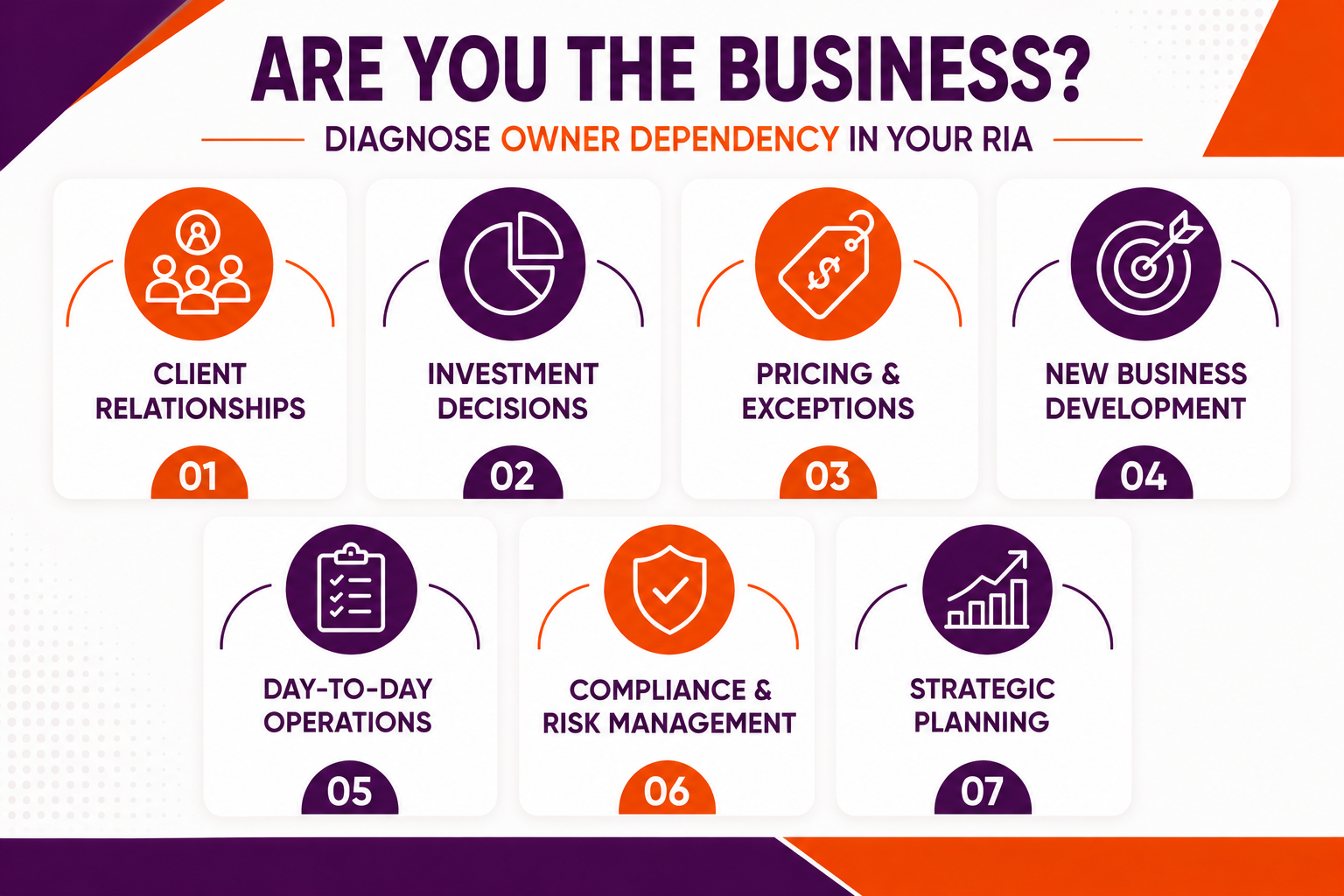
How to Diagnose Owner Dependency in Your RIA

  • Client relationships: Do your top 20 clients primarily interact with you, not other team members? Would they hesitate to stay if you weren't involved post-closing?
  • Investment decisions: Are you the only person who makes portfolio allocation, rebalancing, and manager selection decisions? Is there a documented investment framework others can follow?
  • Pricing and exceptions: Do all fee negotiations, service exceptions, and custom arrangements require your approval? Can your team make decisions without you?
  • New business development: Are you the sole rainmaker? If you stopped prospecting, would new client acquisition drop to zero?
  • Day-to-day operations: Do routine tasks—scheduling, client service follow-ups, billing issues—regularly require your input because processes aren't documented or delegated?
  • Compliance and risk management: Are you personally responsible for all regulatory filings, audits, and risk oversight, with no backup or documented procedures?
  • Strategic planning: Do long-term growth initiatives, hiring decisions, and technology investments depend entirely on your vision and execution?

At the end of this diagnostic process, many founders realize they need structured support to shift from doing everything themselves to leading a team that can operate independently. Executive Coaching from Advisor Legacy helps RIA owners move from managing every detail to strategic leaders of a scalable firm, building the leadership habits and delegation frameworks that reduce owner dependency and increase business value.

Read Next: Exit Readiness Checklist for Advisory Firms: What to Fix Before You Sell

Core Levers to Reduce Owner Dependency and Increase Business Value

Reducing owner dependency requires systematizing your business so it can grow, serve clients, and make decisions without constant founder involvement. Buyers pay premium multiples for RIAs that have documented processes, strong leadership teams, distributed client relationships, and clear succession plans because these firms are transferable, scalable, and resilient.

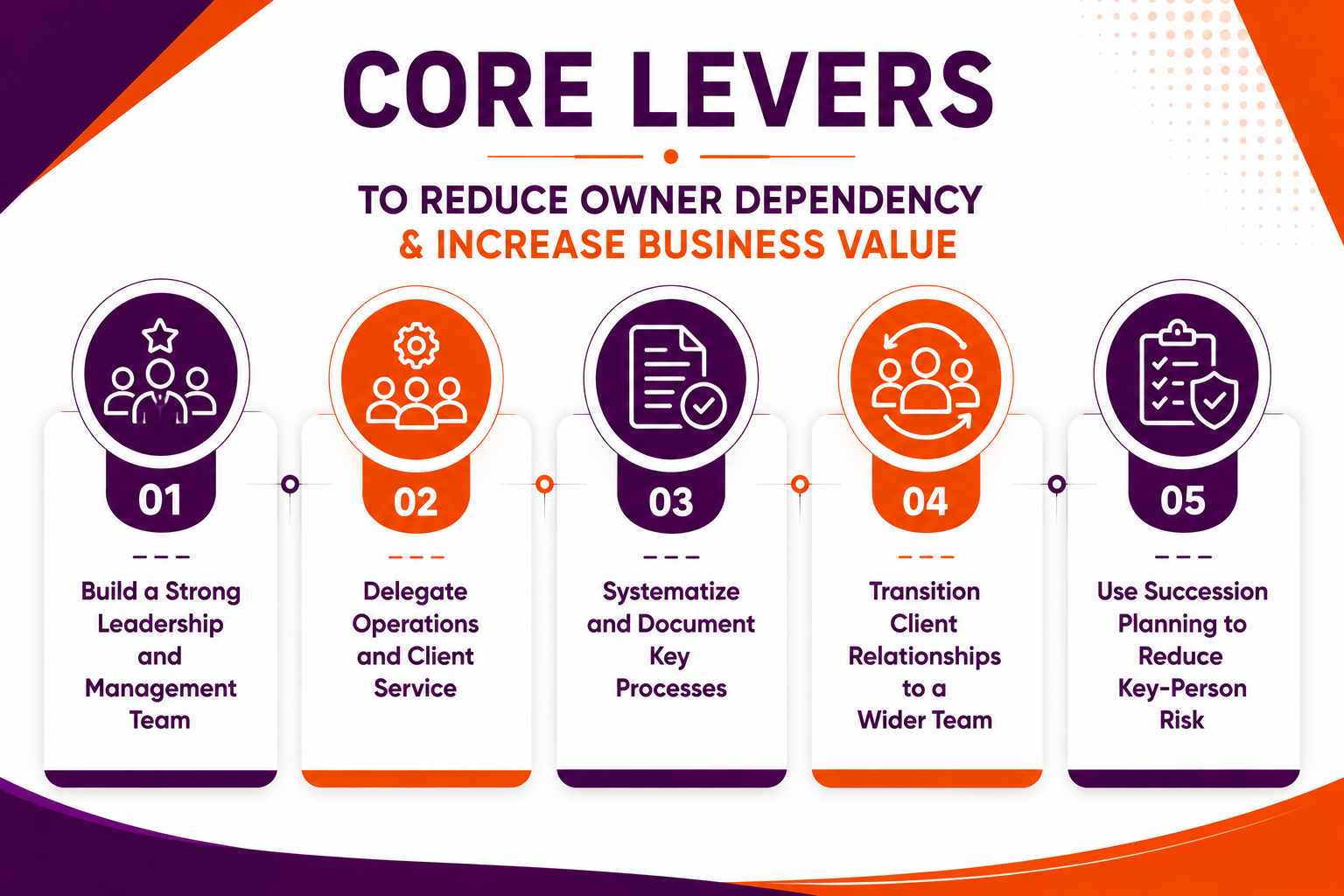
Core Levers to Reduce Owner Dependency

Build a Leadership and Management Team That Can Operate Without You

The single most important step in reducing owner dependency is developing a leadership team that can run day-to-day operations, manage client relationships, and execute strategic initiatives without you. Buyers want to see key employees who can make decisions, solve problems, and lead teams, not support staff who wait for the founder's approval on every issue. This means promoting or recruiting a general manager, lead advisor, or operations director who can step into your role during the transition and post-closing period.

Building this team takes time. You need to delegate real authority. That means letting your leadership team make investment decisions within a documented framework, handle client escalations, manage hiring and performance reviews, and own specific business outcomes.

When buyers see a credible management team during diligence, they're far more confident that the business will continue to perform after you exit. That confidence translates directly into higher valuations, more cash upfront, and shorter earn-out periods.

Read Next:

Delegate Day-to-Day Operations and Client Service to Your Team

Owner-dependent RIAs often have founders who are still deeply involved in routine client service, administrative tasks, and operational problem-solving. This pattern limits scalability and signals to buyers that the business can't function without the owner's constant attention. To reduce this dependence, you need to delegate day-to-day operations systematically, moving responsibility for client service delivery, scheduling, reporting, and follow-up to team members who can execute without your involvement.

Start by identifying which tasks only you can do (strategic planning, major client decisions, succession planning) and which tasks can be handled by others with clear guidelines. Then create role-based responsibilities so your team knows who owns what. Effective delegation includes:

  • Client service calendars: Standardized schedules for reviews, check-ins, and planning updates that team members can execute without founder oversight.

  • Routine follow-ups: Delegating post-meeting action items, document requests, and client communications to support staff using documented templates and workflows.

  • Operational problem-solving: Empowering your operations team to resolve billing issues, technology problems, and service exceptions within defined parameters.

  • Reporting and compliance tasks: Assigning responsibility for performance reporting, regulatory filings, and audit preparation to specific team members with documented procedures.

When you successfully delegate these functions, you free yourself to focus on strategic initiatives that grow the business—and you prove to buyers that the firm can operate without you. That proof is what makes your practice sellable at a premium.

Systematize and Document Your Key Processes Before You Sell

Buyers conducting diligence want to see well-documented business processes that prove the firm can operate consistently without the founder's institutional knowledge. If your onboarding, investment implementation, compliance reviews, and client service workflows exist only in your head or in scattered emails and informal habits, prospective buyers will see transition risk and discount your valuation accordingly.

Systematizing your business means creating standard operating procedures (SOPs) that any competent advisor or operations professional can follow, ensuring continuity and reducing reliance on the owner.

RIA Process Area Owner-Dependent Approach Systematized, Documented Approach
Client Onboarding The founder personally handles each new client setup; the process varies by client and isn't written down. Documented onboarding checklist with role assignments, timelines, and templates; any team member can execute.
Investment Implementation The founder makes all portfolio decisions ad hoc; no written investment policy or rebalancing guidelines. Written investment policy statement (IPS), model portfolios, and rebalancing triggers; the team can implement without the founder.
Compliance Reviews The founder personally completes all regulatory filings and audits; no backup or documented procedures. Compliance calendar, documented procedures, and assigned responsibilities; the team can execute reviews independently.
Client Review Meetings The founder runs all meetings; no standard agenda, prep process, or follow-up workflow. Standard meeting agendas, prep checklists, and post-meeting action item workflows; team members can lead reviews.

Read Next: Thinking of Selling Your Business? Document Your Operations First

Transition Key Client Relationships From Founder to a Wider Team

One of the most worrisome red flags for buyers is when all key client relationships are concentrated with the founder. If your top clients only know you, trust you, and communicate with you, the new owner inherits significant retention risk. Buyers discount valuations heavily when they believe clients will leave post-closing because the relationship was personal, not institutional. To mitigate this risk and increase market value, you need to deliberately transition customer relationships from yourself to a wider team over time.

This transition means gradually introducing other advisors and team members into the relationship so clients develop trust and familiarity with the broader team. Effective strategies include joint client meetings where you and a successor advisor co-lead reviews, structured communication that positions the team (not just you) as the client's advisory resource, and documented relationship management plans that ensure continuity if you step back. The goal is to make the client relationship feel institutional and resilient, not dependent on one person.

Use Succession Planning and Continuity to Reduce Key-Person Risk

Proactive succession planning and continuity agreements signal to buyers that your RIA is built for long-term growth, not dependent on one person's continued involvement. When you have a documented succession plan, whether it's an internal successor, a buy-sell agreement with a partner, or a continuity arrangement with another advisor, you demonstrate resilience and reduce the buyer's perception of key-person risk. This planning shows that the business has a framework to ensure continuity even if something unexpected happens to the founder, which directly increases buyer confidence and business value.

In succession planning, you create a clear path for leadership transition, client relationship handoffs, and ownership transfer. Buyers want to see that you've thought through who will take over, how clients will be informed, and what legal and financial agreements are in place to protect all stakeholders. Continuity agreements, such as buy-sell arrangements or guardian plans, provide additional assurance that the practice won't collapse if the founder exits suddenly. These agreements are especially valuable in M&A diligence because they prove the business is designed to operate long-term, independent of the owner.

PracticeProtect Plus from Advisor Legacy combines a market-based business valuation with a professionally drafted continuity or buy-sell agreement, giving buyers clear evidence that your RIA has a plan to ensure continuity and reduce reliance on one person. This combination strengthens your exit readiness and increases market value.

Read Next: RIA Succession Plan Checklist: A Guide to Continuity, Valuation & Transition

How Reduced Owner Dependency Expands Your Exit Options and Deal Terms

When your RIA is less dependent on you, you unlock more exit strategy options, attract a wider range of buyers, and gain greater flexibility in deal structure and post-closing involvement. The increase in competition drives up business value and gives you more control over timing, structure, and your role after the sale.

More Buyers Are Willing to Engage When the Business Is Independent of the Owner

Reducing owner dependency fundamentally changes who will consider buying your practice. When your business relies on one person, your buyer pool shrinks to those willing to bet on their ability to retain clients and rebuild relationships post-closing. But when your RIA has a strong leadership team, documented processes, and distributed client relationships, you attract a much broader range of prospective buyers—each with different priorities and deal structures.

  • Strategic buyers: These buyers want scalable platforms they can integrate into larger organizations. They're looking for firms with leadership teams that can manage teams, documented workflows that support growth, and client bases that won't churn when the founder exits.
  • Next-gen advisors: Junior partners or rising advisors within your firm (or from outside) are far more willing to buy when they can step into a well-documented system with established client relationships and operational support, rather than trying to replace an irreplaceable rainmaker.
  • Financial buyers and private equity: These buyers focus on predictable, transferable cash flow. They pay premium multiples for businesses that can operate without the founder because they're buying future earnings, not dependence on one person.
  • Regional aggregators: Firms building multi-location advisory platforms want practices that can be integrated smoothly without relying on the original owner to stay involved long-term.

Read Next: Buyer Types for Advisory Firm Sale: How to Find the Right Fit

Better Deal Flexibility When You're Not the Only One Holding Everything Together

Owner-dependent RIAs often get pushed into deal structures that protect the buyer at the seller's expense. Because the buyer is worried about client retention, revenue stability, and operational continuity, they structure deals with long earn-outs (often 3–5 years), aggressive performance hurdles, and seller financing that ties your payout to post-closing results.

These structures shift risk to you and limit your ability to walk away cleanly after the sale. In contrast, when your business can operate without you, buyers are willing to offer more cash upfront, shorter transition periods, and greater flexibility in your post-closing role.

Reduced dependence on the owner gives you negotiating leverage. You can choose whether you want a full exit or a sell-and-stay arrangement where you remain involved on your terms. You can negotiate shorter earn-out periods because the buyer isn't worried about losing clients when you step back.

You can even structure deals where you exit immediately after closing because the leadership team and documented processes give the new owner confidence that they can succeed without you. This flexibility is only possible when the business isn't dependent on one person.

Read Next: Earn-Out Agreements for Financial Advisors: How to Structure Deals and Allocate Risk

3–5 Year Timeline to Start Reducing Owner Dependency Before Exit

Reducing owner dependency isn't a quick fix. It's a multi-year process that requires deliberate planning, investment in your team, and systematic changes to how your business operates. Most founder-led RIAs need 3–5 years to meaningfully reduce reliance on the owner, document key processes, develop successors, and transition client relationships in ways that increase business value and buyer confidence.

Starting this process early gives you time to make mistakes, adjust your approach, and enter the sale process from a position of strength rather than scrambling to fix dependency issues during diligence.

Years 1–2: Diagnose Dependency and Install Systems

The first phase focuses on understanding where your business is too dependent on you and building the foundational systems that allow others to operate without constant founder involvement. This is the diagnostic and infrastructure-building stage.

  • Conduct a market-based valuation: Understand your current business value and identify how owner dependency is affecting your valuation. Use this baseline to track progress over time.

  • Document core business processes: Create standard operating procedures for client onboarding, investment implementation, compliance reviews, and service delivery. Start with the highest-impact workflows.

  • Begin delegating day-to-day responsibilities: Identify routine tasks you can hand off to team members and create clear role assignments so they can execute without your approval.

  • Start transition planning for top client relationships: Introduce key team members to your top clients through co-meetings, joint calls, and structured communication that positions the team as the client's resource.

This phase is about creating the framework that makes your business less reliant on you. It's not glamorous, but it's essential for long-term exit readiness.

Read Next: Exit Readiness Checklist for Advisory Firms: What to Fix Before You Sell

Years 2–3: Develop Successors and Shift Client Relationships

The second phase focuses on building leadership capacity and transitioning client relationships so the business can operate without you. This is where you invest in training, coaching, and deliberate succession planning.

  • Invest in advisor and support team coaching: Develop your next-gen advisors and key employees so they can own client relationships, make decisions, and manage teams without constant oversight.

  • Gradually move from rainmaker to strategic leader: Shift your focus from doing everything yourself to leading a team that can execute growth initiatives, serve clients, and solve problems independently.

  • Formalize succession plans and continuity agreements: Document who will take over if you exit, create buy-sell or continuity agreements, and ensure all stakeholders understand the plan.

By the end of this phase, your business should feel less dependent on you for daily operations and client service. Buyers will see a leadership team that can operate independently, which directly increases market value.

Years 3–5: Optimize for Market Value and Prepare to Sell

The final phase focuses on fine-tuning your business for maximum market value and preparing to engage buyers. This is when you optimize financials, ensure your business can operate without you for sustained periods, and structure the sale process to attract the best buyers.

Fine-tune your financials and overhead to improve profitability and attractiveness. Buyers pay attention to EBITDA margins, revenue concentration, and expense efficiency. Clean up unnecessary costs, document your financial performance, and ensure your books are audit-ready. Test your business's ability to operate without you by stepping back for extended periods—take vacations, delegate major decisions, and see if the team can maintain performance without your involvement. If they can, you've successfully reduced owner dependency.

Engage an M&A advisor or business broker who specializes in financial advisory practices to structure the business sale. These professionals help you identify potential buyers, prepare a strong Confidential Information Memorandum (CIM) that highlights your firm's strengths, and negotiate deal terms that protect your interests. A well-prepared CIM that showcases your leadership team, documented processes, and distributed client relationships will attract more buyers and command higher valuations.

Building a Sellable RIA Takes Time—But the Payoff Is Real

Reducing owner dependency is crucial to attract quality buyers who would be willing to pay a premium for your business. The benefits of reducing owner dependency extend beyond the sale itself—you'll build a stronger business, reduce your own stress, and create long-term value for your clients, team, and stakeholders. However, it isn't a last-minute fix you can implement during the sale process. It's a multi-year commitment to systematizing your business, developing your leadership team, and transitioning client relationships so your RIA can operate, grow, and thrive without you.

  • Owner dependency directly lowers valuation: Buyers discount practices that rely on one person because they see transition risk, not transferable cash flow.

  • Systematizing your business takes 3–5 years: Documenting processes, developing successors, and transitioning client relationships require deliberate planning and consistent execution.

  • Reduced dependence expands exit options: When your RIA can operate without you, you attract more buyers, negotiate better terms, and gain flexibility in your post-closing role.

The earlier you start planning, the more options you'll have when it's time to exit.

Advisor Legacy works with financial advisors and RIAs on selling a financial advisory practice, providing end-to-end support from valuation and preparation through buyer selection, deal structuring, and transition planning. Request a practice transition consultation to start planning a sellable, less owner-dependent RIA on your terms.

FAQs

How does owner dependency affect the valuation of a financial advisory practice?

Owner dependency lowers valuation because buyers see more transition risk when client relationships, decisions, and operations rely heavily on the founder. Practices with documented processes, leadership depth, and shared client relationships are usually more transferable and command stronger deal terms.

What are the most common signs that my RIA is too dependent on me as the founder?

Common signs include personally managing top client relationships, approving most decisions, driving all new business, handling undocumented processes, and serving as the backup for compliance or operations. If the firm struggles without you for a month, it is likely too owner-dependent.

How long does it typically take to reduce owner dependency enough to improve sale value?

Most founder-led RIAs need 3–5 years to reduce owner dependency in a meaningful way. This gives time to document processes, delegate authority, develop successors, transition client relationships, and prove the firm can operate without daily founder involvement.

Can I sell my advisory business if most client relationships are still tied to me personally?

Yes, but buyers may offer a lower valuation, require a longer earn-out, or ask you to stay involved after the sale. Transitioning key relationships to team members before going to market can improve buyer confidence and deal flexibility.

How do buyers evaluate the strength of a leadership team and management structure in an RIA?

Buyers look for leaders who can manage clients, make decisions, and run operations without constant founder input. They review roles, org charts, decision-making processes, and whether the team has a proven ability to execute independently.

What processes should I document first to make my advisory practice more sellable?

Start with workflows that affect client experience and continuity, such as onboarding, investment implementation, compliance reviews, and client meeting preparation. These show buyers that service delivery does not depend solely on the founder’s knowledge.

How does succession planning fit into reducing owner dependency before selling a business?

Succession planning reduces key-person risk by showing how leadership, client relationships, and ownership can transition smoothly. A clear plan gives buyers more confidence that the firm can continue performing after the founder exits.

When should I talk to an M&A advisor or business broker about selling a founder-dependent RIA?

Ideally, speak with an M&A advisor 3–5 years before selling. Early guidance can help identify owner-dependency issues, improve valuation drivers, and prepare the business before entering the market.

About the Author: Nicholas Tucker

Nicholas “Nick” Tucker is Visionary & Co-Owner of Advisor Legacy with more than two decades in the financial services industry. Nick partners with advisors during successions and acquisitions to architect client communication plans, align service models, and build the operational systems that sustain growth after a deal closes. His writing focuses on practical playbooks for client handoffs, stakeholder messaging, onboarding workflows, and KPI tracking that protects revenue and experience through change. He brings a systems-first approach so advisors can execute transitions with confidence and keep teams, clients, and partners aligned.

Subscribe

Receive timely articles, tip sheets, events, and more right in your inbox.

How Reducing Owner Dependency Increases RIA Sale Value

How Reducing Owner Dependency Increases RIA Sale Value

Reducing owner dependency increases RIA sale value because buyers pay for transferable entities and scalable cash flows that don't collapse when the...

Read More
How to Prepare Your Advisory Firm for Buyer Due Diligence

How to Prepare Your Advisory Firm for Buyer Due Diligence

Preparing your advisory firm for buyer due diligence requires assembling clean financial statements, organizing operational records, documenting...

Read More
9 Mistakes Advisors Make When Selling Their Practice: How to Avoid Them

9 Mistakes Advisors Make When Selling Their Practice: How to Avoid Them

Most financial advisors who sell their practice make at least one costly mistake, and many make several. The most damaging include waiting too long...

Read More