



15 min read

8 Factors That Lower the Value of a Financial Advisory Practice

Written by Updated September 1, 2026
Picture of Alan Salomon, CPA/ABV, CVA
Alan Salomon, CPA/ABV, CVA

Alan Salomon, CPA/ABV, CVA, is a valuation and tax specialist with more than a decade of firm ownership and hands-on experience serving closely held businesses. He provides accredited valuations for buy/sell agreements, estate and gift matters, divorces, shareholder/member disputes, and fair value reporting, as well as personal, business, and fiduciary income tax preparation and planning. Alan’s articles explain how valuation approaches apply to advisory practices, how to document defensible con...

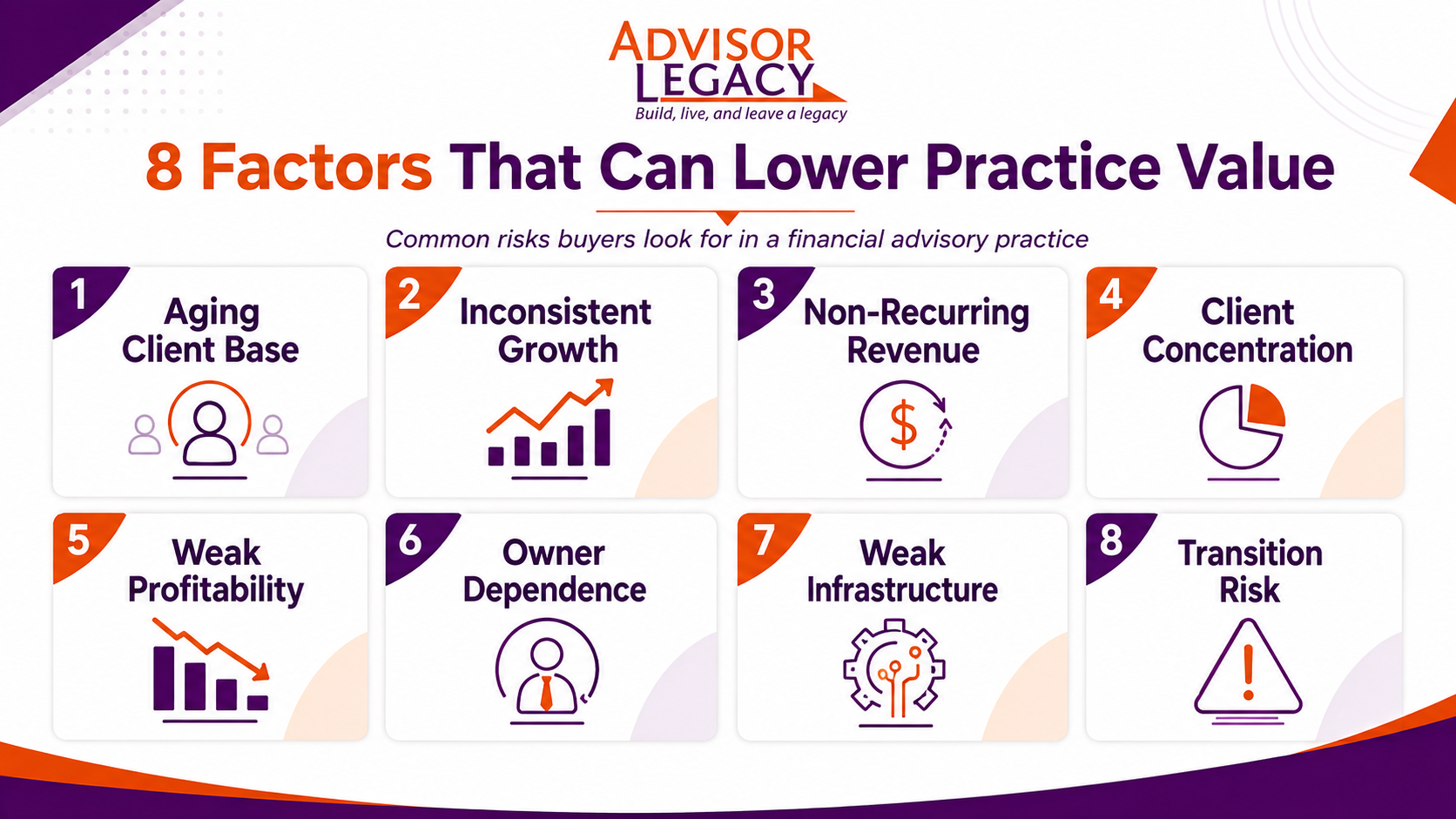
A financial advisory practice can lose value when buyers see risk in its future cash flow, profitability, client retention, or ability to transition smoothly to new ownership. Common concerns include an aging client base, inconsistent growth, low recurring revenue, concentrated client relationships, weak profitability, heavy dependence on the founding advisor, and inefficient operations. These issues can make future earnings less predictable and can directly affect how a buyer views the practice during valuation and due diligence.

The stakes are significant. Advisor Growth Strategies reported that the median RIA valuation reached 11.6 times EBITDA in 2025, based on 60 transactions. For advisors considering a future sale or succession, understanding what may be reducing practice value gives them time to address weaknesses before entering the market. Improvements in growth, profitability, client mix, team structure, and operational readiness can strengthen a practice before the valuation and sale process begins.

💡 This Guide Covers

  • The financial, client, and operational factors that can lower the value of a financial advisory practice

  • How buyers evaluate profitability, recurring revenue, client demographics, and transferability

  • Why owner dependence, client concentration, and weak infrastructure can create valuation risk

  • How succession planning and transition readiness can influence buyer confidence

  • Practical steps advisors can take to strengthen their practice before a valuation or sale


What Determines the Value of a Financial Advisory Practice?

A practice valuation looks beyond revenue and AUM to assess the quality, durability, and transferability of the business. Buyers want to understand how reliably the practice can generate cash flow after ownership changes, how likely clients are to remain, and whether the business can continue operating effectively without the seller.

Two advisory practices with similar revenue can produce very different valuation results because buyers also evaluate recurring revenue, profitability, client age, segmentation, staffing, and operating efficiency.

Revenue and Revenue Quality

Revenue is an important starting point, but buyers also look closely at where that revenue comes from and how predictable it is.

A financial advisory practice with a high percentage of recurring revenue generally gives a buyer greater visibility into future cash flow than a practice that depends heavily on transactional business. Buyers may also review historical growth, revenue concentration, and whether recent results appear sustainable. Common questions during valuation and due diligence include:

  • How much revenue is recurring?

  • Has revenue been growing, flat, or declining?

  • Is a large share of revenue tied to a small number of clients?

  • How much revenue depends directly on the selling advisor?

  • Can the existing revenue stream reasonably transfer to a buyer?

These questions help buyers assess the quality of the revenue they are acquiring rather than relying on gross revenue alone.

Profitability and Cash Flow

A larger practice does not automatically mean a more valuable practice. Operating expenses, staffing levels, service costs, and overall efficiency determine how much revenue ultimately becomes operating profit.

Cash flow also matters because an acquisition must support the buyer’s operating expenses and, in many cases, acquisition debt. A practice with strong top-line revenue but excessive expenses may be less attractive than a smaller, more efficient business with healthier margins.

Profitability, expense structure, and operating efficiency are important valuation considerations when comparing practices of similar size.

Client Base Quality

The composition of the client base can materially affect the value of a financial advisory practice. Buyers may evaluate:

Client Factor Why It Matters
Average Client Age Older clients may be closer to asset withdrawals, wealth transfers, or other events that affect future revenue.
Client Concentration Heavy dependence on a small number of households can increase revenue risk.
Average Client Assets and Revenue Higher-value relationships can support stronger economics and greater practice efficiency.
Client Segmentation A well-segmented book can make the service model easier to understand and operate.
Multigenerational Relationships Relationships with spouses, children, and heirs may reduce the risk of assets leaving the practice over time.

Client age, segmentation, recurring revenue, and overall client quality can all influence both current value and future revenue expectations.

Practice Operations and Transferability

Buyers also need to determine whether the financial advisory business can continue operating effectively after the seller begins stepping away.

A practice that depends on one advisor for most client relationships, business development, decision-making, and day-to-day operations can create greater transition risk. In contrast, documented processes, defined employee roles, established systems, and broader client relationships can make the business easier to transfer.

Transferability becomes especially important during a succession or sale because the buyer is acquiring future cash flow that depends on clients and staff remaining through the transition.

Before preparing a practice for sale, advisors should understand how revenue quality, profitability, client composition, and transferability work together. A weakness in one area does not automatically determine the practice’s value, but several weaknesses combined can increase perceived risk and influence how a buyer approaches valuation, due diligence, and deal structure.

Read More: Understanding Valuation Multiples for a Financial Advisor Practice

8 Factors That Can Lower the Value of a Financial Advisory Practice

Practice value tends to weaken when buyers see uncertainty around future revenue, profitability, client retention, or transferability. Those concerns rarely appear in isolation. An aging client base may be manageable if the practice is still growing. High operating costs may be easier to overlook if margins remain strong. Problems become more serious when several risks begin reinforcing one another.

1. An Aging Client Base

Client age matters because it affects the durability of future revenue. As clients progress through retirement, they may begin drawing down assets, gifting wealth, or transferring assets to heirs. If those heirs have little or no relationship with the advisory team, some of that AUM may eventually leave the practice. Consider two practices with the same revenue and AUM:

Practice A: The advisor has long-standing relationships with clients, spouses, & adult children.
Practice B: Most relationships are concentrated with the primary account holder.

A buyer may view Practice A as more transferable because continuity already exists across generations.

Why this is hard to fix quickly: Relationships with the next generation take time to develop. Introducing heirs shortly before a sale does not create the same level of trust as years of ongoing engagement.

2. Declining or Inconsistent Growth

A practice can appear stable on paper even when its underlying growth engine has started to slow. This often happens when an advisor reduces prospecting and business development activity ahead of retirement. Revenue may remain healthy because of market appreciation, while the business itself is adding fewer households, generating fewer referrals, or winning fewer new clients.

What the Seller May See What the Buyer May See
Stable Revenue Limited Organic Growth
A Mature Client Base Greater Future Attrition Risk
Less Need to Prospect Weak Business Development Activity
Strong AUM Gains Growth Dependent on Market Performance

The source of growth matters. Consistent new client activity, a repeatable referral process, and identifiable growth opportunities can give a buyer greater confidence that the practice still has momentum.

3. Too Much Non-Recurring Revenue

For this factor, the central question is straightforward:

How much of today's revenue can a buyer reasonably expect to receive again next year?

Recurring advisory revenue generally provides greater visibility into future cash flow because it is tied to ongoing client relationships. Transactional revenue can still be valuable, but a buyer may need to examine it more closely. That review often focuses on four areas:

  1. Historical consistency

  2. Source of the revenue

  3. Dependence on the selling advisor

  4. Likelihood that the revenue continues under new ownership

The more assumptions a buyer must make about future revenue, the more uncertainty enters the valuation.

Read More: Recurring Revenue Valuation: The Key Metric for Advisory Firm Value

4. Heavy Client Concentration

Client concentration can make an otherwise attractive book of business significantly riskier. Example: A practice generates $1 million in annual revenue, but five households account for 25% of it. If one or two of those relationships leave during the transition, the economics of the acquisition can change quickly.

This is different from having a defined client niche. A wealth management firm may specialize in physicians, business owners, or retirees while still maintaining a diversified client base within that market. A useful concentration test is:

Would losing one or two clients materially affect profitability, staffing needs, or the buyer's ability to service acquisition debt?

If the answer is yes, a buyer is likely to scrutinize those relationships closely.

5. Weak Profitability and High Operating Expenses

Top-line revenue can hide an inefficient business. Two financial advisory practices may each generate $1.5 million in revenue yet produce very different cash flow because of staffing costs, compensation structures, technology expenses, office overhead, and service commitments.

Where profitability can break down

Area Potential Concern
Staffing More employees than the revenue base requires
Compensation Payroll costs that limit operating profit
Technology Multiple systems with overlapping functions
Service Model High-cost service commitments for lower-value clients
Office and Overhead Fixed costs that are difficult to reduce
Profitability Revenue growth without corresponding earnings growth

This becomes especially important when acquisition financing is involved. The practice needs sufficient cash flow to support operations, debt service, and the buyer's required return. Revenue multiples may help frame a conversation, but buyers still need to understand what the practice earns after accounting for expenses.

Read More: How Expenses Can Impact the Sale of Your Financial Advisory Practice

6. Too Much Dependence on the Founding Advisor

Owner dependence is best understood through a stress test:

What would stop working if the founding advisor were unavailable for the next 90 days?

Potential warning signs include:

  • High-value clients only work with the founder

  • Nearly all new business originates with the founder

  • Staff need the owner to make routine decisions

  • Important processes exist only in the owner's head

  • Clients identify primarily with the individual advisor rather than the firm

If client retention, business development, decision-making, or day-to-day operations would suffer, the practice may have a transferability problem. Reducing that dependence usually takes time. Other advisors need meaningful client relationships, staff members need clear authority, and next-gen leaders need opportunities to make decisions before ownership begins to change.

Read Next: How Reducing Owner Dependency Increases RIA Business Value

7. Weak Operational Infrastructure

Operational weaknesses are often easy for the existing team to tolerate because everyone already knows the workarounds. A buyer sees them differently.

A buyer's operational review may uncover:

  1. Data: Incomplete CRM records, inconsistent household information, or poor documentation.

  2. Processes: Workflows that vary depending on who completes them.

  3. People: Unclear responsibilities, overlapping roles, or excessive reliance on one employee.

  4. Technology: Disconnected systems, overlapping software, or a technology stack that requires replacement.

  5. Financials: Inconsistent reporting or difficulty separating personal, owner, and operating expenses.

The buyer's practical concern is simple:

How difficult will this business be to take over and run?

Weak infrastructure can add integration cost, consume management time, and require additional investment after closing. Those issues can influence both valuation and deal terms.

8. Succession and Transition Risk

The final factor is different because the risk is tied to the handoff itself. A financially strong practice can still become a more uncertain acquisition if clients have never met the successor, staff does not understand what happens after closing, or the seller expects to leave before relationships have transferred.

Internal Succession vs. External Sale

Internal Succession External Sale
Successor may already know clients and staff The buyer may need to build relationships quickly
Ownership can transfer in phases Ownership may transfer in a single transaction
The founder may remain involved for several years Seller transition may be shorter
Leadership development becomes critical Client communication and integration becomes critical

Regardless of the structure, a credible transition plan should answer practical questions:

  • Who manages each client relationship during the transition?

  • How will clients be introduced to the successor?

  • What role will the seller retain, and for how long?

  • What changes will staff experience?

  • How quickly will responsibilities move to the new owner?

When a buyer and seller have already identified each other, Advisor Legacy’s Deal Support can help formalize agreed deal terms and support the documentation needed to move the transaction toward closing.

Early planning gives both buyers and sellers more flexibility by creating time to introduce future leaders, prepare staff, strengthen client relationships across the team, and establish a transition period that reflects how the practice actually operates.

Taken together, these eight factors show why the value of a financial advisory practice cannot be reduced to revenue, AUM, or a single multiple. Buyers are evaluating the durability of the client base, the economics of the business, its dependence on the seller, and how reliably future earnings can continue under new ownership.

Know What’s Driving the Value of Your Practice


Other Risks That Can Affect Practice Value

The eight factors above tend to have the greatest influence on how buyers assess a financial advisory practice, but additional issues can surface during due diligence and affect buyer confidence. These risks may not change the underlying economics of the business on their own, yet they can complicate a transaction, slow the sale process, or cause a buyer to reconsider deal terms.

Compliance and Documentation Issues

A buyer needs confidence that the practice they are acquiring has been managed carefully and that important records are complete.

Incomplete documentation, unresolved compliance matters, inconsistent client files, or unclear agreements can create additional questions during due diligence. Even when an issue is manageable, a buyer may need more time to understand its scope and determine whether it could create financial or operational exposure after closing.

From a seller's perspective, the best time to uncover documentation gaps is before the practice goes to market. A pre-sale review may include:

  • Client agreements and account documentation

  • Employment and contractor agreements

  • Entity and ownership documents

  • Vendor and technology contracts

  • Financial records

  • Written operating procedures

  • Records related to prior compliance matters

The goal is to make the business easier to evaluate. Buyers are generally more comfortable when information is organized, current, and readily available rather than assembled reactively once due diligence begins.

Client Attrition Risk

A buyer may agree with the practice valuation and still worry about how much revenue will remain after clients learn about the ownership change. That concern is especially relevant when most client relationships are concentrated with the seller.

Consider a long-tenured advisor who has served the same families for decades but rarely introduced other team members into client meetings. The book may look attractive financially, yet the buyer has little evidence that those relationships will transfer successfully. Client attrition risk can increase when:

  1. The transition is rushed. Clients receive little time to understand the change or build confidence in the new advisor.

  2. The buyer's service model is materially different. Changes in communication, investment philosophy, technology, fees, or meeting frequency may create friction.

  3. The seller disengages too quickly. Clients who expected continuity may feel the relationship changed overnight.

  4. Key relationships are concentrated with the founder. The buyer has to establish trust while simultaneously taking responsibility for the accounts.

A longer transition period may help in some situations, but time alone does not solve the problem. The transition needs deliberate introductions, clear communication, and enough interaction for clients to become comfortable with the successor.

Poor Financial or Business Records

Messy financial records create a different problem: they make it harder for a buyer to determine what the business actually earns.

A buyer evaluating a financial advisor practice may need to separate recurring operating expenses from discretionary owner spending, one-time costs, compensation, and other items that affect reported profitability. If the financials are inconsistent or difficult to reconcile, the buyer may have less confidence in the earnings assumptions supporting the valuation.

A useful question for sellers is:

Could an outside buyer understand the economics of this practice without relying on the owner's explanation?

If not, the records may need work before the business is ready for sale. Strong financial preparation gives the buyer a clear view of revenue, expenses, staffing costs, owner compensation, and historical trends. That visibility makes it easier to evaluate cash flow and compare the practice with other acquisition opportunities.

These risks often become most visible once due diligence starts. Addressing them earlier can reduce avoidable questions and help the buyer focus on the underlying quality of the business rather than gaps in documentation, records, or transition readiness.

Read Next: Pre-Transaction Readiness Checklist for Due Diligence

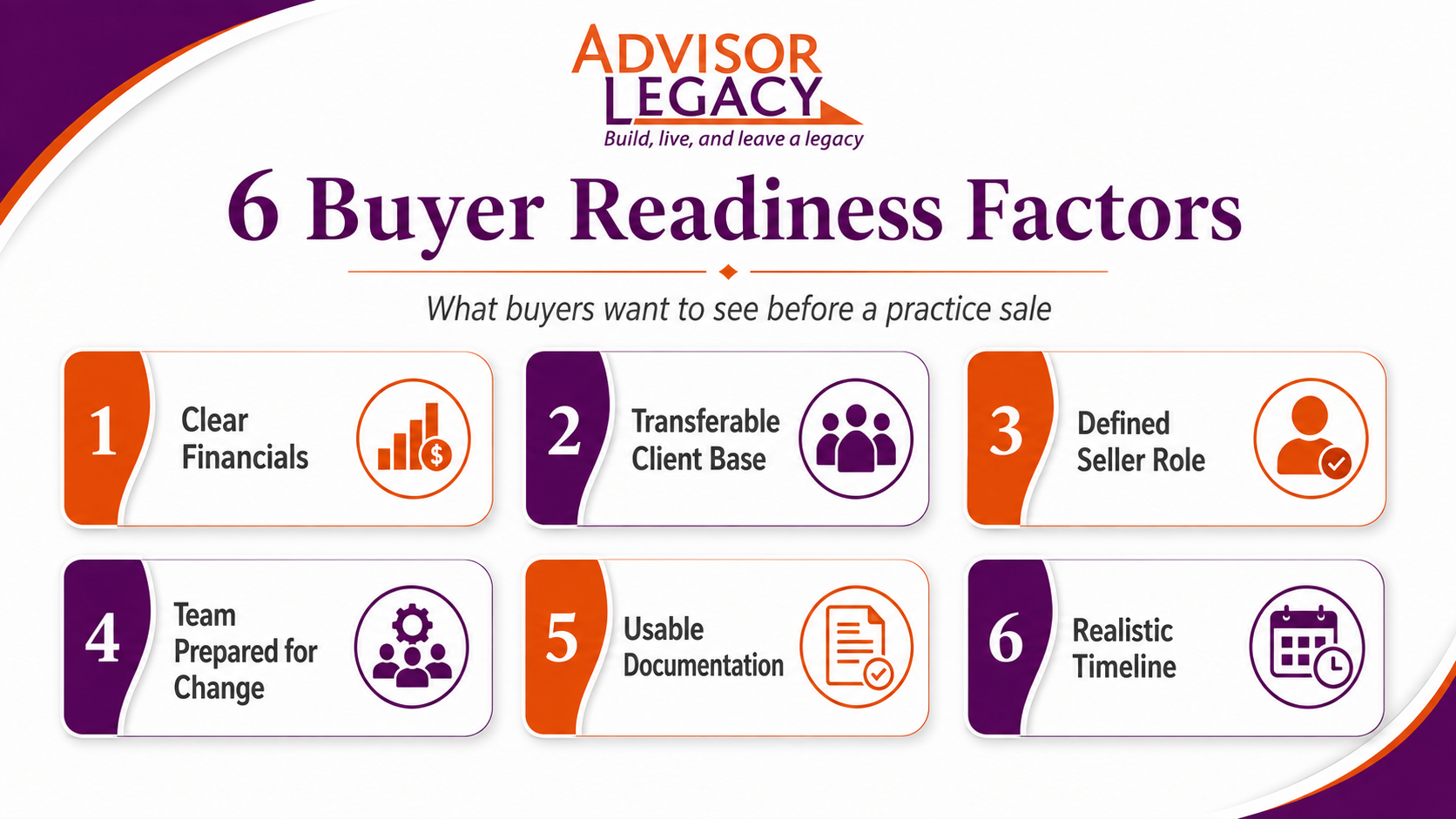
Buyer Readiness Factors That Can Strengthen a Practice Before Sale

Once the major valuation risks are understood, the next question is whether the practice is actually ready for a buyer to evaluate. Buyer readiness comes down to reducing avoidable uncertainty before due diligence begins.

A buyer wants to see a business that is understandable, transferable, and supported by reliable information. The stronger those fundamentals are, the easier it becomes to assess the opportunity and move through the sale process without unnecessary delays or surprises.

Clear and Consistent Financials

Buyers need to understand how the practice makes money, what it costs to operate, and how much cash flow the business produces.

The financials should make it easy to identify recurring and non-recurring revenue, operating expenses, staffing costs, owner compensation, and any unusual or one-time expenses. Historical trends should also be clear enough for a buyer to understand how the business has performed over time.

The goal is not to make the numbers look perfect. It is to make the economics of the practice easy to follow. If a buyer has to spend significant time reconciling records or determining which expenses truly belong to the business, confidence can weaken before the transaction reaches the later stages of due diligence.

A Client Base That Can Transfer

A strong client base only supports value if those relationships have a reasonable chance of staying after the sale. Transferability is easier to demonstrate when key clients already know other advisors or staff members, service expectations are documented, and relationships extend beyond the founding advisor.

Stronger Transferability Greater Transition Risk
Multiple team members know key clients Relationships sit almost entirely with the founder
Client preferences and service history are documented Important knowledge remains informal
Client segmentation is clear Service levels vary without a defined structure
Spouses and heirs are engaged Relationships exist primarily with one account holder

For a founder-led practice, this is often one of the hardest readiness issues to address quickly. Client trust has to be shared over time. It cannot be transferred by paperwork at closing.

A Defined Role for the Seller After Closing

One of the most practical sources of friction in a sale is a mismatch between what the buyer expects from the seller and what the seller expects life to look like after closing.

A buyer may assume the seller will remain highly involved in client meetings for a year. The seller may expect to reduce hours immediately. Both expectations can be reasonable, but they need to be reconciled before the deal is finalized. The transition plan should clearly address:

  • How long the seller expects to remain involved

  • Which clients or responsibilities the seller will continue to support

  • How quickly decision-making will move to the buyer

  • What happens if certain relationships require a longer handoff than expected

Clear expectations here can reduce conflict and help preserve continuity for both clients and staff.

A Team That Is Prepared for Change

Staff can materially influence whether a practice transitions smoothly.

Uncertainty around reporting relationships, compensation, responsibilities, location, technology, or client assignments can create unnecessary turnover at exactly the wrong time. A stable team also supports transferability because employees often carry client history, operational knowledge, and day-to-day relationships that help the business function beyond the founder.

Buyer readiness therefore includes having a thoughtful communication plan for the team. This does not mean announcing a possible transaction before the timing is appropriate. It means the buyer and seller should know how they will communicate the change once the deal is ready to move forward.

Operational Documentation a Buyer Can Actually Use

A practice may run smoothly because the current team knows how everything works. An incoming buyer does not have that institutional knowledge. Useful documentation should make it possible to understand how the practice handles client service, billing, recurring meetings, technology, staff responsibilities, and other core workflows.

A simple test is to imagine the buyer operating the practice for one week without the seller present. Could the buyer determine where client information lives, who owns critical tasks, how service requests are handled, which systems matter, and how revenue is billed? If not, the practice may still depend too heavily on undocumented knowledge.

A Realistic Transition Timeline

There is no universal transition period that works for every financial advisory practice. A firm with deep team relationships and a well-established next-gen advisor may require a different handoff than a founder-centric practice where clients have worked with one person for decades. The timeline should reflect how dependent the business remains on the seller.

A credible transition period gives enough time for client introductions, staff communication, leadership transfer, technology changes, and other operational adjustments without creating unnecessary uncertainty. The strongest timeline is the one that matches the actual needs of the practice rather than an arbitrary closing date.

How to Think About Buyer Readiness

A practice does not need to be flawless before it goes to market. It does need to be clear enough for an outside buyer to understand. A useful readiness test is whether the buyer can answer three questions with confidence:

  1. What am I buying? The financials, client base, revenue streams, and operating structure are clear.

  2. Can this business transfer? Clients, staff, systems, and responsibilities are not excessively dependent on the seller.

  3. What happens after closing? The transition timeline, seller role, and handoff process are realistic and defined.

If those answers require extensive explanation from the owner, there is likely more preparation to do before the practice is ready for sale. Advisor Legacy’s Practice Sales Service helps advisors prepare their practice for market, evaluate potential buyers, structure the transaction, and manage the transition through closing.

Read Next: Financial Advisor Practice for Sale: How to Maximize Value

Addressing Value Risks Before You Sell

Most factors that weaken practice value are easier to address before a buyer enters the picture. Improving profitability, strengthening client relationships, reducing owner dependence, and documenting operations can all take time, so readiness work should begin well before a planned sale or succession.

A valuation can help establish where the practice stands today and identify which issues deserve attention first. An advisor who is several years from an exit may have time to improve growth, client mix, or next-gen leadership, while someone closer to a transaction may need to focus on financial cleanup, operational documentation, and transition planning.

The goal is to enter the sale process with fewer unresolved risks and a clearer picture of how the business will transfer to new ownership. That preparation can make valuation, due diligence, and the eventual transition more straightforward for both buyer and seller.

Protecting Practice Value Starts Before the Sale

The value of a financial advisory practice is shaped long before a buyer begins due diligence. Client demographics, organic growth, profitability, revenue quality, owner dependence, and transition readiness all affect how confidently a buyer can evaluate the future of the business.

Key Takeaways:

  • Revenue and AUM alone do not determine practice value.

  • Aging clients, weak growth, and client concentration can increase future revenue risk.

  • High expenses and owner dependence can reduce profitability and transferability.

  • Operational and transition weaknesses often become more visible during due diligence.

Most of these issues are easier to address before the practice enters the market. Knowing where the business stands gives an advisor more time to strengthen the areas that may have the greatest impact on a future sale or succession.

A professional practice valuation provides that starting point. Advisor Legacy’s Financial Advisor Business Valuation helps advisors understand what their practice may be worth today, identify the factors influencing that value, and determine where improvements may be possible before a sale.

Prepare Your Practice for the Sale You Want


Frequently Asked Questions

How is an RIA valuation different from using a revenue multiple?

A revenue multiple can provide a useful point of comparison, but an RIA valuation typically looks deeper into the economics and risk of the business. A buyer may evaluate profitability, cash flow, client demographics, recurring revenue, AUM, growth trends, owner dependence, and operating expenses to understand what the business is worth.

For larger independent advisory firms, metrics such as EBITDA, net operating income, and enterprise value may also become relevant. The appropriate valuation approach depends on the size, structure, and financial characteristics of the advisory firm.

When should a financial advisor get a practice valuation before deciding to sell?

Ideally, a practice valuation should happen well before an advisor plans to sell. Getting a valuation several years ahead of a planned exit can provide time to address issues that may impact the value of a practice, such as weak organic growth, client concentration, high expenses, or owner dependence.

For advisors closer to a transaction, the valuation can help inform the decision to sell, establish realistic expectations, and provide a foundation for due diligence and deal discussions.

What do buyers review during due diligence for a financial advisory practice?

Due diligence generally focuses on whether the financial and operational information supporting the valuation is accurate and whether the business can transfer successfully.

Depending on the practice, a buyer may examine detailed financial records, client and AUM data, revenue sources, employment agreements, compliance documentation, the investment process, technology, staffing, and the firm's financial planning or wealth management service model. The buyer will also want to understand any issues that could affect client retention after the transaction.

Can deal structure affect the value of a financial advisor practice?

Yes. Deal structure affects how risk is divided between buyers and sellers and can influence the economics of an M&A transaction.

A full sale, internal succession, merger, or transaction with an aggregator may carry different payment terms, transition requirements, financing arrangements, and retention provisions. A higher headline purchase price may also come with greater contingencies or a longer transition period, so sellers should evaluate the complete structure rather than price alone.

How does a succession plan affect the value of your financial advisory practice?

A well-developed succession plan can reduce uncertainty around leadership, client relationships, and the transfer of the business. This is especially relevant when a financial advisor is preparing for retirement or when an RIA expects ownership to pass to a next-gen advisor.

A credible transition plan helps a buyer understand who will manage client relationships, how responsibilities will change, and how continuity will be maintained. For independent advisory firms, addressing these questions early can make the eventual sale or internal succession easier to evaluate and execute.

8 Factors That Lower the Value of a Financial Advisory Practice

8 Factors That Lower the Value of a Financial Advisory Practice

A financial advisory practice can lose value when buyers see risk in its future cash flow, profitability, client retention, or ability to transition...

Read More
The Reality of Life After Selling Your Financial Advisory Firm

The Reality of Life After Selling Your Financial Advisory Firm

Selling your financial advisory firm is only part of the transition. While advisors often spend years preparing for valuation, due diligence, and...

Read More
Advisory Succession Planning: Preparing Your Firm for What's Next

Advisory Succession Planning: Preparing Your Firm for What's Next

Many financial advisors view internal succession as the ideal way to transition their business. It preserves client relationships, protects the...

Read More