



10 min read

How RIA Owners Can Plan a Successful Internal Succession

Written by Updated September 3, 2026
Picture of Todd Doherty
Todd Doherty

Todd Doherty serves as Vice President for Advisor Legacy, where he leads advisors through the full M&A lifecycle—readiness, valuation analysis, buyer/seller matching, due diligence, and post-close integration. With more than 15 years in senior roles at financial advisory firms and hands-on ownership experience, Todd brings an operator’s lens to every engagement. His writing focuses on practical ways to boost enterprise value, structure win-win deals, and avoid execution risk. Todd collaborat...

Internal succession planning for an RIA means preparing an existing partner, associate advisor, or NextGen professional to assume ownership and leadership over time. A workable succession plan should address successor readiness, practice valuation, equity transfer, financing, governance, client relationships, and the founder’s future role before ownership begins to change.

Equity ownership is already playing a meaningful role in how RIAs develop future leaders. Charles Schwab’s 2025 RIA Compensation Report found that one in three staff members at participating firms were equity owners, while nearly half of the equity owners at Top Performing Firms were under age 50. For RIA owners considering an internal transition, that reinforces the need to give potential successors enough time to develop leadership capability, build financial readiness, and take on greater responsibility before control of the firm shifts.

💡 This Guide Covers:

  • How to determine whether an internal succession is the right path for your RIA

  • What to evaluate when preparing a partner, associate advisor, or NextGen successor for ownership

  • How valuation, phased equity, and financing shape the internal ownership transition

  • How to prepare clients, employees, and future leaders as responsibilities begin to shift

  • What to consider around governance, founder involvement, and contingency planning during a multi-year succession

What Has to Be True for an Internal Succession to Work

An internal succession works when the successor, the economics, and the business are all ready for the transition. A strong relationship between the founder and the internal candidate helps, but the plan still has to support ownership transfer, leadership continuity, client retention, and the financial goals of both generations.

For RIA owners, this means testing the succession strategy before equity begins to change hands. A successor may be highly capable with clients but unprepared to manage employees or make ownership-level decisions. The firm may also have a willing internal buyer but a valuation or financing structure that makes the transaction difficult to sustain.

The Successor Has to Be Ready for More Than Client Service

A potential successor needs to demonstrate the ability to operate as an owner, including managing employees, understanding the firm’s financial performance, contributing to growth, making strategic decisions, and accepting the financial responsibilities that come with equity ownership.

For an internal candidate, that readiness may develop over several years. Giving the successor progressively greater responsibility before equity changes hands allows the founder to see how they perform when decisions affect the broader advisory firm.

The Economics Have to Work for Both Generations

An internal transition also needs a purchase structure that the successor can realistically afford and that supports the founder’s financial objectives.

Practice valuation establishes the starting point. From there, both parties need to determine how much equity will transfer, when it will transfer, how the purchase will be financed, and how the transaction will affect firm cash flow.

Financial Question What Needs to be Resolved
What is the RIA worth? A current valuation and an agreed basis for pricing equity
How much equity will transfer? Initial ownership percentage and future purchase stages
How will the successor pay? Personal capital, outside lending, seller financing, or a combination
What does the founder need financially? Liquidity, income expectations, and timing
Can the firm support the structure? Cash flow available after debt service and ongoing operating needs

If the economics are stretched too far, the successor may enter ownership under excessive financial pressure while the founder remains dependent on future payments the business may struggle to support.

The Firm Has to Be Transferable

Internal succession becomes more difficult when too much of the RIA still depends on the founder. Client relationships, decision-making authority, business development, and institutional knowledge should begin shifting before the founder materially reduces their role.

  1. Client and Relationship Transfer: Major clients should already know and trust the successor. If the founder remains the primary relationship for many of the firm’s largest households, the client transition may need to begin earlier.

  2. Leadership and Operations: Employees should understand who will make decisions as responsibilities change. Important processes, responsibilities, and institutional knowledge should also be documented so the firm can operate without constant founder involvement.

  3. Growth and Founder Dependency: The firm should be able to retain clients, develop new business, and make strategic decisions without relying primarily on the founder’s reputation or personal network. A successor who already participates in growth and strategic planning is better positioned to assume ownership responsibility.

A more transferable firm gives the internal successor a stronger platform to assume ownership and reduces the risk that the succession process stalls as the founder steps back.

Read Next: How Reducing Owner Dependency Increases RIA Sale Value

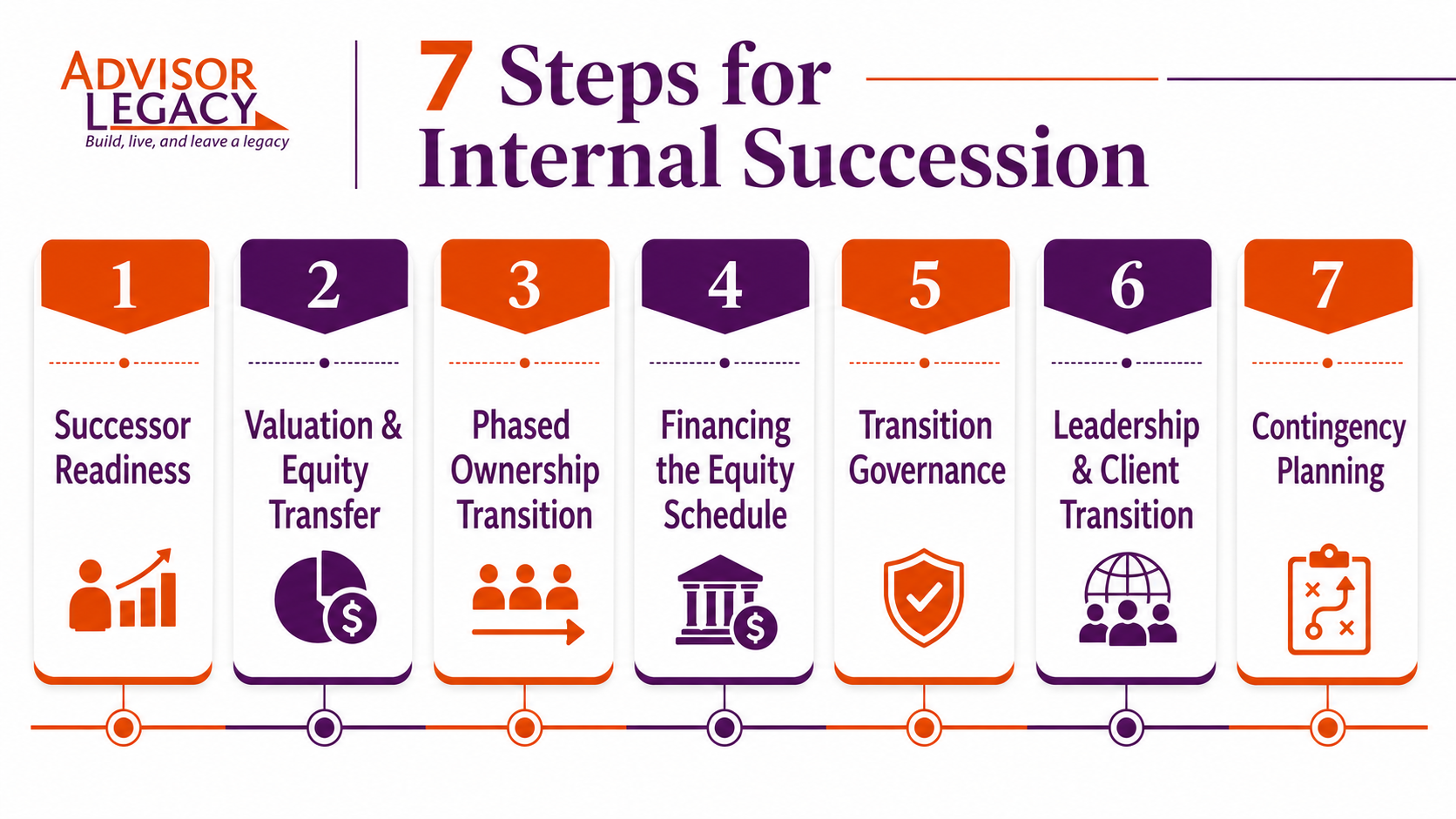
1. Confirm the Successor is Ready for the Ownership Path

Before discussing purchase terms or equity percentages, the founder should confirm that the internal candidate understands the commitment ownership requires and still wants to pursue it. That includes investing capital, accepting greater business risk, and committing to the firm’s long-term ownership path.

The successor does not need to be fully prepared for every responsibility on day one. They should show the ability to continue developing into the role, and both generations should share a realistic view of what the transition will involve. A useful ownership-readiness discussion should address:

  • Whether the successor intends to remain with the RIA for the long term

  • Whether they are willing and able to invest capital in the business

  • Whether they are prepared to assume greater leadership and management responsibility

  • Whether the founder and successor agree on the firm’s future direction, culture, and client experience

  • Whether there is a defined development plan for any remaining readiness gaps

RIA owners who need a structured development path for an internal candidate can use Advisor Legacy’s NextGen Coaching to help prepare emerging advisors for greater leadership and ownership responsibility before equity changes hands.

Once both parties are aligned on the ownership path, the internal succession planning process can move into the financial questions that determine whether the transition is workable: what the RIA is worth, how much equity will transfer, and how the purchase will be financed.

Read More: Finding a Successor For Your Financial Advisory Practice

2. Establish Value and Determine What Equity Will Transfer

Once the successor is committed to the ownership path, the next step is to establish the current value of the RIA and decide how much equity should transfer first. Those decisions affect the successor’s financing needs, the founder’s liquidity, and the pace at which ownership begins to shift.

A current valuation gives both generations a common reference point for discussing equity value. It can help set the price of the initial equity purchase and show whether the proposed ownership path is realistic for both parties. For an RIA, factors such as profitability, recurring revenue, client concentration, growth, and founder dependency can all influence business value.

RIA owners who need an objective starting point for equity pricing can use Advisor Legacy’s Financial Advisor Business Valuation to establish a current practice value before structuring the initial buy-in and future ownership purchases.

The initial ownership percentage should also match the successor’s readiness and financial capacity. Some internal successions begin with a minority stake while the founder retains control. Others move more quickly when the successor already has significant leadership responsibility and financing in place.

Decision What to Clarify
Current RIA Value What the firm is worth today and which factors are driving that value
Initial Equity Purchase How much ownership will transfer in the first transaction
Successor Affordability Whether the proposed purchase fits the successor’s financial capacity
Founder Liquidity How much liquidity the founder expects from the first stage
Future Equity Pricing How later ownership purchases will be valued and priced

For a multi-year transition, both parties should agree on how future equity purchases will be priced. That may mean obtaining updated valuations at defined intervals or using a consistent valuation methodology for later tranches. Establishing the process early can reduce friction as the value of the firm changes over time.

With the valuation and first equity transfer defined, the next step is to decide how ownership will move from the founder to the successor over the full transition period.

Read Next: Using Valuation to Structure a Fair Financial Advisor Partner Buy-In

3. Structure a Phased Internal Ownership Transition

A phased internal succession allows ownership to transfer over several stages instead of through one large transaction. For many RIAs, that can give the successor time to build equity, expand leadership responsibility, and secure financing while the founder gradually reduces ownership and day-to-day involvement.

Match Ownership With Responsibility

Each stage should reflect a meaningful change in the successor’s role. A smaller initial stake may come with greater participation in management decisions, while later purchases may coincide with broader client responsibility, voting authority, or control of the firm. A typical progression may include:

  1. Initial minority ownership: The successor acquires a smaller stake and takes on greater leadership responsibility.

  2. Expanded equity: Additional ownership transfers as responsibility for employees, clients, and business performance increases.

  3. Majority ownership or control: The successor assumes primary decision-making authority as the founder steps back.

  4. Final founder exit: Remaining equity transfers according to the agreed timeline and financing structure.

The exact percentages will vary by firm. What matters is that ownership, authority, and operating responsibility move in a deliberate sequence.

Define What Triggers the Next Stage

Future equity purchases should be tied to clear milestones rather than informal expectations. These may include financing approval, leadership progress, client relationship transfer, an updated valuation, or a specific transition date.

A written ownership schedule can help keep the internal transition from drifting. It should outline when future equity purchases are expected to occur, what conditions must be met, and how the plan will be reviewed if circumstances change.

That gives both the founder and successor a clearer path toward the next stage of ownership while setting up the financing decisions that follow.

Read More: Valuation Insights for NextGen Financial Advisors Building Equity

4. Build Financing Around the Equity Schedule

Once the ownership path is set, the financing plan should show how each purchase will be funded. Depending on the deal, that may involve personal capital, third-party lending, seller financing, or a combination of sources.

The financing structure should remain sustainable after each purchase. Acquisition debt should be considered alongside compensation, distributions, operating expenses, and the capital the RIA still needs for staff, technology, and growth.

Seller financing can help make an internal transition more feasible, but it also keeps the founder financially exposed to the future performance of the business. Both parties should understand how much of the purchase price depends on future payments and whether that exposure fits the founder’s liquidity needs.

A workable financing plan should support the full transition without constraining the firm’s ability to operate and grow.

Read More: What Every Advisor Should Know About Financing an Advisory Firm Acquisition

5. Define Governance During the Multi-Year Internal Transition

When the founder and successor remain owners at the same time, the RIA needs clear rules for how decisions will be made. Ownership percentages alone do not define who controls hiring, compensation, budgets, strategic planning, or major changes to the advisory firm. A written governance framework should clarify:

Governance Area What to Define
Voting Authority Which decisions require majority approval, unanimous consent, or another threshold
Management Responsibility Who oversees day-to-day practice management and specific business functions?
Founder Involvement Which responsibilities the founder will retain as ownership declines
Successor Authority Which decisions move to the successor as their equity position grows
Major Firm Decisions How acquisitions, additional owners, significant spending, or a future merger or sale will be approved

These expectations should also align with the RIA’s entity and partnership structure. Appropriate legal and tax professionals should review ownership agreements and governance documents before the structure is finalized.

RIA owners working through changes to ownership or partnership structure can also use Advisor Legacy’s Entity Support to help organize entity considerations as the internal succession structure is formalized.

Defined governance helps prevent economic ownership from changing while decision-making authority remains unresolved. Aligning ownership rights with decision authority gives the founder and next-generation owner a more workable path through the transition.

Make Sure the Ownership Structure Supports the Transition


6. Transition Leadership and Client Relationships Alongside Equity

As ownership shifts, leadership and client responsibility should move with it. An internal succession can become difficult when the successor owns more of the RIA, but clients and employees still look to the founder for most major decisions.

Shift Leadership Before the Founder Steps Back

The successor should gradually take on greater responsibility for practice management, team leadership, and strategic decisions during the succession planning process. That gives clients and staff time to adjust while the founder is still available to support the transition.

The timing should reflect the successor’s actual ownership role. As equity increases, the successor should have a clearer voice in the direction of the firm and greater accountability for business performance.

Transition Client Relationships Deliberately

Client relationships should also move in stages. For a registered investment advisor, that may mean introducing the successor in joint meetings, increasing their role in financial planning discussions, and eventually making them the primary relationship for more of the client base.

RIA leaders should pay particular attention to relationships that remain heavily tied to the founder. A successful succession is easier to sustain when clients already know who will lead the advisory firm before the founder reduces their involvement. Ownership, leadership responsibility, and client relationships should progress together throughout the internal transition.

Read Next: How to Host Joint Client Meetings During Team Transitions

7. Plan for the Internal Succession to Change or Fail

Even a well-structured internal succession can change over time. The successor may leave, financing may fall through, the founder’s timeline may shift, or the value of the RIA may change enough to affect the original ownership plan.

A written succession plan should address those possibilities before they become urgent. At minimum, the founder and successor should understand what happens if:

  • A scheduled equity purchase is delayed

  • The successor no longer wants to pursue ownership

  • Financing becomes unavailable

  • The founder needs to exit the business earlier than expected

  • A partner leaves after acquiring equity

  • The original succession strategy no longer fits the firm

The contingency plan should also coordinate with the RIA’s business continuity arrangements. If the founder becomes unexpectedly unavailable during a multi-year internal transition, the firm still needs clear leadership, client-service responsibilities, and decision authority.

If the internal transition ultimately becomes unworkable, the owner may need to consider another RIA, a merger or sale, or another external succession path. Identifying an alternative path early gives the firm another option if circumstances make the internal succession unworkable.

Effective succession planning leaves room for adjustment. A successful internal transition depends on having a clear ownership path while preserving enough flexibility to respond when the successor, financing, business, or founder’s goals change.

Read Next: Selling to Junior Partner vs External Buyer: Which Path Fits Your Succession Plan?

Internal Succession Works Best When Ownership and Readiness Advance Together

A successful internal succession requires coordination across equity transfer, leadership readiness, financing, governance, and client relationships. Those elements should remain aligned as ownership shifts and the founder gradually reduces their role.

Key Takeaways:

  • Confirm the successor is committed to the ownership path before structuring the transaction.

  • Use a current valuation to establish a credible basis for equity pricing and future ownership purchases.

  • Align phased ownership with financing, governance, leadership responsibility, and client transition.

  • Keep a contingency plan in place if the internal succession no longer works as expected.

Most internal succession issues are easier to address before meaningful equity has changed hands. Clarifying valuation, financing, governance, and the ownership schedule early gives the founder and successor more room to adjust the plan without disrupting clients, employees, or the business.

For RIA owners moving from planning into transaction execution, Advisor Legacy’s Deal Support can help coordinate the deal structure and implementation considerations involved as the ownership transition progresses.

Move Your Internal Succession From Plan to Transaction


Frequently Asked Questions

When should RIA owners start succession planning?

RIA owners should start succession planning well before they expect to reduce their role or exit the business. An internal transition often requires time to develop the right successor, establish the value of the business, arrange financing, transfer client relationships, and document how ownership will change.

Starting early also gives the founder more flexibility if the original succession strategy changes or the successor needs additional time before taking on greater responsibility.

What are the key steps in RIA succession planning?

The key steps in RIA succession planning include confirming successor readiness, obtaining a current valuation, defining the equity-transfer schedule, arranging financing, establishing governance, transitioning leadership and client relationships, and preparing a contingency plan.

For an internal succession, these decisions should be coordinated rather than handled separately. Changes in valuation, financing, or leadership responsibility can affect the broader transition.

How should an RIA choose the right successor?

The right successor should have the ability and willingness to assume both leadership and ownership responsibilities. That means looking beyond performance as a financial advisor and considering business judgment, financial capacity, commitment to the firm, relationships with clients, and alignment with the RIA’s culture and values.

For many firms, the strongest internal candidate is someone who has already taken on increasing responsibility and demonstrated that they can help lead the business without relying heavily on the founder.

How does AUM affect an internal RIA succession?

Assets under management can help describe the scale of an RIA, but AUM alone does not determine business value or the economics of an internal transition. Profitability, revenue quality, client concentration, growth, founder dependency, and the makeup of the book of business can also influence valuation.

A current valuation helps both generations understand what the RIA may be worth and how that value affects equity pricing, financing, and future ownership purchases.

What happens if an internal RIA succession does not work?

A written succession plan should include an alternative path if the internal transition becomes unworkable. That may be necessary if the successor leaves, financing becomes unavailable, the founder’s timeline changes, or the firm no longer supports the original ownership structure.

Depending on the circumstances, the owner may consider another internal candidate, another RIA, a merger or sale, or another external succession option. Having that contingency plan in place can help protect business continuity while the firm determines the next path forward.

How RIA Owners Can Plan a Successful Internal Succession

How RIA Owners Can Plan a Successful Internal Succession

Internal succession planning for an RIA means preparing an existing partner, associate advisor, or NextGen professional to assume ownership and...


Read More
Financial Advisor Succession Planning Checklist: What to Have in Place Before You Transition

Financial Advisor Succession Planning Checklist: What to Have in Place Before You Transition

A financial advisor succession planning checklist should cover the decisions that need to be resolved before ownership, leadership, and client...

Read More
How to Choose the Right Successor for Your Financial Advisory Practice

How to Choose the Right Successor for Your Financial Advisory Practice

Choosing a successor for a financial advisory practice requires evaluating whether the candidate can earn client trust, lead the team, make sound...

Read More