



Financial Advisor Succession Planning Checklist: What to Have in Place Before You Transition
A financial advisor succession planning checklist should cover the decisions that need to be resolved before ownership, leadership, and client...
Know what your business is worth
M&A Guidance and Deal Support
Coaching and Operations
Continuity, Legal, and Lending
12 min read
Todd Doherty serves as Vice President for Advisor Legacy, where he leads advisors through the full M&A lifecycle—readiness, valuation analysis, buyer/seller matching, due diligence, and post-close integration. With more than 15 years in senior roles at financial advisory firms and hands-on ownership experience, Todd brings an operator’s lens to every engagement. His writing focuses on practical ways to boost enterprise value, structure win-win deals, and avoid execution risk. Todd collaborat...
A financial advisor succession planning checklist should cover the decisions that need to be resolved before ownership, leadership, and client responsibilities begin to transfer. That includes the advisor’s goals, transition timeline, practice valuation, succession path, continuity plan, staff preparation, client communication, deal structure, financing, and implementation.
The scale of upcoming advisor retirements makes that preparation especially important. McKinsey reported in 2025 that an estimated 110,000 advisors, or 38% of the current advisor population, representing 42% of total industry assets, are expected to retire within the next decade. For practice owners, working through a checklist early can surface gaps in valuation, successor readiness, financing, client continuity, and implementation while there is still time to address them.
How to define your personal, financial, and business goals before building a succession plan
The 10 core steps to organize your transition, from timeline and valuation through implementation
How to evaluate succession options, including internal succession, an external buyer, or another transition path
What to address for business continuity, staff preparation, and client communication
How deal structure, financing, and documentation affect whether the succession plan can move forward
How to use the checklist to identify gaps, assign next steps, and keep the plan current as circumstances change
A financial advisor succession plan depends on more than identifying who will eventually take over the practice. The transition also needs a realistic timeline, a current valuation, a workable ownership structure, continuity planning, staff preparation, client communication, and a clear implementation process.
Reviewing those areas early helps the owner see what is already in place and which gaps could delay the transition.
Even when an advisor has a potential successor in mind, several other decisions still need to be resolved. The owner has to determine how leadership, ownership, client relationships, and financial responsibilities will change over time. That includes questions such as:
What role does the current owner want after the transition?
How will the practice be valued?
Can the successor finance the ownership transfer?
How will employees be prepared for leadership changes?
When should clients begin working more directly with the successor?
What happens if the planned succession path changes?
These questions help reveal whether the proposed transition is practical and whether the successor is prepared to support it.
Certain succession issues require more time to address. An internal successor may need more management experience, client exposure, or ownership-level responsibility before they are ready to lead the practice. Key client relationships may also need to shift gradually so the firm becomes less dependent on the founding advisor.
Financing and business readiness can take time as well. A successor may need to build liquidity or secure outside financing, while the practice may need operational improvements before a valuation or ownership transfer. Identifying those gaps early gives the owner more room to adjust the timeline or succession strategy.
A succession planning checklist helps bring unresolved decisions into one place. An advisor may have a likely successor but no formal transition timeline, or a continuity plan that no longer reflects current staff and client responsibilities.
The checklist should make it easy to distinguish what is complete, what is still in progress, and what depends on another decision. That creates a practical roadmap for the succession process and helps the owner focus attention on the issues most likely to affect timing, continuity, or the eventual ownership transition.
Read More: Advisory Succession Planning: Preparing Your Firm for What's Next
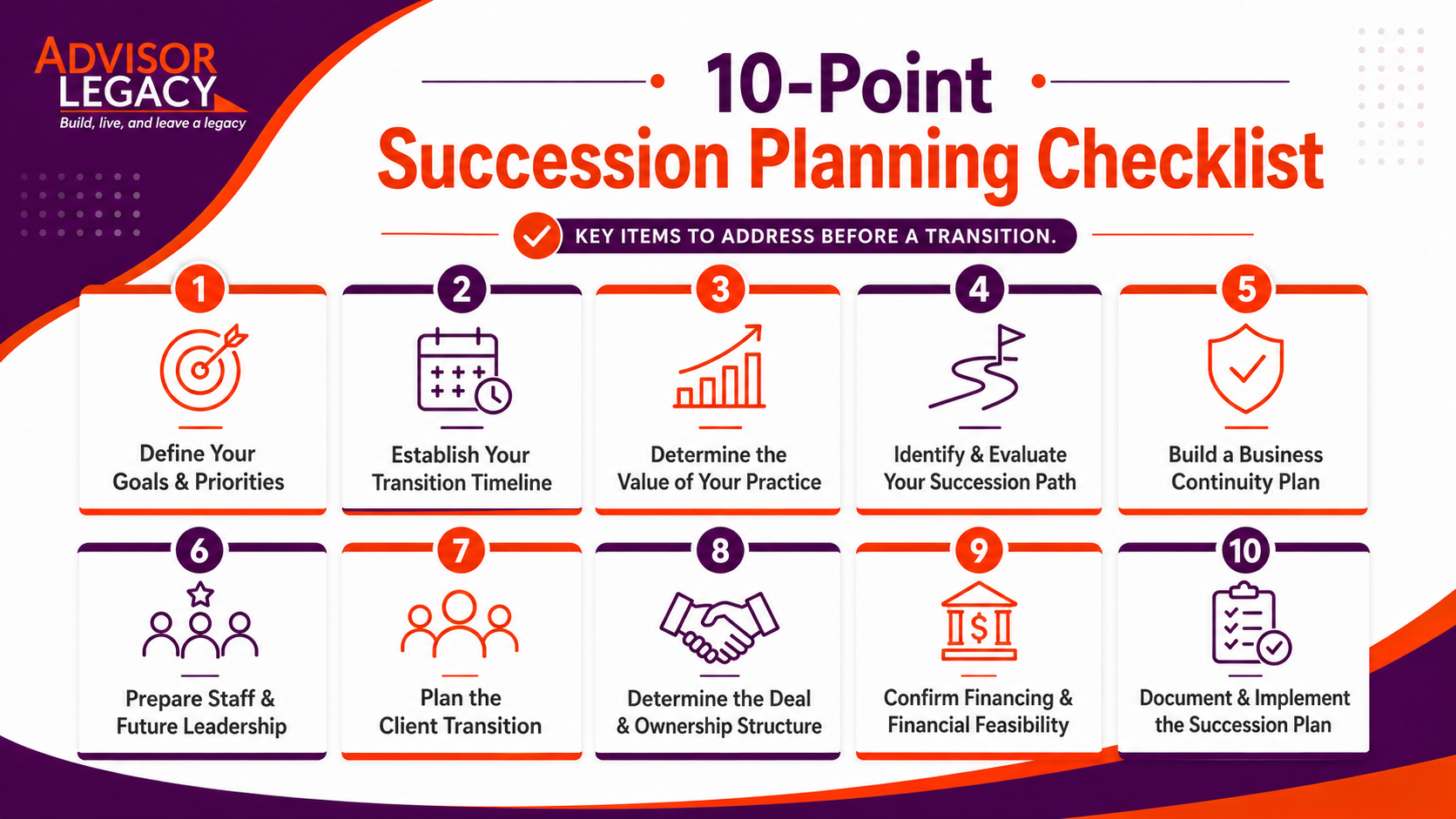
Succession planning for financial advisors works best when the major decisions are organized before a transition becomes urgent. This checklist provides a practical way for a business owner to review what is already in place, identify unresolved issues, and determine which items need attention before leadership, ownership, and client responsibilities begin to change.
The steps to succession planning are connected. Valuation affects deal structure. The succession strategy affects financing. Successor readiness influences the transition timeline. Client relationships and business continuity can determine how smoothly the advisory business operates while responsibilities shift. Reviewing these areas together gives financial advisory firms a more complete view of their readiness.
| Succession Planning Item | What Should Be in Place |
|---|---|
| 1. Personal and Business Goals | Transition timing, future role, financial needs, client and staff priorities |
| 2. Transition Timeline | Major milestones and responsibility-transfer dates |
| 3. Practice Valuation | Current value, value drivers, and material risks |
| 4. Succession Path | Internal successor, external buyer, merger, or another viable option |
| 5. Business Continuity | Interim leadership and essential operating responsibilities |
| 6. Staff and Leadership Preparation | Development needs, future roles, and reporting structure |
| 7. Client Transition | Successor introductions, joint meetings, and communication timing |
| 8. Deal Structure | Ownership transfer, purchase terms, and founder involvement |
| 9. Financing | Buyer or successor capacity, seller financing, cash flow, and liquidity |
| 10. Documentation and Implementation | Responsibilities, deadlines, professional coordination, and review dates |
Start by defining what you want the transition to accomplish. Consider when you expect to step away, whether you want to remain involved after ownership changes, and how the transaction fits into your broader financial plan and financial goals.
The future of the practice should also factor into the decision. Some owners place a high priority on preserving the firm’s culture, retaining employees, or developing the next generation of advisors. Others may prioritize liquidity, reducing management responsibilities, or completing an outright sale.
Personal financial needs and business succession goals should be considered together. If the expected value of the business will play an important role in retirement or estate planning, understanding those expectations early can help determine whether the proposed succession strategy is realistic.
A financial advisor succession plan needs more than a target retirement date. A useful transition timeline should identify when specific responsibilities are expected to move from the current owner to the successor or acquiring firm.
Include milestones for successor development, client introductions, business valuation, financing, documentation, ownership transfer, and the owner’s eventual reduction in day-to-day responsibilities. An internal succession may require a longer period for training and development, while an outright sale may involve a shorter ownership transition but still require significant client and staff preparation.
Build flexibility into the timeline. Succession planning often changes as the successor develops, the health of the business changes, or the owner’s financial needs evolve. Starting early provides more room to adjust without forcing decisions simply because a retirement date is approaching.
Read More: Plan Your Business Exit: The 3–5 Year Timeline That Protects Value
A current business valuation provides a financial foundation for creating a succession plan. It helps the owner understand what the business is worth today and establishes a more informed basis for discussing purchase price, financing, ownership percentages, and liquidity.
The valuation process can also reveal factors that may affect business value. For a financial advisor practice, those may include recurring revenue, profitability, client concentration, client demographics, growth trends, and dependence on the founding advisor.
Understanding these factors early gives the owner time to address issues that could influence the eventual transition. It also helps align the succession plan with the owner’s financial future instead of relying on an assumed value that may not reflect the current practice.
Advisors who need a current starting point can use Advisor Legacy’s Financial Advisor Business Valuation to assess the practice’s fair market value and the factors influencing that value before ownership or financing terms are structured.
Read Next: Pre-Transaction Valuation Readiness Checklist for Advisory Firms
There are multiple succession options, and the appropriate path depends on the owner’s goals, the available candidates, the financial feasibility of the transaction, and the needs of clients and employees.
| Succession Option | What to Evaluate |
|---|---|
| Internal Succession | Leadership readiness, client relationships, financial capacity, and willingness to assume ownership |
| External Buyer | Cultural fit, client continuity, transaction terms, and transition expectations |
| Merger or Strategic Combination | Operating fit, leadership roles, client experience, and economics of the combined firm |
| Alternative Path | Whether another structure better supports timing, liquidity, or continuity goals |
For an internal succession, identifying and developing the future owner may require years of leadership development, client exposure, and ownership preparation. An external transaction may provide a more direct path to liquidity, but it still requires careful evaluation of culture, client service, and how the acquiring firm will manage the book of business.
The preferred path should be practical enough to execute. A contingency plan is also useful in case the intended successor changes direction, financing falls through, or another firm becomes a better fit.
Read More: Finding a Successor For Your Financial Advisory Practice
Business succession addresses the planned transition of ownership and leadership. Business continuity addresses what happens if the owner becomes unavailable before the formal succession plan is completed.
A continuity plan should identify who can make key decisions, manage client relationships, oversee employees, and keep critical operations running. For a wealth management firm, that may also include documenting responsibilities that currently depend heavily on one founding advisor or a small number of financial professionals.
The plan should reflect the way the firm operates today. Review it when key employees leave, ownership changes, client responsibilities shift, or the practice adopts a new operating model. Keeping the continuity plan current helps protect clients and the business if the planned path forward is interrupted.
Advisors who need a more formal framework for unexpected owner absence can use Advisor Legacy’s Continuity Services to establish a plan for leadership, client service, and ongoing practice operations if the owner becomes unavailable before the planned succession is completed.
A future owner should have opportunities to demonstrate that they can run the business before ownership changes. Technical competence with clients is important. Leadership succession also requires experience with employees, financial management, operating decisions, and business strategy.
For an internal successor, a training and development plan can help identify the responsibilities that need to be transferred over time. That may include supervising staff, participating in financial reviews, managing service issues, contributing to growth decisions, or taking responsibility for a larger group of client relationships.
For firms developing an internal successor, Advisor Legacy’s NextGen Coaching provides a structured development path around leadership, business planning, client development, accountability, and readiness for greater responsibility.
Employees also need clarity about their future roles. Clear reporting relationships and decision authority can reduce uncertainty as the successor takes on more responsibility and the current owner becomes less involved.
Read Next: How Reducing Owner Dependency Increases RIA Sale Value
Client relationships are often one of the most sensitive parts of the succession planning process. Clients need time to understand who will serve them, how the relationship will change, and whether the service experience they value will continue.
Start by identifying the clients most dependent on the current owner. Those relationships may require earlier successor introductions, more joint meetings, or a longer period of shared responsibility. A practical client transition may follow this sequence:
Introduce the successor in shared client meetings.
Give the successor responsibility for follow-up and selected planning discussions.
Increase the successor’s role in ongoing client communication.
Communicate the formal transition after clients have had meaningful experience with the successor.
A gradual transition can give clients more time to become comfortable with the successor and give the firm time to address concerns before ownership changes.
Read Next: How to Host Joint Client Meetings During Team Transitions
The deal structure should align with the business valuation, the owner’s financial needs, the successor’s financial capacity, and the desired pace of the transition.
| Structure | Typical Consideration |
|---|---|
| Full Sale | Faster ownership transfer and potentially greater immediate liquidity |
| Phased Equity | Gradual transfer of ownership and responsibility |
| Seller Financing | May improve transaction feasibility but creates ongoing financial exposure for the seller |
| Combination Structure | Can blend outside financing, seller financing, and staged ownership |
An internal succession may use phased equity to align ownership with the successor’s increasing responsibilities. An outright sale may transfer control more quickly but still require a defined transition period for clients and employees.
The structure should be reviewed against cash flow, purchase terms, future owner involvement, and the financial security the seller expects from the transaction. The structure should show whether the deal can work in practice once purchase price, financing, cash flow, and transition terms are considered together.
A succession strategy can appear workable until financing is tested. The successor or buyer needs a realistic way to fund the transaction, and the seller needs confidence that the structure supports their financial goals.
Estimate the amount that must be financed and review the potential sources of capital. Depending on the transaction, that may include personal capital, outside lending, seller financing, phased ownership, or a combination of approaches.
Cash flow matters as well. A structure that places too much pressure on the advisory business may create problems after closing, particularly if the new owner also needs to invest in staff, technology, or growth. Addressing financing early gives both parties more time to adjust the structure before financial commitments make revisions difficult.
Read More: What Every Advisor Should Know About Financing an Advisory Firm Acquisition
Once the major decisions have been made, they should be converted into a formal succession plan with clear responsibilities, deadlines, and implementation milestones.
Document the agreed transition timeline, ownership structure, client and staff responsibilities, financing arrangements, and remaining decisions. Identify where appropriate legal, tax, valuation, financing, or transaction professionals need to be involved so each area receives the appropriate review.
Once the successor or buyer has been identified and the valuation, financing, and major transaction terms are established, Advisor Legacy’s Deal Support can help move the agreed structure into documentation and implementation as the ownership transition progresses toward closing.
Implementation should also include regular checkpoints. The successor’s readiness may change, the firm’s value may shift, or the owner’s financial goals may evolve. Reviewing the plan periodically helps ensure the succession plan remains relevant and effective as the transition of the business progresses.

You have now reviewed the 10 core areas that should be addressed before a succession plan moves into implementation. The downloadable checklist turns those planning areas into a working document for tracking progress and unresolved items.
Use it to identify what is complete, assign responsibility for outstanding tasks, set target dates, and revisit key decisions as your practice, successor, or transition timeline changes.
A succession plan should be reviewed whenever a material change could affect timing, valuation, successor readiness, financing, or client continuity. Even a well-developed plan can become outdated if the business, the intended successor, or the owner’s personal circumstances change.
For many financial advisory firms, an annual review provides a useful baseline. More significant changes should trigger an earlier review rather than waiting for the next scheduled planning cycle.

Growth, staffing changes, new partners, or shifts in the client base can all change how the succession plan should work.
For example, a practice that has grown substantially since its last business valuation may require a different financing structure or ownership plan. A key employee departure could also affect business continuity or increase dependence on the founding advisor. Review the plan when there are meaningful changes in:
Revenue, profitability, or business value
Ownership or partnership structure
Key employees or leadership responsibilities
Client concentration or demographics
Service model, technology, or operating structure
Growth strategy or acquisition activity
The goal is to make sure the succession strategy still reflects the current health and structure of the business.
Successor readiness should be reassessed throughout the succession planning process. A candidate who looked like the right fit several years ago may have different career goals, financial capacity, or leadership readiness by the time ownership begins to transfer.
An internal successor may need more training and development than originally expected. An external buyer may change the proposed deal structure or transition expectations. In some cases, the preferred candidate may decide not to pursue ownership at all.
When that happens, revisit the transition timeline, financing assumptions, client preparation, and contingency plan. Keeping alternative succession options available can prevent one change from forcing the entire process into an unrealistic timeline.
The owner’s circumstances can change just as much as the practice itself. Retirement timing, desired involvement, liquidity needs, family considerations, or broader financial goals may all affect the original plan.
A business owner who originally expected to remain involved for five years after a transaction may later prefer a shorter transition. Another may decide that maintaining income over time is more important than maximizing immediate liquidity.
Those changes should be reflected in the formal succession plan rather than handled separately. Reviewing the plan alongside your financial plan, estate planning considerations, and desired future role helps keep the transition aligned with your current business succession goals.
A financial advisor succession plan is easier to execute when key decisions are resolved well before ownership changes hands. Goals, valuation, successor readiness, business continuity, client communication, financing, and implementation all affect whether the transition can move forward on a realistic timeline.
Key Takeaways:
A succession planning checklist helps organize the decisions that need to be completed before a transition.
Practice valuation, financing, and deal structure should be considered together.
Internal succession often requires time for leadership development, client exposure, and ownership preparation.
Business continuity and client transition planning should remain current as the practice changes.
A formal succession plan should be reviewed regularly so it continues to reflect the owner’s goals and the condition of the business.
Most succession issues are easier to address while the owner still has time to adjust the plan. Reviewing the checklist early can reveal gaps in successor readiness, valuation expectations, financing, staff preparation, or client continuity before those issues begin to affect the transition.
The downloadable Financial Advisor Succession Planning Checklist provides a practical starting point for tracking those decisions, assigning responsibility, and identifying what still needs attention as the plan moves toward implementation.
Succession planning for financial advisors should begin well before the business owner expects to retire or transfer ownership. Starting early gives the advisor time to understand the value of the business, develop a successor, strengthen client relationships, address financing, and adjust the succession strategy if circumstances change.
Having a succession plan in place several years before a transition also gives the owner more flexibility to coordinate the business succession with personal financial goals, estate planning considerations, and the desired timing of retirement.
The core steps to succession planning include defining personal and business goals, establishing a transition timeline, obtaining a current business valuation, evaluating succession options, preparing staff and clients, determining the deal structure, confirming financing, and documenting the implementation plan.
An effective succession plan should also include business continuity provisions in case the planned transition cannot proceed as expected. Careful planning and execution help reduce the risk of unresolved issues surfacing after the ownership transition has begun.
A business valuation helps establish what the financial advisor practice may be worth and provides a foundation for discussing purchase price, financing, ownership percentages, and liquidity.
For an internal succession, valuation can help determine whether the next owner has a realistic path to acquiring equity. For an outright sale, it can help the seller evaluate offers and understand how prospective buyers may view the practice. Updating the valuation as the business changes helps keep the succession strategy grounded in current information.
The right path depends on the owner’s financial needs, available successors, client needs, desired future involvement, and the condition of the business.
Internal succession may offer greater continuity when a capable successor already has strong relationships with clients and employees, but it often requires more time for leadership development and financing. An outright sale to another advisor or firm may provide a faster ownership transition, but cultural fit, client communication, deal terms, and transition expectations still need careful evaluation.
Advisory firms should review the plan regularly and whenever a material change affects the practice, intended successor, valuation, financing, or owner’s financial plan. Leadership changes, client concentration, business value, retirement timing, or succession options can all make an existing plan outdated.
A well-executed succession plan should remain flexible enough to change with the business. Regular reviews help keep the plan relevant and improve the chances of a smooth transition when ownership eventually changes.
A financial advisor succession planning checklist should cover the decisions that need to be resolved before ownership, leadership, and client...
Choosing a successor for a financial advisory practice requires evaluating whether the candidate can earn client trust, lead the team, make sound...
A financial advisory practice can lose value when buyers see risk in its future cash flow, profitability, client retention, or ability to transition...