



13 min read

Why Financial Advisory Firms Hit a Growth Plateau and How to Find the Real Constraint

Written by Updated October 7, 2026
Picture of Todd Doherty
Todd Doherty

Todd Doherty serves as Vice President for Advisor Legacy, where he leads advisors through the full M&A lifecycle—readiness, valuation analysis, buyer/seller matching, due diligence, and post-close integration. With more than 15 years in senior roles at financial advisory firms and hands-on ownership experience, Todd brings an operator’s lens to every engagement. His writing focuses on practical ways to boost enterprise value, structure win-win deals, and avoid execution risk. Todd collaborat...

A financial advisor growth plateau usually means the firm has reached a constraint somewhere in its growth system. The issue may be pipeline, but it can also come from limited capacity, inefficient workflows, unclear roles, leadership bottlenecks, or weak execution. The first step is to identify where growth is actually breaking down before adding more marketing, staff, or technology.

Recent industry research supports that diagnosis. Cerulli Associates reported in its 2025 U.S. RIA Marketplace research that advisor time constraints are the largest challenge RIAs face when implementing new organic-growth strategies. That matters because a firm can have demand and still struggle to grow if its advisors are already at capacity or too much work depends on a small number of people.

For a firm whose revenue, clients, or AUM have flattened, the practical question is where the constraint sits. More leads will not solve a capacity problem, and another hire will not fix unclear responsibilities or weak execution. Sustainable growth starts with finding the bottleneck that is limiting the rest of the business.

💡 This Guide Covers

  • Why a financial advisor growth plateau can develop even when demand remains strong

  • How to separate pipeline problems from capacity, service-model, leadership, role-clarity, and execution constraints

  • The warning signs that reveal where growth is actually breaking down

  • A practical framework for identifying the firm’s binding constraint before adding more marketing, staff, or technology

  • Why hiring or increasing demand can make the wrong problem worse

  • How to determine whether the firm has enough operational and leadership capacity for its next phase of growth

What is a Financial Advisor Growth Plateau?

A financial advisor growth plateau is a sustained period in which revenue, AUM, new-client growth, or another important growth measure stops advancing despite continued effort. The firm may still have demand and referrals, but something inside the business is preventing those opportunities from translating into consistent growth.

A plateau can surface in several parts of the practice:

Where the Plateau Shows Up What It May Look Like What It Could Signal
Pipeline Fewer qualified prospects or referrals Weak business development or lead generation
Conversion Prospects enter the pipeline but do not become clients Follow-up, positioning, or advisor conversion issues
Capacity Advisors and staff cannot absorb more clients Workload, staffing, or workflow constraints
Client Service Onboarding slows, or service quality becomes inconsistent Service-model complexity or inefficient processes
Leadership Routine decisions continue flowing through the owner Weak delegation or insufficient leadership depth
Execution Strategic projects repeatedly stall Unclear ownership, competing priorities, or weak accountability

The important distinction is whether the slowdown is temporary or structural. Short-term changes in markets or new-business activity can affect results for a period. A structural plateau persists because one part of the firm's operating model has become a bottleneck.

Firm owners should also avoid relying on AUM alone. Market appreciation can increase assets without improving organic growth. New clients, net new assets, revenue, profitability, advisor capacity, and service performance provide a clearer view of whether the underlying business is still advancing.

The next step is to determine which constraint is limiting growth, because each one requires a different response.

Why Advisory Firms Hit a Growth Plateau

A growth plateau usually develops when one part of the firm stops keeping pace with the rest of the business. The visible symptom may be slower revenue, fewer new clients, or weaker AUM growth, but the underlying cause can sit in very different places. For most advisory firms, the constraint falls into one of six categories:

Six common constraints that can cause a financial advisory firm to hit a growth plateau

Pipeline Constraint

A pipeline constraint exists when the firm is not generating enough qualified opportunities to support its growth goals. Common signs include declining referral activity, inconsistent prospecting, weak follow-up, low conversion, or too much dependence on one advisor for business development.

If the pipeline is genuinely the problem, the firm may need to improve its referral strategy, positioning, prospecting discipline, or conversion process. Before increasing marketing spend, leadership should identify exactly where prospects are falling out of the process.

Capacity Constraint

A capacity constraint occurs when the firm can attract business but struggles to serve additional clients without creating strain. Warning signs may include:

  • Advisors carrying too much administrative work

  • Slow onboarding

  • Delayed client service

  • Strategic work repeatedly getting pushed aside

  • The owner stepping into routine issues

  • New clients creating more pressure than economic benefit

Capacity problems do not always require another hire. The firm may need to redesign workflows, reassign responsibilities, improve segmentation, or use technology more effectively before adding headcount.

Read More: Burnout Driving Advisors Out of the Industry

Service-Model Constraint

A service-model constraint develops when the way the firm serves clients becomes too complex to scale efficiently. That may include excessive customization, unclear service standards, too many exceptions, or services that do not align well with the economics of the relationship.

As those exceptions accumulate, the firm becomes harder to manage. Employees spend more time figuring out what should happen next, and advisors become more involved in work that should be handled through a consistent process.

Read More: Client Retention Strategies for Financial Advisors

Leadership Constraint

A leadership constraint often appears when the owner remains the default decision-maker as the firm grows. The team may be capable, but routine questions, approvals, and client issues still flow back to the founder. That slows decision-making and limits how much complexity the firm can absorb.

At this stage, growth depends partly on whether leadership responsibilities can expand beyond one person.

Read Next: How Reducing Owner Dependency Increases RIA Sale Value

Role-Clarity Constraint

Growth becomes harder when employees do not clearly understand what they own. Overlapping responsibilities, unclear authority, and poorly defined handoffs create delays and make accountability difficult. Senior advisors may also spend time on tasks that no longer require their level of expertise.

As the firm grows, roles often need to be redesigned rather than simply expanded.

Execution Constraint

Some firms understand the problem and still struggle to implement the solution. Strategic initiatives may remain unfinished because there are too many priorities, ownership is unclear, or day-to-day client work consistently takes precedence.

In these cases, the issue is not a lack of ideas. The firm needs clearer ownership, stronger accountability, and a more disciplined process for completing important work. These constraints can produce similar symptoms, which is why the firm needs a structured diagnostic process before deciding what to fix.

Not Sure What’s Holding Your Firm Back?


How to Identify the Firm’s Binding Constraint

Once a growth plateau is visible, the firm should avoid jumping straight to a solution. The better approach is to trace where performance starts to weaken, determine what is causing it, and confirm that diagnosis before committing more resources. The goal is to move from a broad concern such as “growth has stalled” to a specific problem that can be measured, addressed, and monitored.

Step 1: Identify Where Growth Is Breaking Down

Start with the full growth path:

Lead generation → Conversion → Onboarding → Client service → Capacity → Leadership → Execution

The objective is to find the first point where performance begins to deteriorate. If the firm has enough qualified prospects but struggles to convert them, the issue likely sits in the sales process or follow-up. If the firm continues winning new business but onboarding slows, service teams are overloaded, or advisors are stretched too thin, the constraint is more likely operational.

This sequence matters because problems often show up downstream from their original cause. A client-service issue may begin with poor onboarding. An owner-capacity issue may begin with weak delegation. A profitability problem may trace back to an overly complex service model.

Tracing the path in order helps the firm narrow the diagnosis before making changes.

Step 2: Separate Symptoms From Causes

The most visible issue is often a result of something deeper.

Visible Symptom Possible Root Cause
Advisors are overloaded Poor workflow design or too much low-value work
Client service is inconsistent Excessive service-model complexity
The owner is involved in every decision Weak delegation or unclear authority
The team wants another hire Responsibilities may be poorly distributed
Strategic initiatives keep slipping Weak ownership or accountability

A useful question is:

What is creating this problem repeatedly?

If the answer points to a process, role, leadership, or structural issue, the firm has moved closer to the real source. For example, adding staff may temporarily relieve an overloaded team, but if work is duplicated and responsibilities remain unclear, the same pressure will return. Likewise, increasing marketing may generate more opportunities while creating even more strain on an already constrained service model.

The goal here is to avoid treating recurring symptoms with short-term fixes.

Step 3: Find the Constraint With the Greatest Impact

A binding constraint is the issue that places the clearest limit on the rest of the business. One practical way to identify it is to test the firm under additional growth:

  • If new-client demand increased, where would pressure show up first?

  • If another advisor joined, would the firm know exactly what that person should own?

  • If the owner stepped away, which decisions would stop moving?

  • If the firm added new technology, would there already be a defined process for using it?

  • If client volume increased, could the team maintain the same service standard?

These questions reveal where the firm has the least room to absorb more volume, responsibility, or complexity.

That area deserves priority because improvements elsewhere may have limited impact until the constraint is addressed. A stronger pipeline will not help much if the firm cannot onboard new clients efficiently. Better technology will not solve weak role clarity. Another hire will not fix a decision-making structure that still routes everything through the owner.

Step 4: Test the Diagnosis Before Investing

Before hiring, increasing marketing spend, or making a major technology investment, define what should improve if the diagnosis is correct.

Before Moving Forward, Ask Why It Matters
What evidence supports this diagnosis? Confirms that the problem is based on observable performance
What result should improve? Creates a measurable outcome
What has already been tried? Prevents repeating ineffective fixes
Could this change create pressure elsewhere? Helps anticipate the next bottleneck
Who owns implementation? Establishes accountability

The proposed solution should connect to a specific outcome. If the firm believes capacity is the constraint, the change should improve workload, onboarding time, service delivery, or advisor availability. If leadership is the issue, the expected result may be fewer decisions escalating to the owner and clearer accountability across the team.

A sound diagnosis gives the firm a clear reason for the change, a way to measure progress, and a better basis for deciding where to invest time and capital.

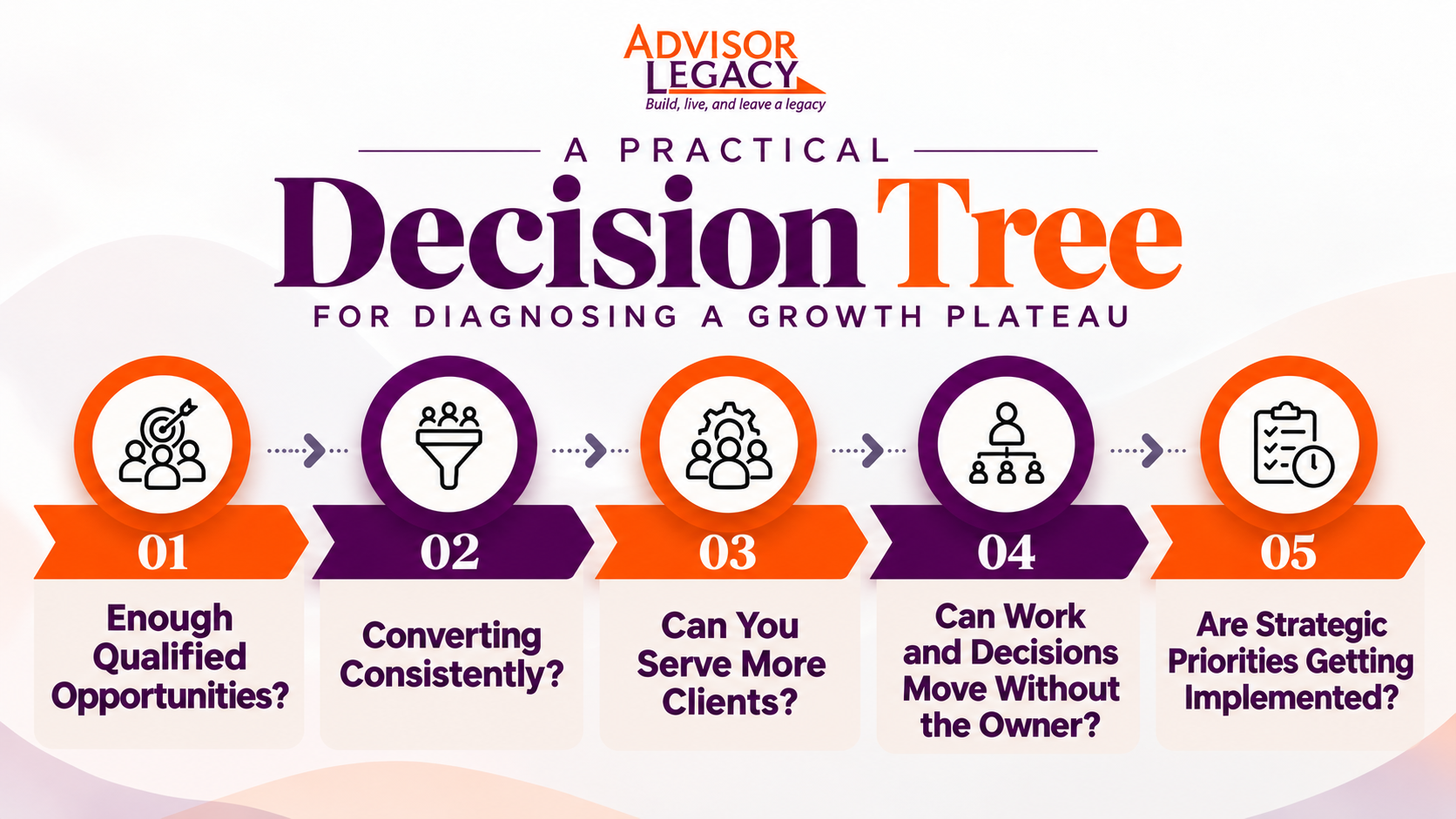
A Practical Decision Tree for Diagnosing a Growth Plateau

Once the likely constraint has been narrowed down, leadership can work through the growth process in sequence. The goal is to identify the first point where performance weakens and focus attention there.

Decision tree for diagnosing a financial advisory firm growth plateau and identifying the primary constraint

Are There Enough Qualified Opportunities?

Start with demand.

Review whether the firm is generating a steady flow of qualified prospects through referrals, prospecting, centers of influence, or other business-development channels. Weak opportunity flow points to a pipeline problem. Strong opportunity flow suggests the constraint sits further downstream.

Is the Firm Converting Opportunities Consistently?

Next, examine what happens after prospects enter the pipeline. Poor conversion may point to weaknesses in qualification, follow-up, meeting structure, positioning, or advisor communication. A firm can generate plenty of interest and still plateau if qualified prospects are not becoming clients at a consistent rate.

Healthy conversion shifts the focus to delivery capacity.

Can the Firm Serve More Clients Without Creating Strain?

This is where many firms begin to feel the effects of growth. Longer onboarding times, service backlogs, heavier advisor workloads, or more owner involvement can signal that the operating model is reaching its limit. The issue may involve staffing, workflows, segmentation, service standards, or how responsibilities are distributed across the team.

A firm that can absorb additional clients without meaningful strain should then examine leadership.

Can Work and Decisions Move Without the Owner?

Owner dependency can become a meaningful constraint as the firm grows. Routine approvals, client issues, and team decisions should not consistently stall when the founder is unavailable. When they do, the firm may need stronger delegation, clearer decision rights, and greater leadership depth.

This also affects transferability. A business that depends heavily on one person is harder to scale and more difficult to transition.

Are Strategic Priorities Actually Getting Implemented?

The final question is whether the firm can execute on the changes it already knows it needs to make.

Missed deadlines, shifting priorities, unclear ownership, and repeated delays may indicate an execution problem rather than a strategy problem. At that point, the focus should move to accountability, implementation discipline, and management cadence.

Diagnostic Question Primary Area to Review
Are enough qualified opportunities entering the pipeline? Pipeline and business development
Are qualified prospects becoming clients? Conversion
Can the firm absorb more clients without strain? Capacity and operations
Can work move without the owner? Leadership and role clarity
Are strategic priorities being completed? Execution and accountability

The value of the decision tree is that it shows where the firm should focus first, so leadership can address the real constraint before committing more time, capital, or resources.

When More Marketing Does Not Solve a Growth Plateau

Marketing can support growth when the firm needs more qualified opportunities. But when the underlying constraint sits in capacity, service delivery, leadership, or execution, increasing lead volume may have little effect on the real problem.

A firm may respond to slower growth by increasing marketing activity, generating more prospects, and creating more opportunities for advisors. That can help when demand is the limiting factor. But when onboarding is already slowing, advisors are stretched thin, or service delivery is inconsistent, additional volume can put more pressure on an operating model that is already near its limit. The consequences may include:

  • Slower response times

  • Increased advisor and staff workload

  • More service errors or rework

  • Greater owner involvement in routine problems

  • Higher risk of employee burnout

  • Lower profitability per client

  • Less time available for strategic work

Before increasing marketing spend, leadership should confirm that the firm can absorb and convert more demand effectively. That means looking at conversion, onboarding capacity, advisor availability, service consistency, and whether additional growth can be supported without increasing owner dependency or weakening profitability.

When those areas are functioning well, additional marketing can help accelerate growth. When they are not, strengthening the operating model first gives the firm a better foundation for turning new demand into sustainable growth.

Why Hiring is Not Always the First Answer

Hiring can be the right move when the firm has a genuine capacity gap. But adding headcount too early can increase cost without improving performance if the underlying problem is unclear roles, inefficient workflows, weak delegation, or inconsistent accountability.

A new employee enters the operating system that already exists. If that system is poorly designed, the new hire may simply inherit the same bottlenecks.

Observed Problem Risk of Hiring Too Soon What to Clarify First
Roles overlap, or ownership is unclear A new hire may add another layer of ambiguity without resolving who owns the work Which responsibilities belong to each role, and where should final ownership sit?
Workflows are inefficient or inconsistent Additional capacity may allow inefficient processes to continue rather than improve them Which steps create delays, duplication, or unnecessary handoffs?
Too much work still depends on the owner The owner may gain another employee to manage without actually reducing personal workload Which decisions and responsibilities can move away from the owner first?
Service demands vary widely across clients More staff may increase capacity without addressing why certain relationships consume disproportionate resources Are service levels and responsibilities aligned with client segments?
Accountability is weak Headcount may increase without improving follow-through or performance What outcomes will the role own, and how will performance be measured?
Manual work is consuming capacity The firm may hire someone to perform tasks that could be simplified, automated, or eliminated Which work truly requires additional human capacity?

Before opening a new position, leadership should define what the role will own, which responsibilities will move from existing team members, and how success will be measured. The firm should also confirm that its workflows, decision rights, and management structure are ready to support the new employee.

Hiring is most effective when it creates usable capacity around a clearly defined need. When the operating model is not ready, additional headcount can spread existing inefficiencies across a larger team rather than resolve them.

Read Next: Building a Team-Based Advisory Practice: A Complete Guide for Advisors

How Different Constraints Require Different Solutions

A growth plateau does not have one universal remedy. The response should match the constraint that is actually limiting the firm.

  1. Pipeline Problems: Focus on referral development, prospecting consistency, lead qualification, follow-up, and advisor business-development skills. The objective is to create a more reliable flow of qualified opportunities. If demand is already healthy, expanding the pipeline should not be the default response.

  2. Capacity and Operations Problems: Review workflows, client segmentation, role design, process documentation, automation, service standards, and staffing. The priority is to remove friction and create more usable capacity from the resources already in place. Advisor Legacy’s Operations Coaching supports firms working through systems, workflows, roles, and execution challenges.

    Read More: Building a Team-Based Advisory Practice: A Complete Guide for Advisors

  3. Leadership Problems: Strengthen delegation, decision authority, manager development, communication, and accountability. The goal is to reduce unnecessary dependence on the founder and build enough leadership depth to support a more complex business. Advisor Legacy’s Executive Coaching can support owners and leaders in these areas.

  4. Execution Problems: Narrow the number of active priorities, assign clear ownership, define measurable outcomes, and review progress consistently. When the firm already knows what needs to change, the priority is making sure the work actually gets completed.

The more precisely the firm defines the constraint, the easier it becomes to choose a response that addresses the source of the plateau rather than its symptoms.

When Coaching and Practice Management Support Can Help Prepare the Firm for Growth

Coaching or practice management support can be useful when leadership has identified a growth constraint but needs help diagnosing it more precisely, implementing the right changes, or building the management habits needed to sustain progress.

The type of support should match the issue. Operations-focused support may fit when the constraint involves systems, workflows, roles, service delivery, or capacity. Executive coaching may be more appropriate when the challenge involves delegation, accountability, decision-making, or leadership development. Some firms may need both because operational and leadership issues often overlap.

Advisor Legacy’s Coaching Services for Financial Advisors are designed to support firms across these different needs. The engagement should remain tied to a defined constraint, clear implementation priorities, and measurable progress.

A firm is generally in a stronger position to resume growth when the following conditions are in place:

Growth Readiness Area What Readiness Looks Like
Capacity The team can absorb additional clients without chronic overload or declining service
Role Clarity Employees understand what they own, where decisions belong, and when escalation is necessary
Leadership Depth Routine decisions can move without depending on the founder
Service Model Client commitments are defined and can be delivered consistently as the firm grows
Execution Important priorities have clear owners, deadlines, and regular review
Technology CRM, automation, and other systems reduce friction instead of adding it
Profitability Additional growth improves the economics of the business rather than simply increasing activity
Client Experience More volume does not reduce responsiveness, consistency, or service quality

These same characteristics also support continuity, succession, and exit readiness. A firm with repeatable systems, clearer leadership, and less owner dependency is better positioned to handle both future growth and eventual transition.

Read Next: How a Succession Plan is a Growth Strategy

Address the Constraint as the Firm Grows

A growth plateau should prompt diagnosis, but it does not mean the firm should stop pursuing growth. The priority is to understand which constraint is limiting performance and address it as the business continues to develop.

When revenue, AUM, or new-client growth slows, leadership should determine whether the limiting factor sits in the pipeline, capacity, service model, leadership structure, role clarity, or execution. Growth remains welcome, but the firm needs to strengthen the area most likely to create pressure as volume and complexity increase.

Key Takeaways

  • Diagnose the binding constraint before adding more marketing, people, or technology.

  • Separate visible symptoms from the underlying cause.

  • Use measurable evidence to identify where growth is breaking down.

  • Match the response to the constraint rather than defaulting to a familiar solution.

  • Build enough operational and leadership capacity to support continued growth.

Next Steps and Planning Considerations

Start with a focused diagnostic review. Identify where performance is weakening, confirm the issue with measurable evidence, and prioritize the constraint creating the greatest pressure. As the firm addresses that constraint, the improvements can also strengthen continuity, succession readiness, enterprise value, and the firm’s ability to operate with less dependence on the owner.

Advisors who want help diagnosing and addressing practice-growth constraints can explore Advisor Legacy’s Coaching Services for Financial Advisors.

Read More: Profitability in Financial Advisor Practices

Ready to Strengthen the Next Stage of Your Firm’s Growth?


Frequently Asked Questions

Why Did My Financial Advisory Firm Stop Growing?

A growth plateau can develop when one part of the business no longer keeps pace with the rest of the firm. The constraint may sit in client acquisition, advisor capacity, service delivery, leadership, or execution.

For business owners, the most useful insight usually comes from identifying where organic growth first begins to weaken rather than looking at a single headline metric such as AUM. Revenue, new clients, net new assets, profitability, workload, and service performance can provide a more complete view of the firm’s growth problems.

How Do I Know if My Advisory Firm Has a Capacity Problem?

A capacity problem often shows up through slower onboarding, delayed client work, increasing workloads, service inconsistency, or greater owner involvement in routine decisions.

Leadership should also look at whether additional client relationships can be absorbed without materially increasing strain. A scalable advisory firm should be able to grow while maintaining service standards, reasonable workloads, and operational predictability.

Should I Hire More Staff When Growth Slows?

Hiring may be appropriate when the firm has a clearly defined human capital need. Before adding headcount, determine what the new role will own, which responsibilities will shift, and whether inefficient workflows or unclear roles are contributing to the workload.

The management team should also consider whether process improvements, automation, better segmentation, or role redesign could create capacity before committing to another permanent expense.

Can Leadership Problems Cause an Advisory Firm Growth Plateau?

Yes. Business growth can slow when too many decisions, client relationships, or internal responsibilities continue to depend on the founder.

Improving delegation, decision authority, accountability, and management depth can reduce that dependency. These changes can also strengthen important value drivers such as scalability, continuity, and the firm’s ability to operate predictably without constant owner involvement, which may become relevant in a future valuation or transition.

When Should an Advisory Firm Consider Coaching or Practice Management Support?

Coaching or practice management support may be useful when leadership can see that performance has stalled but has difficulty identifying the underlying constraint or implementing the changes required to address it.

Operations-focused support can help refine workflows, roles, systems, and service delivery. Executive coaching may be more useful when the challenge involves leadership, delegation, accountability, or strategic decisions. The best approach is tied to a specific business problem and measurable outcome rather than a general effort to optimize the firm.

Why Financial Advisory Firms Hit a Growth Plateau and How to Find the Real Constraint

Why Financial Advisory Firms Hit a Growth Plateau and How to Find the Real Constraint

A financial advisor growth plateau usually means the firm has reached a constraint somewhere in its growth system. The issue may be pipeline, but it...

Read More
Financial Advisor Coaching vs. Consulting: Which Kind of Help Does Your Practice Need?

Financial Advisor Coaching vs. Consulting: Which Kind of Help Does Your Practice Need?

Financial advisor coaching and consulting solve different problems. Consulting is generally the better fit when a firm needs diagnosis, specialized...

Read More
Is Your Firm Growing Faster Than Your Systems Can Support?

Is Your Firm Growing Faster Than Your Systems Can Support?

A financial advisory firm is reaching capacity when growth starts to strain the people, systems, and workflows supporting the business. The signs...

Read More