





EBITDA vs Revenue Multiples in Advisory Firm Valuations
Advisory firm buyers do not value every firm the same way. Some focus primarily on revenue multiples, while others rely on EBITDA multiples to assess...
Know what your business is worth
M&A Guidance and Deal Support
Coaching and Operations
Continuity, Legal, and Lending
10 min read
Alan Salomon, CPA/ABV, CVA, is a valuation and tax specialist with more than a decade of firm ownership and hands-on experience serving closely held businesses. He provides accredited valuations for buy/sell agreements, estate and gift matters, divorces, shareholder/member disputes, and fair value reporting, as well as personal, business, and fiduciary income tax preparation and planning. Alan’s articles explain how valuation approaches apply to advisory practices, how to document defensible con...
Advisory firm buyers do not value every firm the same way. Some focus primarily on revenue multiples, while others rely on EBITDA multiples to assess profitability, cash flow, and long-term enterprise value. Understanding the difference is critical because the valuation methodology a buyer uses can significantly influence your firm's valuation range, deal structure, and ultimate sale price.
The distinction has become increasingly important as advisory industry M&A activity continues to accelerate. In 2025, RIA M&A reached a new high-water mark, with 276 completed transactions representing $796.4 billion in purchased assets, according to Fidelity Institutional. As more capital flows into the advisory market, the methodology buyers use to value an advisory firm, whether through revenue multiples, EBITDA multiples, or a combination of both, can have a meaningful impact on deal economics and seller outcomes.
For sophisticated RIA owners, the key question is not whether buyers use revenue multiples or EBITDA multiples. It is when each approach is used, what factors influence the multiple applied, and why the same advisory firm can produce materially different valuation outcomes under each method.
How EBITDA multiple valuation works
How revenue multiple valuation works
When buyers use EBITDA versus revenue multiples
Factors that influence valuation multiples
How advisory firm owners can prepare for a more accurate valuation
The valuation multiple a buyer uses can materially influence how an advisory firm is priced. While two firms may generate similar revenue, differences in profitability, operating efficiency, growth prospects, and client retention can lead buyers to apply very different valuation methodologies and multiples.
This is why sophisticated buyers rarely rely on a single valuation metric. Revenue multiples help assess the strength and transferability of a firm's revenue base, while EBITDA multiples provide insight into profitability, cash flow, and operational performance. Most buyers evaluate both perspectives before determining enterprise value and negotiating a final transaction structure.
For advisory firm owners, the mistake is assuming that one valuation approach tells the entire story. In reality, buyers often compare revenue-based and EBITDA-based valuations against comparable transactions, market multiples, and the firm's specific risk profile to determine what the business is worth.
| Valuation Approach | What Buyers Are Evaluating | Most Relevant When |
|---|---|---|
| Revenue Multiple | Revenue quality, recurring revenue, client retention, transferability | The firm has stable, predictable revenue streams and strong recurring revenue |
| EBITDA Multiple | Profitability, cash flow, EBITDA margin, and operating efficiency | Earnings are reliable and accurately reflect business performance |
| Discounted Cash Flow (DCF) | Future cash flow potential and long-term growth assumptions | The buyer wants a forward-looking valuation analysis |
| Comparable Transactions | Multiples paid for similar firms in recent transactions | Sufficient transaction data exists within the advisory industry |
Understanding which valuation approach buyers are likely to prioritize can help advisory firm owners identify strengths, address weaknesses, and position the business for a more favorable valuation outcome.
Read More: Understanding Valuation Multiples for a Financial Advisor Practice
An EBITDA multiple measures a firm's value relative to its earnings before interest, taxes, depreciation, and amortization (EBITDA). In advisory firm valuation, buyers use EBITDA as a proxy for operating profitability and cash flow after normalizing owner compensation, one-time expenses, and other non-recurring items.
Unlike a revenue multiple, which focuses on top-line performance, an EBITDA multiple helps buyers understand how efficiently a firm converts revenue into earnings. This distinction is important because two advisory firms with similar revenue may generate significantly different levels of profitability and enterprise value.
EBITDA multiple valuation is most common among private equity firms, consolidators, and larger RIAs that evaluate acquisitions based on cash flow, scalability, and long-term return on investment. For these buyers, earnings often provide a clearer picture of economic value than revenue alone.
Buyers use EBITDA to assess:
Current EBITDA and normalized earnings
EBITDA margin and overall profitability
Cash flow available to support debt or future growth
Operating efficiency and expense management
Potential synergies following an acquisition
Long-term enterprise value
A higher EBITDA multiple may be justified when an advisory firm demonstrates strong recurring revenue, durable client relationships, healthy EBITDA margins, and consistent business growth. Buyers may also pay premium multiples when they believe future earnings can be expanded through operational improvements or economies of scale.
Because EBITDA focuses on profitability, buyers closely examine the quality and sustainability of earnings. Firms that lack financial transparency or rely heavily on owner involvement often face increased scrutiny during valuation and due diligence.
| Risk | Why It Matters to Buyers |
|---|---|
| Unclear Add-Backs | Creates uncertainty around adjusted EBITDA |
| Weak EBITDA Margin | May indicate operational inefficiencies |
| Owner-Dependent Revenue | Increases transition and retention risk |
| Inconsistent Financial Reporting | Reduces confidence in earnings quality |
| Poor Expense Documentation | Makes normalization more difficult |
Read More: How Expenses Can Impact the Sale of Your Financial Advisory Practice
A revenue multiple values an advisory firm based on gross revenue, recurring revenue, or other revenue streams. Rather than focusing primarily on profitability, this approach evaluates the strength, consistency, and transferability of the firm's revenue base.
Revenue multiples are widely used in advisor M&A because many advisory firms generate predictable recurring revenue through long-term client relationships. In these situations, buyers often view revenue stability as an important indicator of future performance, particularly when profitability may be affected by owner compensation decisions or other discretionary expenses.
For this reason, revenue multiples frequently serve as a starting point in valuation analysis before buyers compare those results against EBITDA multiples and other valuation approaches.

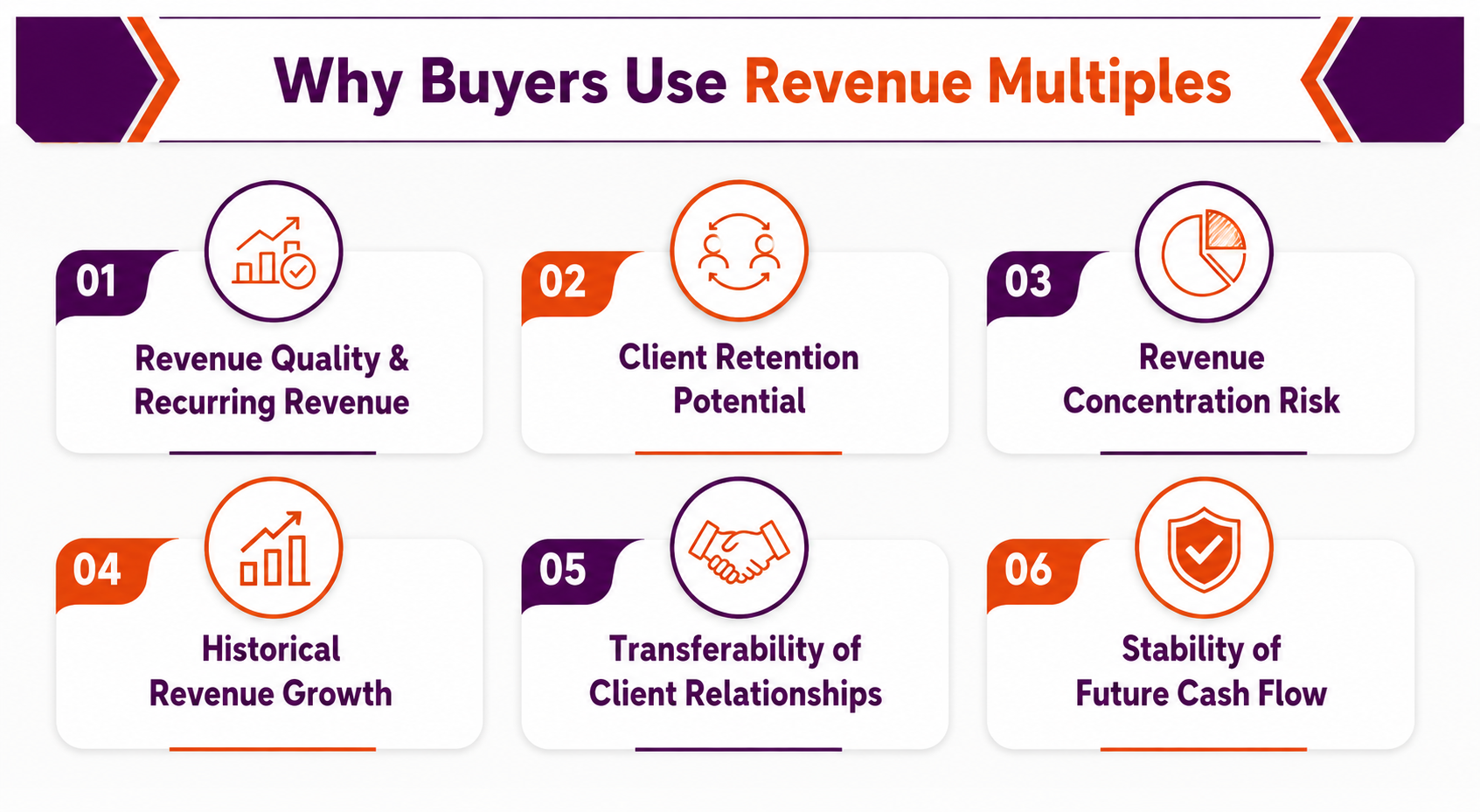
Buyers use revenue multiples to evaluate:
For many acquirers, recurring revenue is one of the most important drivers of value. Firms with stable revenue, strong client retention, and diversified revenue streams often attract greater buyer interest because future revenue is viewed as more predictable.
Revenue alone does not tell the entire story. Two advisory firms may generate identical gross revenue but produce very different valuation outcomes if one firm operates more efficiently or generates stronger earnings.
For example, a firm with strong revenue but weak profitability may receive a lower valuation than a similarly sized firm with healthier margins and stronger cash flow. This is why sophisticated buyers rarely rely on revenue multiples alone. Instead, they compare revenue-based valuations against EBITDA, comparable transactions, and other market-based valuation metrics.
| Revenue Characteristic | Potential Buyer Interpretation |
|---|---|
| High Recurring Revenue | Supports valuation stability |
| Strong Client Retention | Reduces transition risk |
| Revenue Concentration | May reduce valuation |
| Rapid Revenue Growth | May support premium multiples |
| Declining Revenue Trends | May lower buyer confidence |
Read More: Valuation Differences Between Fee-Only and Commission-Based Advisory Firms
Sophisticated buyers rarely rely on a single valuation metric when assessing an advisory firm. Instead, they use both revenue multiples and EBITDA multiples to evaluate different aspects of the business and determine whether the valuation range is supported from multiple perspectives.
Revenue helps buyers understand the quality, stability, and transferability of future income. EBITDA helps them evaluate profitability, operating efficiency, and cash flow generation. Together, these metrics provide a more complete picture of value than either approach can provide on its own.
In practice, buyers often use one valuation method as a starting point and then test the results against the other. If the implied valuation appears inconsistent with comparable transactions, market multiples, or the firm's underlying economics, buyers will investigate further before determining a final value.
| Buyer Question | Revenue Multiple Helps Answer | EBITDA Multiple Helps Answer |
|---|---|---|
| Is the revenue base stable and recurring? | ✓ Primary Indicator | Secondary Indicator |
| Is the firm generating strong earnings? | Limited Insight | ✓ Primary Indicator |
| Can profitability improve after an acquisition? | Partial Insight | ✓ Strong Indicator |
| Is the purchase price supported by cash flow? | Limited Insight | ✓ Strong Indicator |
| Are client relationships likely to transfer successfully? | ✓ Strong Indicator | Partial Insight |
| Does the firm justify premium valuation multiples? | Partial Insight | ✓ Strong Indicator |
Ultimately, buyers are not choosing between revenue and EBITDA. They are determining how much weight each metric deserves based on the firm's characteristics, financial profile, and growth potential.
Buyers tend to place greater emphasis on EBITDA multiples when profitability and cash flow provide the clearest picture of economic value. This is particularly common among private equity firms, consolidators, and larger RIAs that evaluate acquisitions based on earnings performance and expected return on investment.
EBITDA-based valuation is often most relevant when:

The firm has reliable and consistent EBITDA
Financial statements support earnings normalization
Owner compensation can be adjusted appropriately
Operating margins are meaningful and sustainable
Cash flow supports acquisition financing
The buyer is comparing similar firms on profitability
In these situations, EBITDA often becomes one of the most important valuation metrics because it helps buyers assess both current performance and future earnings potential.
However, buyers do not apply EBITDA multiples mechanically. The exact multiple depends on factors such as recurring revenue, client demographics, growth outlook, market position, team depth, and transition risk. While EBITDA multiples by industry can provide context, advisor-specific comparable transactions generally provide a more meaningful benchmark than broad industry averages.
Read More: Using Valuation to Negotiate Earnout Terms in Advisory M&A Deals
Revenue multiples often receive greater weight when revenue quality is easier to evaluate than profitability. This is common among smaller advisory firms, firms with owner-driven expense structures, or businesses where normalized earnings may not fully reflect future performance under new ownership.
Revenue-based valuation may be particularly useful when:
The firm generates highly recurring revenue
Client relationships are stable and transferable
Owner expenses distort reported profitability
Revenue growth has been consistent
The buyer expects operational efficiencies after closing
The business has strong revenue but limited scale
In these situations, buyers may view recurring revenue as a more reliable indicator of value than current EBITDA. This is especially true when a strategic acquirer believes it can improve profitability through integration, shared resources, or economies of scale after the acquisition.
Even so, revenue alone rarely determines valuation. Sophisticated buyers still evaluate profitability, client retention, staffing, compliance history, transition planning, and long-term growth potential before establishing a final valuation range.
EBITDA multiples can vary significantly from one advisory firm to another because buyers evaluate more than current earnings. Profitability matters, but buyers also assess revenue quality, growth potential, transferability, and the level of risk tied to future cash flow.
This is why two firms with similar EBITDA can receive different valuation outcomes. Buyers are ultimately determining how confident they are that earnings can be maintained or expanded after the acquisition.
| Factor | Why Buyers Care |
|---|---|
| Recurring Revenue | Stable recurring revenue increases predictability and may support higher multiples. |
| EBITDA Margin | Strong margins demonstrate operating efficiency and scalability. |
| Client Demographics | Aging clients or concentrated relationships may increase retention risk. |
| Revenue Growth | Consistent growth signals future earnings potential. |
| Owner Dependency | Heavy reliance on the owner can reduce transferability and valuation. |
| Team Depth | A strong leadership and service team improves continuity after a transition. |
| Data Quality | Reliable financial reporting increases confidence in valuation assumptions. |
| Market Position | Specialized expertise or a defined niche may support premium multiples. |
Buyers rarely evaluate these factors in isolation. A firm with modest EBITDA margins may still command a strong multiple if it has exceptional recurring revenue, a transferable client base, and a clear growth trajectory. A highly profitable firm may receive a lower multiple if future earnings depend too heavily on the owner.
Read Next: How Reducing Owner Dependency Increases RIA Sale Value
The right valuation approach depends on the advisory firm, the buyer, and the transaction context. A firm with strong profitability and consistent cash flow may be best evaluated through an EBITDA multiple. A firm with highly recurring revenue but owner-driven expenses may require greater emphasis on revenue multiples. In many cases, buyers use both.
No single valuation metric tells the full story. Revenue multiples highlight the strength and transferability of the revenue base, while EBITDA multiples show profitability, operating efficiency, and cash flow. Buyers compare both before considering growth prospects, client demographics, team depth, market position, and transition risk.
For advisory firm owners, the goal is not to focus on one metric in isolation. The more useful question is how buyers view the business as a whole. An accurate valuation should reflect the firm’s risk profile, growth potential, revenue quality, and long-term cash flow outlook, not just a generic industry benchmark.
Advisors who want a clearer understanding of their firm’s value can work with Advisor Legacy’s Financial Advisor Business Valuation service, which helps owners evaluate both revenue-based and EBITDA-based valuation approaches before entering a transaction process.
Read Next: Pre-Transaction Valuation Readiness Checklist for Advisory Firms
Advisory firm buyers rarely rely on a single valuation metric. Revenue multiples help assess the quality, stability, and transferability of revenue, while EBITDA multiples provide insight into profitability, cash flow, and operational performance. The most accurate valuations consider both approaches, along with factors such as growth potential, client demographics, owner dependency, and transition risk. Ultimately, valuation is about understanding the quality and sustainability of future earnings, not simply applying a multiple from an industry benchmark.
Key Takeaways
Whether you're actively considering a sale or simply planning for the future, understanding how buyers evaluate advisory firms can help you make more informed decisions about growth, succession planning, and long-term value creation. Firms that strengthen both revenue quality and profitability are often better positioned for future valuation discussions and transition opportunities.
If you're evaluating your firm's value, Advisor Legacy's Financial Advisor Business Valuation service can help you understand how buyers may assess both revenue-based and EBITDA-based valuation approaches. Advisors preparing for a future transition may also benefit from Advisor Legacy's Practice Sales for Sellers service, which helps owners navigate valuation, buyer discussions, and transaction planning.
Ready to understand what your firm may be worth? Get a customized valuation estimate.
An EBITDA multiple values a business based on profitability, earnings, and cash flow, while a revenue multiple values a business based on gross revenue or recurring revenue. Buyers often use both valuation approaches to determine whether the valuation range is supported by the firm's financial performance and growth potential.
Most sophisticated buyers use both. Revenue multiples help assess the stability and transferability of revenue, while EBITDA multiples help evaluate profitability and operating performance. The weighting of revenue or EBITDA often depends on the firm's size, financial profile, and transaction circumstances.
An EBITDA multiple represents the relationship between a firm's enterprise value and its EBITDA. Buyers use this valuation metric to estimate what a business may be worth based on its earnings-generating ability and future cash flow potential.
Several factors can influence EBITDA multiples, including recurring revenue, EBITDA margin, business growth, client demographics, owner dependency, team depth, and market position. Buyers also consider transition risk, revenue quality, and the sustainability of future earnings when determining an appropriate multiple range.
EBITDA multiples by industry can provide a general context, but advisory firms are typically valued using advisor-specific comparable transactions and similar companies. Market conditions, buyer demand, and transactions within the industry are often more relevant than broad industry averages used for consulting firms or other professional service businesses.
Two firms with the same level of revenue may have very different profitability, client retention rates, growth prospects, and operating structures. Because buyers evaluate the value of a business based on both revenue quality and earnings, firms with similar revenue can produce significantly different valuation outcomes.
Private equity buyers often rely heavily on EBITDA because it helps them evaluate cash flow, scalability, and potential return on investment. They typically compare a firm's profitability, growth potential, and market position against comparable companies when determining an appropriate multiple of EBITDA.
Advisors should consider obtaining a professional business valuation when planning for succession, evaluating a sale, assessing business growth opportunities, or preparing to exit their business. An experienced valuation firm can provide a more accurate valuation by evaluating revenue, EBITDA, comparable transactions, and other factors that influence market value.
Advisory firm buyers do not value every firm the same way. Some focus primarily on revenue multiples, while others rely on EBITDA multiples to assess...
Selling a financial advisory practice typically takes 6 to 24 months, depending on factors such as valuation readiness, buyer demand, deal structure,...
Recurring revenue quality is one of the most important factors affecting valuation in an advisory firm acquisition. While total revenue often...