



How Successful Advisory Firms Retain Staff During an Acquisition
Retaining staff during an advisory firm acquisition is one of the most important factors in determining whether a transaction succeeds after closing....
Know what your business is worth
M&A Guidance and Deal Support
Coaching and Operations
Continuity, Legal, and Lending
11 min read
Todd Doherty serves as Vice President for Advisor Legacy, where he leads advisors through the full M&A lifecycle—readiness, valuation analysis, buyer/seller matching, due diligence, and post-close integration. With more than 15 years in senior roles at financial advisory firms and hands-on ownership experience, Todd brings an operator’s lens to every engagement. His writing focuses on practical ways to boost enterprise value, structure win-win deals, and avoid execution risk. Todd collaborat...
Retaining staff during an advisory firm acquisition is one of the most important factors in determining whether a transaction succeeds after closing. While buyers often focus on financial performance and due diligence, experienced acquirers also recognize that retaining key employees protects client relationships, preserves institutional knowledge, and reduces integration risk. The connection between talent retention and transaction value is substantial.
PwC research found that 82% of companies that experienced significant value loss after their most recent acquisition also lost at least 10% of their key employees following the deal. In an advisory firm transaction, where client trust is often built around individual advisors and support teams, losing critical talent can disrupt operations, weaken client confidence, and erode the long-term value of the combined firm.
Employee retention is also a strategic consideration for both buyers and sellers. Sellers who demonstrate a stable, engaged team often present a more transferable business, while buyers who invest in retaining talent are better positioned to maintain continuity and achieve their post-acquisition growth objectives. Whether you're preparing to acquire another advisory firm or planning your own succession strategy, developing a thoughtful retention plan should be a priority long before the transaction closes.
Why employee retention matters during an advisory firm acquisition
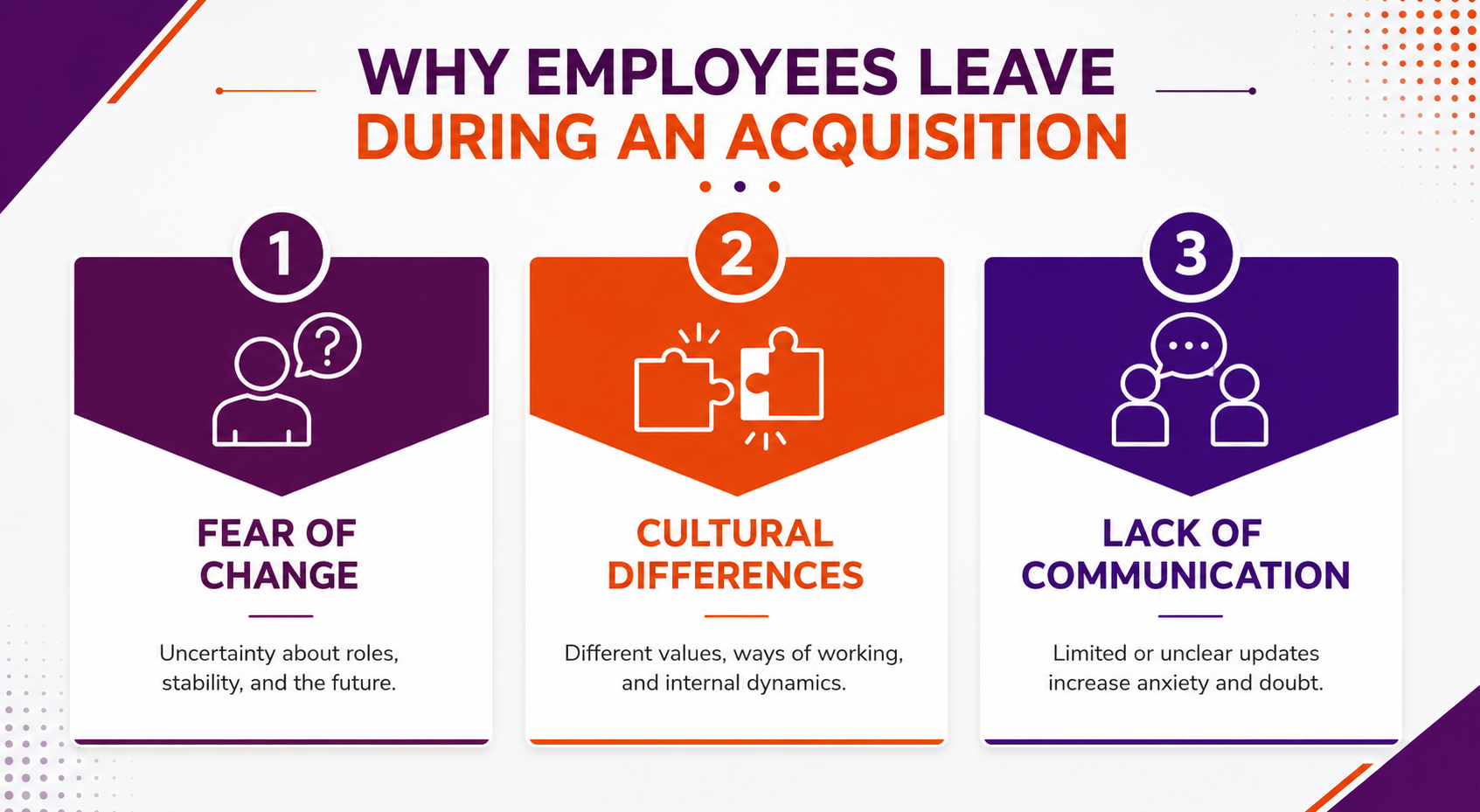
The most common reasons employees leave during organizational change
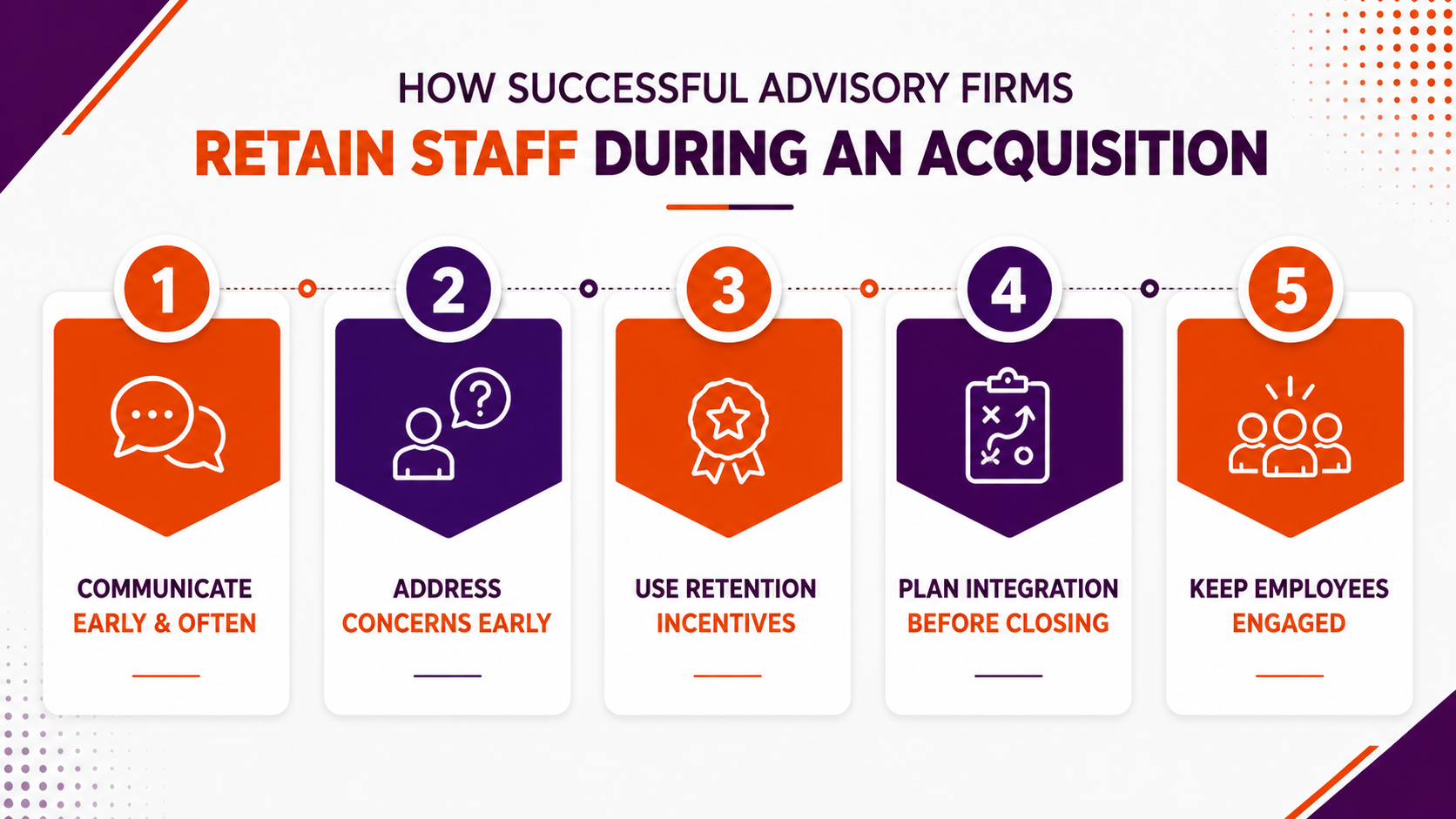
Proven strategies for retaining key employees before and after closing
How to build an effective retention plan through communication and integration
Employee retention is far more than an HR consideration during an advisory firm acquisition. It is a business issue that directly affects client continuity, operational stability, and the long-term success of the transaction. While buyers evaluate assets under management, recurring revenue, and client demographics during due diligence, they also assess whether the people responsible for serving those clients are likely to remain after closing. A stable leadership team and engaged support staff reduce transition risk, strengthen buyer confidence, and make it easier to integrate two organizations successfully.
For sellers, retaining employees demonstrates that the business is transferable beyond the owner's personal relationships. For buyers, it provides confidence that client service standards, internal processes, and firm culture can continue with minimal disruption. Strong employee retention ultimately protects the transaction's value while laying the foundation for sustainable growth after the acquisition.
The table below highlights how staff retention can influence the outcome of an advisory firm acquisition.
| Business Area | Strong Staff Retention | High Employee Turnover |
|---|---|---|
| Client Relationships | Continuity and confidence | Greater risk of client attrition |
| Operations | Stable workflows and productivity | Operational disruption and training delays |
| Firm Culture | Easier cultural alignment | Lower morale and uncertainty |
| Buyer Confidence | Lower perceived transaction risk | Increased integration concerns |
| Long-Term Growth | Faster integration and sustainable growth | Delayed synergies and reduced efficiency |
A thoughtful retention plan demonstrates that leadership has prepared for both the financial and human aspects of a merger or acquisition. It also signals to employees, clients, and buyers that the firm is committed to maintaining stability throughout the transition.
When key employees leave during an acquisition, the consequences extend far beyond replacing an individual. Advisors, client service professionals, and operations staff often possess years of institutional knowledge that supports client relationships, operational efficiency, and regulatory workflows. Their departure can interrupt the integration process, increase recruiting and training costs, and place additional pressure on leadership at a time when the organization should be focused on executing a successful transition.
The impact is often felt by clients as well. Changes in familiar points of contact can create uncertainty, weaken trust, and increase the risk of client attrition. At the same time, remaining employees may experience heavier workloads and lower morale, making it more difficult to maintain consistent service standards. Protecting key employees helps preserve many of the intangible assets that buyers value most, including institutional knowledge, team cohesion, and strong client relationships.
Read Next: Key Employee Retention During a Business Sale: What Smart Sellers Get Right
Successful acquisitions are built on more than favorable financial terms. They depend on people who can execute the transition effectively while maintaining the level of service clients expect. Employees who understand their role within the combined organization and trust the leadership team's vision are more likely to remain engaged throughout the integration process, helping both firms navigate change with greater confidence.
Staff stability also creates measurable advantages for buyers and sellers. Buyers benefit from faster operational integration, stronger collaboration between existing and acquired employees, and fewer disruptions to client service. Sellers, meanwhile, demonstrate that their practice can thrive beyond the owner's direct involvement, reinforcing its transferability and long-term value. Rather than treating employee retention as an initiative that begins after closing, advisory firms should make it a core part of their due diligence and transition planning from the outset.
Advisors preparing to transition ownership can work with Advisor Legacy's Practice Sales for Sellers service, which helps firm owners improve transferability, prepare for buyer due diligence, and build a comprehensive transition strategy.
Read More: How to Prepare Your Advisory Firm for Buyer Due Diligence
Even the most carefully planned advisory firm acquisitions create uncertainty for employees. While leadership may view the transaction as a strategic opportunity, employees often experience it as a period of significant change. Questions about job security, reporting structures, compensation, and workplace expectations can quickly affect morale if they are not addressed early in the acquisition process.
Understanding why employees become uncertain allows leadership teams to anticipate concerns instead of reacting to them. Firms that proactively address these issues are better positioned to retain key employees, maintain client confidence, and execute a smoother integration after closing.

Organizational change naturally raises questions, particularly when employees have limited information about what the acquisition will mean for their future. They may wonder whether their responsibilities will change, whether they will report to new leaders, or whether new performance expectations will affect their role within the organization.
Much of this uncertainty stems from a lack of clarity rather than resistance to change itself. Employees are generally more willing to support an acquisition when leadership communicates how the transaction will affect their day-to-day responsibilities and long-term career opportunities. Addressing these questions early helps reduce speculation, strengthen employee trust, and reinforce confidence in the leadership team.
Culture is one of the most overlooked aspects of acquisition planning, yet it often has the greatest influence on long-term employee retention. Even firms with similar business models can differ in leadership style, decision-making processes, client service expectations, technology adoption, and workplace norms.
If these differences are not identified before closing, employees may struggle to adapt to the new work environment, increasing the likelihood of turnover during the integration process. Evaluating cultural compatibility should therefore receive the same level of attention as financial and operational due diligence.
Cultural Alignment Checklist
✔ Leadership expectations are clearly defined.
✔ Client service philosophies are compatible.
✔ Technology adoption plans have been documented.
✔ New roles and responsibilities have been established.
✔ Integration milestones have been communicated to employees.
Read More: Cultural Alignment in Mergers and Acquisitions: Finding the Right Buyer
Communication is often the deciding factor in whether employees remain engaged throughout an acquisition. When information is limited, employees naturally begin filling in the gaps with assumptions, creating uncertainty that can spread quickly across the organization.
Leadership should establish a communication plan as early as confidentiality requirements allow. Regular updates, consistent messaging, and opportunities for one-on-one conversations help employees understand what is changing, what will remain the same, and what decisions are still being finalized. Transparency does not require having every answer immediately. Instead, it demonstrates that leadership values its employees, respects their concerns, and is committed to guiding them through the transition with honesty and consistency.
Retaining employees during an advisory firm acquisition requires more than offering financial incentives after the deal closes. Successful firms take a proactive approach that begins well before the transaction is finalized, recognizing that employee confidence is just as important as financial due diligence. By addressing uncertainty early and creating a structured transition plan, firms can reduce turnover, maintain client relationships, and position the combined organization for long-term success.
The most successful acquisitions share a common characteristic: leadership treats employee retention as a strategic priority throughout the transaction. Rather than reacting to resignations, they anticipate potential concerns, communicate consistently, and create an environment where employees feel informed, valued, and confident about the future.

Communication is one of the most effective ways to retain employees during an acquisition. While confidentiality may limit what can be shared initially, leadership should begin communicating as soon as practical and continue providing updates throughout the transaction. Employees are more likely to remain engaged when they understand why the acquisition is happening, how it will affect the business, and what they can expect during the transition.
Consistent communication also strengthens buyer confidence by demonstrating organized leadership and thoughtful transition planning. Rather than waiting until every decision has been finalized, firms should provide regular updates, explain what is known, acknowledge what is still being evaluated, and create opportunities for employees to ask questions. Transparency builds trust, reduces speculation, and helps employees remain focused on serving clients throughout the acquisition process.
| Acquisition Stage | Leadership Priority | Employee Outcome |
|---|---|---|
| Pre-Announcement | Prepare messaging and identify key stakeholders | Consistent communication once announced |
| Initial Announcement | Explain the purpose and expected timeline | Reduced uncertainty and speculation |
| Due Diligence | Provide regular updates as appropriate | Continued employee engagement |
| Closing | Clarify organizational changes and responsibilities | Greater confidence in the transition |
| Integration | Reinforce expectations and celebrate progress | Improved long-term retention |
Read Next: How to Communicate an Advisory Firm Sale to Clients
Uncertainty is one of the biggest drivers of employee turnover during an acquisition. Even when the transaction creates new opportunities, employees may worry about job security, reporting relationships, compensation, career progression, or changes to the firm's culture. If leadership fails to address these concerns early, employees may begin exploring other opportunities before the transaction is complete.
Beyond individual roles, firms should also evaluate cultural compatibility before closing. Differences in leadership style, decision-making, technology, client service expectations, and workplace norms can create friction during integration if they are overlooked during due diligence. Taking time to assess these areas allows leadership to identify potential challenges and develop a smoother transition plan before employees begin experiencing uncertainty firsthand.
Cultural Alignment Checklist
✔ Leadership expectations are clearly defined.
✔ Client service philosophies are aligned.
✔ Technology integration plans have been documented.
✔ New roles and responsibilities have been communicated.
✔ Key integration milestones have been shared with employees.
While compensation can influence retention, financial incentives alone rarely convince employees to remain with an organization if they lack confidence in its future. Effective retention strategies combine financial rewards with meaningful career opportunities, leadership support, and recognition throughout the transition.
Retention bonuses, deferred compensation, and performance-based incentives can encourage critical employees to remain through key milestones, but they should be part of a broader retention strategy rather than the sole solution. Firms that also invest in leadership development, expanded responsibilities, mentoring, and professional growth create stronger long-term engagement and demonstrate that employees have a meaningful future within the combined organization.
Employee retention begins long before the transaction officially closes. Firms that develop an integration plan during due diligence are better prepared to manage organizational change while maintaining operational continuity. Planning ahead allows leadership to align expectations, coordinate technology implementation, define reporting structures, and establish a consistent communication strategy before uncertainty begins affecting employee morale.
A successful integration plan should also preserve the strengths of both organizations. Rather than replacing one firm's culture with another, leadership should identify shared values, establish common service standards, and implement operational changes in phases. A thoughtful approach reduces disruption, encourages collaboration between existing and acquired employees, and creates a more stable work environment throughout the transition.
Read More: How to Prepare Your Advisory Firm for Buyer Due Diligence
Employee retention efforts should continue well beyond the closing date. The first several months following an acquisition often determine whether employees remain committed to the new organization or begin considering other opportunities. Leadership should continue communicating openly, measure employee engagement, recognize important contributions, and reinforce the firm's long-term vision as integration progresses.
Maintaining engagement also requires listening to employees throughout the transition. Regular one-on-one conversations, leadership visibility, and recognition of key milestones help reinforce trust while allowing managers to identify and address concerns before they affect morale or client service. Firms that continue investing in their people after closing are better positioned to retain top talent, preserve client relationships, and realize the full value of the acquisition.
Advisors navigating an acquisition can work with Advisor Legacy's Deal Support services to strengthen transition planning, coordinate due diligence, and develop integration strategies that support both operational continuity and long-term employee retention.
Read Next: Client Retention Strategies for Financial Advisors
Even the best-planned advisory firm acquisitions encounter challenges. However, many employee retention issues stem from avoidable leadership decisions rather than the transaction itself. When communication breaks down, cultural differences are ignored, or employees feel unsupported throughout the transition, uncertainty grows, and valuable team members begin exploring other opportunities.
Recognizing these common mistakes before closing allows firms to strengthen their retention strategy, maintain employee confidence, and reduce unnecessary disruption during integration.
| Common Mistake | Potential Impact |
|---|---|
| Delayed communication | Increased rumors and employee trust |
| Poor Cultural Alignment | Reduced morale and higher turnover |
| Overloading Employees | Burnout and declining productivity |
| Relying only on financial incentives | Short-term retention without long-term engagement |
Employees rarely expect leadership to have every answer immediately, but they do expect honest and consistent communication. When updates are delayed, uncertainty often fills the gap. Questions about job security, organizational changes, and future responsibilities can quickly evolve into speculation that affects morale and employee trust. Establishing regular communication throughout the acquisition helps reduce anxiety and reinforces confidence in the leadership team, even when important decisions are still being finalized.
A successful acquisition involves more than combining financial assets and client relationships. It also requires bringing together two organizations with potentially different leadership styles, service philosophies, and workplace expectations. When cultural alignment is overlooked during due diligence, employees may struggle to adapt to new ways of working, increasing the likelihood of turnover during integration. Evaluating culture alongside financial performance helps leadership identify potential challenges before they affect employees or clients.
During an acquisition, employees are often expected to maintain their normal responsibilities while learning new technology, adapting to updated workflows, and supporting organizational change. Without realistic timelines and adequate resources, these additional demands can lead to burnout and lower engagement. A phased integration plan allows employees to adjust more effectively while maintaining the level of service clients expect throughout the transition.
Retention bonuses and other financial incentives can encourage employees to stay through important milestones, but compensation alone rarely creates long-term commitment. Employees are more likely to remain with an organization when they trust its leadership, understand their future opportunities, and feel valued throughout the transition. Combining financial incentives with clear communication, career development, meaningful recognition, and a positive company culture creates a stronger foundation for lasting employee retention.
Read More: 9 Mistakes Advisors Make When Selling Their Practice: How to Avoid Them
An advisory firm acquisition doesn't end when the transaction closes. Its long-term success depends on whether employees remain engaged, clients continue to receive consistent service, and the organization can move forward with confidence. Firms that make employee retention a strategic priority before and throughout the acquisition process are better positioned to reduce disruption, strengthen buyer confidence, and preserve the value of the transaction.
Key Takeaways:
Employee retention should be part of your acquisition strategy long before closing.
Clear communication and cultural alignment help reduce uncertainty and build employee trust.
Retention incentives are most effective when paired with career development and strong leadership.
Integration planning should focus on both operational readiness and the employee experience.
Protecting key employees helps preserve client relationships, business continuity, and long-term firm value.
Whether you're acquiring another advisory firm or preparing your own practice for sale, retaining key employees should be treated as a core component of transaction planning rather than a post-closing task. A proactive retention strategy strengthens transferability, supports smoother integration, and helps protect the client relationships that drive enterprise value.
Advisors who need guidance before or during a transaction can work with Advisor Legacy's Deal Support and Practice Sales for Sellers services, which help firms navigate due diligence, transition planning, and acquisition execution with a focus on long-term success.
Ready to strengthen your acquisition strategy? Talk with Advisor Legacy about developing a transition plan that helps retain key employees, protect client relationships, and support a successful integration.
Retaining employees after a merger or acquisition starts with a proactive retention plan. Firms that communicate early, align leadership, provide retention incentives where appropriate, and involve managers throughout the integration process are better positioned to retain key employees, maintain employee trust, and support long-term staff retention.
An effective retention plan should identify key employees and critical team members, establish clear communication and expectations, define new job titles and reporting structures where necessary, and outline key milestones throughout the acquisition process. Every plan should be tailored to the firm's culture, leadership structure, and long-term business objectives.
Not on their own. Retention packages and financial incentives can help retain critical talent during a merger and acquisition. Still, they are most effective when combined with career development, leadership support, employee recognition, and a positive work environment. The best retention strategies address both financial and organizational factors.
Employee retention planning should begin during due diligence, well before the transaction closes. Starting early gives leadership time to identify retention challenges, review employment agreements where appropriate, communicate with key people, and reduce uncertainty before employees begin worrying about their future with the acquiring company.
Employees may leave when they feel uncertain about job security, changing responsibilities, or their place within the new business. A merger or acquisition requires clear leadership, consistent communication, and thoughtful integration planning to reduce talent flight and help employees remain engaged throughout the transition.
Retaining staff during an advisory firm acquisition is one of the most important factors in determining whether a transaction succeeds after closing....
The right time to sell your financial advisory practice is when your business value, personal readiness, client relationships, succession plan, and...
Advisory firm buyers do not value every firm the same way. Some focus primarily on revenue multiples, while others rely on EBITDA multiples to assess...